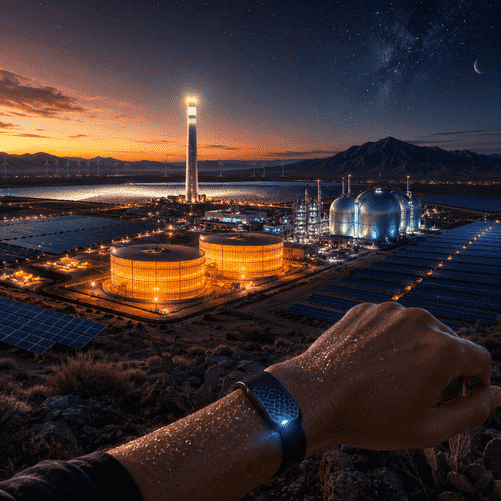
From liquefied air and superheated salt to sand and sweat-powered devices, engineers are developing new ways to keep renewable electricity flowing when the sun sets and the wind stops.

In the deserts of Abu Dhabi, thousands of solar panels are being assembled as part of an energy project designed to overcome one of the most persistent weaknesses of renewable power: its dependence on the weather.
The development will combine 5.2 gigawatts of solar capacity with a 19 gigawatt-hour battery-storage system, allowing it to deliver one gigawatt of continuous electricity around the clock. Its developers say the facility will be the largest and most technologically advanced project of its kind, producing enough uninterrupted clean power to supply hundreds of thousands of homes.
The sheer scale of the project demonstrates how rapidly conventional battery storage is expanding. But it also forms part of a much broader global search for alternatives to lithium-ion technology—systems capable of storing electricity for longer periods, using cheaper materials and avoiding dependence on minerals whose extraction can carry environmental and geopolitical costs.
From the Nevada desert to industrial Manchester and laboratories developing electronics powered by human perspiration, researchers are reconsidering what a battery can be.
The challenge is increasingly urgent. Solar and wind farms can generate enormous volumes of low-carbon electricity, but their output is variable. Solar panels stop producing after sunset, while wind turbines slow when conditions become calm. Without sufficient storage, electricity generated during periods of abundance may be wasted, while gas- or coal-fired power stations must remain available to meet demand later.
Large lithium-ion batteries have become the dominant solution because they respond quickly and can be installed almost anywhere. Yet they are generally best suited to storing power for a limited number of hours. As electricity systems become more dependent on renewables, countries will require technologies capable of holding energy overnight, across several days or potentially through entire seasons.
One of the most visually striking approaches uses molten salt.
At concentrating solar-power plants, vast fields of mirrors direct sunlight towards a receiver, heating liquid salt to extremely high temperatures. The hot material can be stored inside insulated tanks before being used to produce steam and drive a turbine, generating electricity long after daylight has disappeared.
The technology has already been demonstrated in the United States. Nevada’s Crescent Dunes project was the first American concentrating solar plant to use molten salt both to collect heat and preserve it for later electricity production. Other U.S. facilities use similar thermal-storage systems to extend solar generation into the evening.
Unlike an ordinary battery, the system does not initially store electricity through a chemical reaction. Instead, it preserves heat—sometimes for many hours—before converting it into electrical power when it is needed.
Molten salt is only one of several materials being tested for thermal storage. In Finland, developers have filled insulated structures with sand or crushed stone, heating the material with surplus renewable electricity. The stored heat can then be released into district-heating networks during colder periods.
The concept is comparatively simple: renewable electricity powers resistance heaters, the temperature of a cheap and abundant material rises, and insulated containers prevent the energy from escaping too quickly. Although converting that heat back into electricity can be inefficient, the system may be highly practical in communities where heating itself represents a major share of energy demand.
In Greater Manchester, developers are taking an entirely different approach by turning air into a cryogenic liquid.
Highview Power’s facility at Carrington is designed to use excess electricity to cool air to about minus 196 degrees Celsius. At that temperature, the air becomes liquid and can be held in insulated tanks. When the grid needs additional power, the liquid is warmed, expands rapidly and drives a turbine.
The plant is expected to provide 300 megawatt-hours of storage with an output of 50 megawatts for six hours. Its developer says the facility could supply the equivalent of approximately 480,000 homes during its discharge period.
Liquid-air storage does not depend on mountain reservoirs, rare minerals or particular geological formations. Its principal ingredients are ordinary air, industrial equipment and large storage tanks, meaning plants could potentially be built close to cities and electricity-grid connections.
Other developers are exploring gravity itself. When renewable electricity is plentiful, heavy blocks can be lifted, railway wagons moved uphill or water pumped into elevated reservoirs. When demand increases, the weight is lowered and the stored gravitational energy is converted back into electricity.
These systems are, in principle, mechanical versions of a rechargeable battery. Instead of moving ions between electrodes, they move mass between two elevations.
At the opposite end of the scale, researchers are developing batteries and biofuel cells small enough to be worn directly on human skin.
Some experimental devices harvest energy from lactate, glucose or other substances found in perspiration. Enzymes or microorganisms trigger electrochemical reactions that convert those compounds into small amounts of electricity, potentially allowing sensors to operate without conventional button batteries.
Laboratory devices have already demonstrated the ability to harvest energy from passive fingertip sweat, while other systems have used perspiration to power wearable health sensors. The electricity generated is modest, but it may be sufficient for low-energy electronics that monitor biomarkers or transmit occasional readings.
Such technology is unlikely to support national electricity grids. Its significance lies elsewhere: millions of disposable microbatteries are used in medical patches, fitness trackers and connected sensors. Replacing even some of them with self-powered systems could reduce electronic waste while allowing devices to operate for longer periods without charging.
The diversity of these experiments reflects an important reality about the energy transition. No single storage technology is likely to satisfy every requirement.
Lithium-ion systems may remain essential for electric vehicles and rapid grid balancing. Pumped hydropower can store vast quantities of electricity where suitable landscapes exist. Molten salt and sand may provide heat for hours or days. Liquid air could support urban electricity networks, while sweat-powered cells may serve a new generation of wearable electronics.
Cost, efficiency and durability will ultimately determine which technologies survive beyond demonstrations. Some projects have already encountered technical problems, delays or disappointing commercial performance. Moving from a successful laboratory prototype to a reliable industrial system is often the most difficult stage of development.
Even so, the global storage race is accelerating. Governments and companies increasingly recognise that adding wind turbines and solar panels is only part of the transition away from fossil fuels. Electricity must also be available at the precise moment consumers, factories and data centres require it.
The giant solar-and-battery complex rising in Abu Dhabi represents one response: building conventional storage at unprecedented scale. The more unusual projects emerging elsewhere offer another—expanding the definition of a battery until it includes tanks of frozen air, reservoirs of molten salt, heated sand and even the chemistry of the human body.
Renewable energy’s future may therefore depend not on discovering a single perfect battery, but on combining many different forms of storage, each designed for a particular place, duration and purpose.