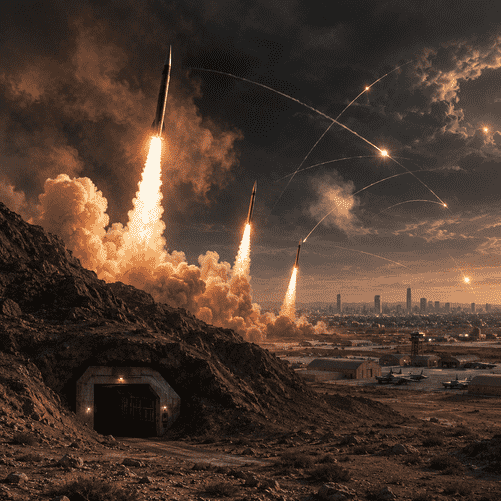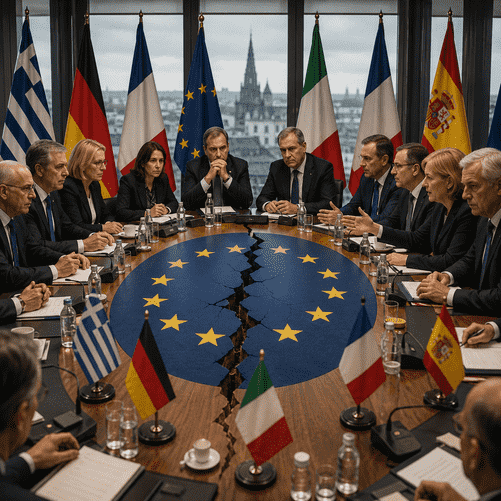
Hungary’s new government is no longer automatically obstructing EU action against Moscow, exposing how Greece, France, Italy, Germany and other member states are defending their own economic and political interests.

For years, Viktor Orbán gave other European Union governments a convenient degree of protection.
Whenever negotiations over sanctions against Russia collapsed, Hungary’s former prime minister was usually identified as the principal obstacle. Budapest repeatedly delayed collective decisions, threatened vetoes and demanded concessions, allowing less vocal governments to support tougher measures publicly while raising their own objections behind closed doors.
Orbán’s defeat in Hungary’s April 2026 election was therefore expected to make European unity easier. His successor, Prime Minister Péter Magyar, promised a more cooperative relationship with Brussels and removed one of Ukraine’s most persistent adversaries from the EU’s negotiating table.
Instead, the struggle to approve the bloc’s 21st sanctions package against Russia has revealed a more uncomfortable reality: Hungary was never the EU’s only source of resistance.
With Budapest no longer routinely exercising its veto, national governments from southern and western Europe are being forced to defend their own demands for exemptions. The result is a sanctions package weakened by disputes over liquefied natural gas, shipping, seafood, visas and prominent Russian individuals.
EU ambassadors met in Brussels on July 22 in another attempt to reach an agreement. The proposed package is intended to tighten restrictions on Russia’s financial system, energy revenues and ability to obtain technology for its military-industrial complex. It would target about 215 entities, including more than 90 banks, while seeking to close routes used to process payments through smaller lenders, cryptocurrency networks and institutions outside Russia.
The central obstacle is now Greece.
Athens is resisting restrictions connected to the transportation of Russian liquefied natural gas to countries outside the EU. Greek officials argue that preventing European vessels from carrying Russian LNG would not significantly reduce Moscow’s income because companies from China, Japan, the United States or other maritime powers could take over the trade. The immediate result, Greece says, would be lost business and employment for Europe’s shipping industry rather than decisive damage to the Kremlin.
The dispute is particularly sensitive because Greek-controlled companies occupy a powerful position in the global LNG-carrier market. One Greek shipping group operates specialised ice-class vessels designed to transport gas from Russia’s Yamal project in the Arctic. An EU prohibition could make those ships commercially difficult to operate or force their sale to non-European competitors.
Greece’s argument reflects a broader principle increasingly shaping the sanctions debate: national governments are willing to punish Russia, but not when they believe the economic cost falls disproportionately on their own companies.
Athens can also point to an apparent contradiction in European energy policy. France, Belgium and Spain have continued importing Russian LNG, with shipments from the Yamal project reaching record levels during the first half of 2026. Greek officials therefore question why their shipping industry should absorb the cost of restrictions while terminals elsewhere in the bloc continue receiving Russian gas.
The LNG dispute is only the most visible of several national objections.
Germany and Portugal opposed proposed restrictions on imports of Russian cod, pollock and other fish products, citing potential disruption to domestic processors and consumers. The seafood measures were subsequently removed from the draft package.
France and Italy resisted a broad proposal to deny EU entry to anyone who had served in the Russian armed forces since the beginning of the full-scale invasion. Both countries sought to narrow the measure, arguing that a general ban would create legal, administrative and consular difficulties. France, Italy and Spain are also among the member states processing the largest numbers of Russian visa applications.
The original proposal presented by the European Commission would have excluded from the EU anyone who served in Russia’s armed forces after the invasion began. The compromise under discussion would reportedly focus more narrowly on personnel who actually participated in military operations in Ukraine.
Bulgaria, meanwhile, opposed placing Patriarch Kirill, the head of the Russian Orthodox Church, on the sanctions list. Kirill has been accused by European officials of using religious authority to justify Moscow’s war, but the Bulgarian government’s objections helped keep his name out of the emerging agreement.
Austria has also sought changes, while other governments have pressed Brussels to protect particular companies, industries or commercial relationships. Greece, France, Italy, Germany, Austria and Portugal have all demanded exemptions or blocked parts of the package, according to officials familiar with the negotiations.
None of these governments has adopted Orbán’s openly confrontational approach toward Ukraine. Nor are they necessarily opposed to sanctions as a strategic instrument. Their positions instead illustrate how the political calculation changes when proposed restrictions begin affecting influential domestic industries.
The EU’s sanctions regime requires unanimity, giving every member state leverage over the final text. That structure has allowed governments to remove individual names, protect specific sectors and demand transitional periods before agreeing to a package presented publicly as a common European response.
The 21st package was designed to demonstrate that the bloc could continue increasing pressure on Russia more than four years after the invasion of Ukraine. The European Commission proposed restrictions on Russian banks, energy transportation, military procurement and the sale of LNG tankers, alongside new measures against seafood imports and Russian military personnel.
Many of those elements have now been diluted, postponed or abandoned.
The remaining proposals would still increase the number of Russian banks facing EU restrictions to more than 100. They would also target institutions and payment mechanisms used to bypass earlier measures, reflecting Brussels’ growing focus on enforcement rather than simply adding major Russian companies to existing blacklists.
European leaders have also renewed the bloc’s broader economic sanctions until July 31, 2027, while calling for further action against Russian energy revenues, the shadow fleet transporting its oil and the financial institutions supporting the war economy.
Yet the disagreement over the new package raises questions about how much additional pressure the EU can realistically impose.
After 20 previous rounds, the most politically straightforward targets have already been sanctioned. Further action increasingly touches sectors in which European companies still have commercial exposure. Each new package therefore demands more direct sacrifices from member states, intensifying the conflict between collective foreign policy and domestic economic interests.
Orbán’s departure has not ended that contradiction. It has merely made it harder to conceal.
Under his leadership, Hungary served as the bloc’s most visible dissenter and absorbed much of the political blame when negotiations failed. Other governments could portray themselves as committed supporters of Ukraine while quietly requesting narrower restrictions or protection for national industries.
The current confrontation removes that cover. Greece must now defend its shipping interests openly. Germany and Portugal must explain their concerns about seafood imports. France and Italy must take responsibility for weakening restrictions on Russian military veterans. Bulgaria must justify its protection of Patriarch Kirill.
For Moscow, those divisions offer an encouraging signal. Russia has long calculated that economic pressure, political fatigue and national competition would gradually weaken Europe’s resolve. Every exemption provides another potential channel for trade, revenue or influence.
For Ukraine, the danger is not merely that one sanctions package will be delayed. The larger risk is that Europe is approaching the political limits of its sanctions strategy just as Kyiv continues to argue that sustained economic pressure is essential to forcing Russia toward meaningful negotiations.
The post-Orbán era was expected to produce a more united European front. Instead, it has revealed that the EU’s divisions were broader than one government and deeper than one leader.
Europe may still approve its 21st sanctions package. But the negotiations have already demonstrated that the bloc’s toughest struggle is no longer simply against a veto from Budapest. It is against the accumulating red lines of capitals that support pressure on Russia—provided someone else bears the cost.