Fresh attacks on American forces and regional allies show that months of intense bombing damaged Tehran’s military infrastructure without eliminating the underground weapons network at the heart of its deterrence strategy.

Iran’s latest missile attacks have delivered an uncomfortable message to Washington and its allies: Tehran’s ballistic arsenal remains capable of inflicting serious damage despite an extensive campaign by the United States and Israel to dismantle it.
The clearest demonstration came in the deadly strike on Muwaffaq Salti Air Base in Jordan on Friday, July 17. Three American service members were killed in an attack that military analysts believe may have involved the Kheibar Shekan, one of Iran’s most advanced medium-range ballistic missiles. The weapon can be launched from mobile platforms and is designed to reach targets across much of the Middle East.
The attack directly challenged President Donald Trump’s repeated assertions that Iran’s military capabilities had been almost completely destroyed. Although months of airstrikes damaged launchers, storage complexes, command facilities and missile-production sites, Iran has demonstrated that it retained—or rapidly recovered—enough of its arsenal to threaten American bases and the countries hosting them.
Tehran reinforced that message on Wednesday, July 22, by launching another missile attack toward Jordan. The Jordanian military said four missiles were intercepted and two fell in uninhabited areas near the port city of Aqaba. The barrage formed part of a broader series of Iranian attacks against Bahrain, Kuwait and other states connected to the American military presence in the region.
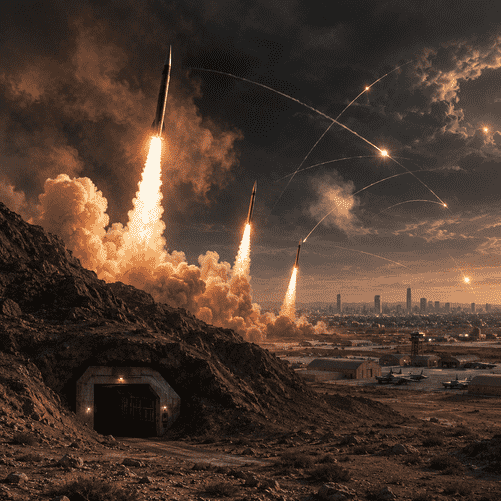
The operational recovery appears to have been made possible by Iran’s vast network of underground missile bases. During the early stages of the war, American and Israeli aircraft repeatedly bombed entrances, ventilation systems, access roads and suspected launch sites. Such strikes could temporarily trap equipment and personnel inside hardened facilities, but sealing a tunnel is not necessarily the same as destroying the weapons stored deep beneath the surface.
Iranian engineering teams have since cleared rubble from several entrances and restored access to launch positions, according to military analysts cited by The Wall Street Journal. Missiles believed to have been housed in underground complexes targeted during the spring campaign have subsequently returned to combat.
That resilience reflects decades of Iranian military planning. Unable to compete with the United States or Israel in conventional air power, Tehran invested heavily in missiles, drones, mobile launchers, concealed storage facilities and dispersed production networks. The objective was not to achieve battlefield superiority but to preserve the ability to retaliate after absorbing an initial attack.
Iran’s missile program was therefore designed around survival. Weapons can be distributed among underground bases, moved by road and launched with limited preparation. Command structures can be decentralised, allowing individual units to continue operating even when communications and senior leadership are disrupted.
The spring bombing campaign undoubtedly weakened the program. Launchers were destroyed, manufacturing sites were damaged and entrances to major missile complexes were collapsed. But emerging intelligence assessments suggest that the destruction was considerably less comprehensive than the Trump administration initially claimed.
A leaked American assessment reportedly concluded in May that Iran had regained access to 30 of 33 missile-launch locations near the Strait of Hormuz. The same assessment estimated that Tehran may have retained approximately 70 percent of its prewar missile stockpile and launchers after the 38-day American-Israeli campaign.
Those findings help explain the continuing scale of Iranian operations. Tehran has been able to attack military installations, energy facilities and shipping routes while forcing American allies to activate air-defence systems across a wide geographical area.
Iran does not need every missile to penetrate those defences. Sustained barrages can force the United States and its partners to consume expensive interceptor missiles, disperse aircraft and personnel, suspend operations and maintain constant readiness. Even unsuccessful attacks impose financial and operational costs.
The Kheibar Shekan illustrates the problem facing American planners. It is a solid-fuel missile, meaning it can generally be prepared and launched more rapidly than liquid-fuel systems. Its mobility and relatively short launch cycle make it difficult to locate and destroy before firing. Iran has presented the missile as capable of manoeuvring during its descent, although the full extent of those capabilities remains difficult to verify independently.
The weapon is only one component of a diverse arsenal that includes short- and medium-range ballistic missiles, cruise missiles and one-way attack drones. That variety enables Iran to combine different systems in an attempt to complicate detection and interception.
The strategy is particularly effective against the network of American installations scattered across the Gulf. Bases in Jordan, Bahrain, Kuwait, Qatar, Saudi Arabia and the United Arab Emirates provide Washington with enormous military reach, but they also create numerous fixed targets within range of Iranian weapons.
Many of those sites are protected by Patriot, Terminal High Altitude Area Defense and other sophisticated systems. No defensive network, however, can guarantee the interception of every incoming missile or drone. A single weapon reaching an airfield, fuel depot, command centre or desalination facility can have significant consequences.
Iran has also shown that it can broaden the battlefield beyond military bases. Recent attacks have affected commercial vessels and infrastructure connected to the Strait of Hormuz, through which a crucial share of internationally traded oil and gas normally passes.
Missile and drone strikes against shipping do not have to close the waterway completely to disrupt the global economy. The threat alone can force vessels to change routes, increase insurance costs and delay energy deliveries. After attacks on tankers and renewed military activity around the strait, daily ship transits declined sharply and international oil prices rose.
This gives Iran an important form of leverage. The United States retains overwhelming conventional military superiority and can continue destroying exposed Iranian infrastructure. Tehran, however, can respond by raising the economic and human cost of the conflict for Washington, its regional partners and the wider international community.
That does not mean Iran’s military has escaped serious damage. Its air defences, aviation assets, naval forces and parts of its missile infrastructure have been heavily degraded. Continued American strikes will make reconstruction increasingly difficult and may gradually reduce the number and frequency of launches.
Yet the campaign also demonstrates the limits of air power against a dispersed and deeply buried missile system. Aircraft can destroy visible launchers and collapse tunnel entrances, but confirming the elimination of weapons stored beneath mountains is far more difficult. Intelligence may identify major facilities without revealing every chamber, secondary exit or concealed stockpile.
Iran also possesses a domestic defence industry capable of repairing launch equipment and producing replacement components. International sanctions complicate access to specialised materials and electronics, but Tehran has spent decades developing procurement networks designed to evade restrictions.
The current fighting has therefore become a contest between destruction and regeneration. The United States is attempting to damage Iranian capabilities faster than Tehran can restore them. Iran is trying to preserve enough weapons to demonstrate that further escalation will remain costly.
The psychological dimension is equally important. Iranian leaders want domestic and international audiences to see that the country survived the initial assault and retained the ability to retaliate. Every successful launch undermines claims that the arsenal has been neutralised and strengthens Tehran’s argument that military pressure cannot force an unconditional surrender.
For Trump, the persistence of the missile threat creates a strategic dilemma. Continuing the bombing campaign may further weaken Iran, but it also risks additional casualties, attacks on allied territory and disruption to the global energy market. Ending the campaign without a broader agreement could allow Tehran to repair more facilities and replenish its stockpiles.
The danger is that each side may interpret endurance as evidence that the other will eventually retreat. Washington can point to its ability to strike almost anywhere in Iran. Tehran can point to its continuing ability to fire missiles, threaten shipping and impose costs across the region.
Iran’s arsenal is smaller, more exposed and more heavily pressured than it was before the war. But it is not irrelevant, and it is far from eliminated.
The attacks on Jordan and the Gulf have shown that destroying buildings is easier than destroying a military doctrine built around concealment, dispersion and retaliation. Iran does not need to defeat the United States conventionally. It needs only to preserve enough missiles—and enough uncertainty—to ensure that every new round of escalation carries an unacceptable price.