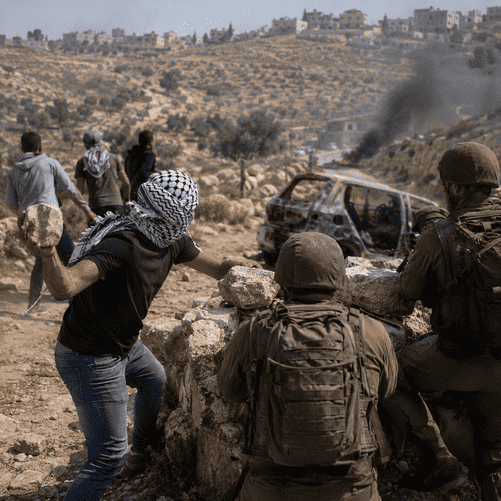
Conflicting accounts of how the violence began near the Palestinian village of Tell have intensified fears of a broader escalation around Nablus, where Israeli forces have imposed restrictions and conducted raids.

A deadly confrontation near the Palestinian village of Tell has left four Palestinians and two Israelis dead, triggering a large Israeli military operation across the northern occupied West Bank and raising fears that localised violence could develop into a wider cycle of raids, reprisals and settler attacks.
The gunfire erupted near Tell, southwest of Nablus, after a group of Israelis entered an area administered by the Palestinian Authority. Israeli authorities said the group had been hiking in territory that Israelis are generally prohibited from entering without military coordination.
The precise sequence of events remains disputed. The Israeli military said Palestinians confronted the group and that one Palestinian seized a firearm before opening fire. Palestinian accounts and other reporting described the incident as beginning when armed Israeli settlers entered or approached the village, prompting a confrontation with residents.
Two Israelis, identified in reports as members of Israel’s security forces or reserve personnel, were killed during the exchange. Four Palestinians also died from gunfire, although the circumstances of each death and whether all those killed had participated in the fighting were not immediately clear.
The conflicting narratives have become central to the political response. Israeli officials characterised the incident as an armed Palestinian attack on Israeli civilians, while Palestinians pointed to the presence of armed settlers in a Palestinian community and accused Israeli forces of using lethal force during the subsequent confrontation.
Following the killings, Israel deployed additional troops throughout the Nablus area, established roadblocks and restricted movement between several Palestinian communities. The military announced what it described as an extensive counterterrorism operation intended to locate suspects and recover weapons connected to the shooting.
Israeli forces surrounded parts of Nablus and carried out raids in the city and surrounding villages. According to reports, troops entered a hospital in Nablus and detained suspects, prompting Palestinian allegations that medical personnel were assaulted and that the raid disrupted patient care. The Israeli military said its forces were pursuing people connected to the violence.
Road closures and checkpoints left residents facing long delays, while some communities reported being effectively placed under lockdown. Such restrictions frequently affect access to employment, schools, medical treatment and commercial centres, even for Palestinians with no connection to the original incident.
Israeli Prime Minister Benjamin Netanyahu ordered a forceful response, while Defence Minister Israel Katz indicated that security operations would be expanded. The government’s far-right members demanded still more severe measures, including the destruction of alleged militant infrastructure and the removal of Palestinian communities from areas near Israeli settlements.
Finance Minister Bezalel Smotrich, a prominent advocate of settlement expansion, called for Palestinian villages associated with attacks to be cleared or fundamentally transformed. His comments drew alarm from Palestinians and human-rights advocates, who warned that collective punishment or forced displacement would violate international law and inflame an already volatile situation.
The clash was followed by reports of Israeli settlers attacking Palestinian property in Tell and nearby communities. Homes, vehicles and agricultural land were reportedly targeted as violence spread to several villages. Palestinian residents said they feared that the military deployment would fail to protect them from retaliatory assaults.
Israeli settler violence has become a major source of instability in the West Bank. United Nations monitors, Palestinian officials and Israeli human-rights organisations have documented attacks involving shootings, beatings, arson, vandalism and the destruction of crops.
The United Nations recorded more than 1,800 settler attacks during 2025, according to figures cited in reporting on the latest crisis. Hundreds of additional incidents and the displacement of nearly 2,000 Palestinians were reported during the first four months of 2026.
Israeli authorities say some settler attacks are investigated and reject accusations that the state systematically supports such violence. Critics, however, argue that arrests and prosecutions remain rare and that soldiers frequently fail to intervene when Palestinians or their property are attacked.
The latest deaths came amid an especially violent period in the West Bank. Earlier in the week, Israeli forces killed two Palestinians during an incident linked to a settler raid on the village of Deir Jarir. The Israeli military said troops fired after Palestinians threw stones, while Palestinian witnesses said settlers had entered the community and attempted to seize livestock.
In another incident, two Palestinian men were reportedly shot while attempting to extinguish fires on agricultural land allegedly set alight by settlers. These cases have strengthened Palestinian claims that settler violence, military raids and restrictions on movement are forming a coordinated pattern that is making rural communities increasingly difficult to inhabit.
The Israeli government argues that intensified military operations are necessary to prevent shootings and other attacks against Israeli civilians and security personnel. Israeli officials have repeatedly pointed to the presence of armed Palestinian groups in and around Nablus, Jenin and other northern West Bank cities.
Palestinian officials counter that large-scale raids, settlement expansion and the weakening of Palestinian Authority control are contributing to militancy rather than suppressing it. They say young Palestinians increasingly view the Palestinian Authority as unable to protect them from either Israeli forces or settlers.
Tell lies close to Nablus, one of the West Bank’s largest Palestinian cities and a longstanding centre of political activism and armed resistance. The surrounding region contains Palestinian villages, Israeli settlements, military checkpoints and roads governed by different security arrangements, creating frequent points of friction.
Under agreements reached in the 1990s, the West Bank was divided into administrative zones. Tell is located in an area where the Palestinian Authority exercises civilian and security responsibility, meaning Israeli civilians are ordinarily barred from entering without authorisation.
The Israelis’ presence in such an area has therefore generated additional scrutiny. Palestinian residents questioned why armed settlers or hikers had entered the vicinity, while Israeli commentators raised concerns about civilians travelling into locations where the military could not easily guarantee their safety.
The confrontation also comes as Israel accelerates settlement construction and moves to recognise previously unauthorised outposts. Netanyahu’s government has presented settlement growth as a security and ideological priority, while Smotrich and other coalition figures have openly promoted the eventual application of Israeli sovereignty to substantial parts of the West Bank.
Most of the international community considers Israeli settlements in occupied territory illegal under international law. Israel disputes that interpretation, citing historical and security claims to the land.
Settlement expansion fragments the territory Palestinians seek for an independent state and complicates the possibility of creating a contiguous Palestinian political entity. The growth of smaller outposts has also placed settlers and Palestinian farming communities in increasingly close proximity, particularly in rural areas where land ownership and grazing access are regularly contested.
In the aftermath of the Tell clash, Israeli officials also indicated that they would accelerate the recognition or development of additional settlement outposts. That response suggested the incident could produce lasting political consequences beyond the immediate security operation.
The Palestinian Authority condemned the Israeli military measures and warned against using the deaths as justification for collective punishment. It called for international intervention to protect Palestinian communities and restrain settler attacks.
Palestinian political factions portrayed the confrontation as evidence of growing resistance to Israeli occupation. Such rhetoric may increase pressure on the Palestinian Authority, which cooperates with Israel on some security matters but has steadily lost credibility among Palestinians.
International governments are likely to face renewed calls to intervene diplomatically. European states and the United States have repeatedly criticised settler violence and settlement expansion, but those statements have done little to reverse developments on the ground.
The immediate risk is that arrests, demolitions or retaliatory attacks could provoke further shootings. Israeli forces often demolish the family homes of Palestinians accused of carrying out deadly attacks, a practice Israel describes as deterrence but which human-rights organisations condemn as collective punishment.
Settler reprisals can also spread rapidly after Israeli deaths. In previous cases, groups have entered Palestinian communities, burned buildings and vehicles or attacked residents, occasionally while Israeli soldiers were present nearby.
The growing presence of weapons among both settlers and Palestinian groups has made such confrontations increasingly lethal. Israeli civilians living in settlements may carry firearms, while weapons circulate among Palestinian militant organisations and criminal networks despite repeated confiscation operations.
Beyond the competing claims surrounding the initial clash, the deaths illustrate how quickly an encounter involving civilians, settlers, armed Palestinians and soldiers can escalate in the West Bank’s fragmented security environment.
Six people were killed in a matter of hours. The consequences, however, are spreading across a much wider area as military forces tighten control around Nablus, settlers mobilise and Palestinian communities prepare for further raids.
Whether the confrontation remains an isolated episode will depend partly on Israel’s military response and whether authorities prevent reprisals against Palestinian civilians. It will also depend on whether armed Palestinian groups respond to the operation with additional attacks.
For residents on both sides, the killings have reinforced a sense that violence is no longer confined to occasional flashpoints. The West Bank is instead entering a period in which settlement expansion, armed attacks, military operations and the erosion of political authority are converging into a more persistent and unpredictable conflict.