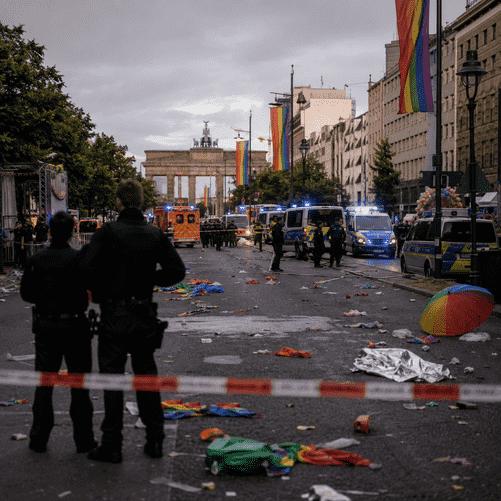
Police say the suspected attacker is linked to the city’s Islamist milieu, as investigators examine a deadly assault that disrupted one of Europe’s largest LGBTQ+ gatherings.

German authorities launched a major manhunt on Sunday after a deadly attack near Berlin’s Christopher Street Day Pride celebrations left one person dead and at least 16 others injured, deepening fears over extremist violence and the security of large public events in the capital.
Police and prosecutors identified the suspected attacker as a 21-year-old man and appealed to the public for help locating him. Authorities said he is believed to have driven a vehicle into people near the Pride event on Saturday evening and warned that he may be armed and dangerous.
Berlin police said the suspect was known to them and was considered part of the city’s Islamist scene. However, officials have not yet confirmed a specific motive, and investigators are still working to establish whether the attack was planned, whether others were involved, and how the assault unfolded.
The incident occurred during Christopher Street Day, Berlin’s annual Pride celebration and one of the largest LGBTQ+ events in Europe. Hundreds of thousands of people had gathered in the city before the festivities were abruptly disrupted by the attack and emergency response.
According to early reports, a white vehicle struck people near the event area, after which at least one person may have fled on foot. Police also said some victims appeared to have suffered stab wounds, adding another layer of uncertainty to the investigation.
The attack has shaken Berlin, a city that often presents itself as a symbol of openness, tolerance and LGBTQ+ visibility. Pride events in Germany are not only celebrations but also political demonstrations for equality, safety and civil rights. For many participants, the violence was therefore seen not simply as an attack on individuals, but as an assault on the values represented by the event.
German officials condemned the violence and promised a full investigation. The case is likely to intensify political debate over public security, extremist networks and the protection of minority communities at major gatherings. It may also raise questions about whether authorities had enough information to prevent the suspect from acting, given that police said he was already known to them.
For Berlin’s LGBTQ+ community, the immediate focus remains on mourning the victim, supporting the injured and resisting fear. Vigils and solidarity gatherings are expected to become central expressions of public grief in the coming days, as the city tries to respond to an attack that turned a day of visibility into one of shock and loss.
The manhunt remains the central priority for police. Until the suspect is arrested and investigators clarify the motive, Germany faces a tense period of uncertainty — one that touches not only counterterrorism concerns, but also the wider question of how democratic societies protect public spaces dedicated to freedom, identity and collective expression.