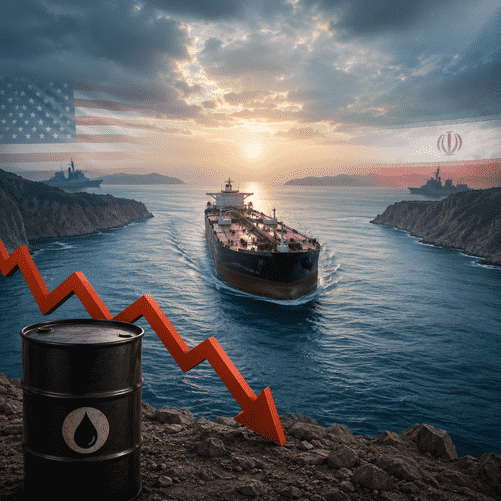
A temporary halt in hostilities has reduced fears of an immediate supply crisis, but disruption around the Strait of Hormuz keeps global energy markets on edge

Oil prices fell sharply on Monday after the United States and Iran paused their attacks for a second consecutive day, raising hopes that diplomacy could prevent a renewed escalation in the Middle East.
Brent crude, the international benchmark, dropped by more than 6% during trading, briefly moving close to $90 a barrel. U.S. West Texas Intermediate crude also declined by more than 6%, falling to approximately $84 a barrel. The retreat reversed part of the steep increase recorded during the previous three weeks, when Brent briefly climbed above $100.
The decline reflected a rapid reduction in the geopolitical risk premium that traders had added to oil prices. Markets had feared that sustained fighting between Washington and Tehran could further restrict the movement of crude through the Strait of Hormuz, one of the world’s most important energy corridors.
Commercial traffic through the strait remains severely reduced, however, and the latest pause has not yet restored normal shipping activity. Concerns also persist around the Bab el-Mandeb passage near Yemen, where attacks on vessels in the Red Sea have threatened an important alternative route for Middle Eastern exports.
The military pause does not amount to a formal ceasefire. U.S. officials have described the suspension of strikes as an opportunity for diplomatic negotiations, while Iran has indicated that it will refrain from further attacks as long as Washington does the same. Mediation efforts involving regional governments and other international actors are reportedly continuing.
Investors nevertheless interpreted the absence of new attacks as an indication that both sides may be seeking a way to contain the conflict. The resulting fall in oil prices supported wider financial markets, lifting European shares and reducing pressure on government bond yields. Energy companies moved in the opposite direction, as lower crude prices weighed on expectations for their revenues.
The retreat could also provide relief for consumers and central banks. Rising energy prices had threatened to increase transportation, manufacturing and food-distribution costs just as inflationary pressures were beginning to ease in several major economies. In the United States, average gasoline prices had already risen to around $4.11 a gallon, compared with $3.90 a month earlier.
A sustained decline in crude could reduce those inflation risks and weaken the case for additional interest-rate increases. Traders, however, remain cautious because any renewed exchange of fire could quickly push prices higher again.
The Strait of Hormuz remains the central concern. Before the latest conflict, roughly one-fifth of global oil supplies passed through the narrow waterway. Even without a complete closure, lower tanker traffic, higher insurance costs and longer shipping routes can tighten supplies and increase the price ultimately paid by businesses and households.
Other risks have not disappeared. Attacks on Russian energy infrastructure, instability in the Red Sea and uncertainty surrounding Iranian exports could continue to support oil prices even if direct U.S.-Iran hostilities diminish.
For now, the market is treating the pause as a potentially important opening rather than a permanent settlement. Further price declines will probably depend on evidence that negotiations are advancing and that tankers can safely resume normal operations through the region’s strategic waterways.
Until then, oil is likely to remain highly volatile, responding not only to changes in global supply and demand but also to every diplomatic statement, military movement and shipping alert emerging from the Middle East.


