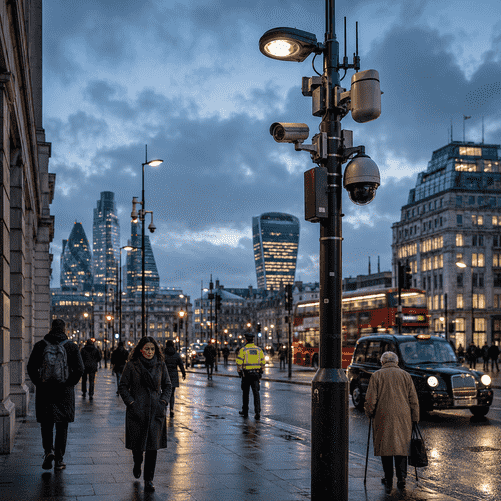
AI-equipped lamp-posts could help police locate missing people, detect crime, and manage public spaces, but critics warn they may also normalize constant monitoring in everyday life.

A new generation of AI-enabled smart lamp-posts is raising difficult questions in Britain about where public safety ends and mass surveillance begins.
The devices, sometimes described as intelligent street infrastructure, combine ordinary lighting with cameras, sensors, connectivity, and artificial intelligence. Supporters argue that they could help authorities detect crime, locate missing persons, monitor traffic, improve emergency responses, and manage public spaces more efficiently. But privacy campaigners warn that putting AI-powered cameras into the street furniture of ordinary towns and cities risks creating a permanent surveillance network that people cannot easily avoid.
The debate has intensified after renewed attention on camera-equipped “smart” lamp-posts, including systems promoted as capable of expanding beyond lighting into security and monitoring functions. CPG’s chairman, Edward Fitzpatrick, told the BBC World Service’s Tech Life programme that such lamp-posts could eventually help track down missing people or fight crime, provided that any such use was developed with the relevant authorities. The company has also announced an agreement to supply 50,000 iLamps to Katsina state in Nigeria, where the technology’s wider surveillance potential has drawn particular attention.
For police and local authorities, the appeal is obvious. Cameras placed high on existing street infrastructure offer a broad view of public spaces without the need to build obvious new surveillance towers. If connected to facial recognition, number-plate recognition, behavioural analytics, or missing-person databases, they could become powerful tools for tracking suspects, finding vulnerable individuals, or responding quickly to incidents.
There is already evidence that police see fixed public-space cameras as a major operational tool. In Croydon, the Metropolitan Police said a live facial recognition pilot using cameras mounted on existing structures, including lamp-posts, contributed to 100 arrests and helped reduce crime in Fairfield ward by 12%. The Met said the approach allowed officers to run deployments without relying on a van, making the system more flexible and less conspicuous.
That flexibility is exactly what alarms civil-liberties groups. Traditional CCTV is already widespread in Britain, but AI changes the nature of surveillance. Instead of merely recording footage that may later be reviewed, AI systems can analyse faces, movements, objects, behaviour, vehicles, and patterns in real time. A camera on a lamp-post is no longer just a camera; it can become an automated decision-making point in the street.
The risk is not limited to today’s stated purpose. A lamp-post installed to improve lighting, traffic flow, or public safety could later receive software updates that expand its functions. A system initially designed to detect accidents or locate missing people could, in theory, be adapted for facial recognition, crowd monitoring, protest surveillance, or tracking individuals across a city. That possibility is at the heart of the concern: once the infrastructure exists, the political temptation to use it more widely may grow.
Supporters of the technology argue that these fears can be managed through strict rules, transparency, independent oversight, and limits on data retention. They say AI-enabled streetlights do not have to become instruments of a surveillance state if their functions are clearly defined and legally controlled. In high-crime areas, near transport hubs, or during urgent searches for missing people, the technology could provide real public benefit.
But critics counter that Britain’s legal framework has not kept pace with the speed of deployment. They argue that public consultation is often weak, technical capabilities are poorly explained, and residents may not know whether they are being passively recorded, actively analysed, or checked against watchlists. Similar concerns have been raised around AI surveillance trials in public spaces, including transport systems, where campaigners warned that behaviour-detection tools and automated monitoring could normalize intrusive public observation.
The question, then, is not whether smart lamp-posts are inherently good or bad. It is who controls them, what they are allowed to do, how long they keep data, whether the public can challenge their use, and whether future governments can expand their powers without meaningful democratic consent.
Britain is not choosing between darkness and safety, nor between crime and technology. It is choosing what kind of public space it wants. AI-enabled lamp-posts could become a useful civic tool, quietly improving security and emergency response. Or they could become the architecture of everyday surveillance, turning streets into places where people are watched, assessed, and recorded by default.
The arrival of smart streetlights should therefore trigger more than technical excitement. It should prompt a national debate about privacy, policing, transparency, and the limits of automated power in public life. Once surveillance is built into the street itself, reversing it may be far harder than installing it.