Hundreds of death-row prisoners have joined a mass protest inside Iran’s largest prison after six men convicted on drug-related charges were moved to solitary confinement ahead of possible execution.

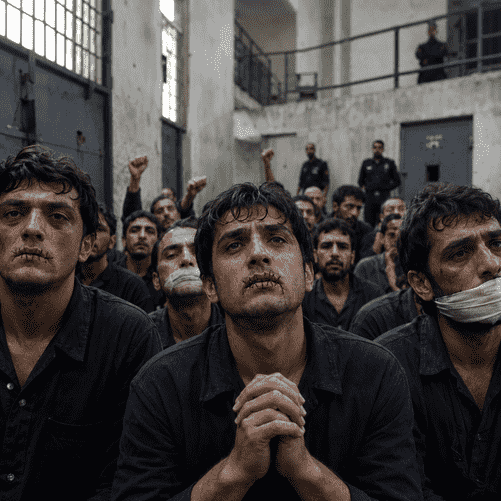
Prisoners at Ghezel Hesar, Iran’s largest prison, have launched a mass hunger strike in protest against a sharp rise in executions, with some inmates reportedly sewing their lips shut in an act of desperation. The protest began after six men sentenced to death on drug-related charges were transferred to pre-execution solitary confinement cells, a move widely understood by prisoners and rights groups as a sign that their executions may be imminent.
The hunger strike, involving at least 1,500 death-row prisoners in Unit 2 of the prison near Tehran, has become one of the most visible acts of resistance inside Iran’s penal system this year. Videos and messages shared by human rights groups show prisoners appealing for international attention, with some chanting against executions and calling on the outside world to “be our voice.”
Ghezel Hesar prison, located in Karaj, has long been associated with Iran’s extensive use of capital punishment, especially in drug-related cases. Human rights monitors say many of those facing execution come from poor and marginalised backgrounds and were convicted in proceedings that failed to meet basic standards of due process. Rights organisations have repeatedly criticised Iran’s revolutionary and criminal courts for relying on coerced confessions, restricted access to lawyers, and rapid trials in capital cases.
According to the Oslo-based Iran Human Rights NGO, Iran has carried out at least 424 executions so far in 2026, with hundreds more prisoners on death row. The group says drug-related offences account for a significant share of the executions, despite repeated international calls for Iran to halt the use of the death penalty for non-violent crimes.
The current strike began on July 13, when the six prisoners were moved to solitary confinement. Iran Human Rights reported that inmates in Unit 2 started the protest immediately afterward in an effort to stop the executions. By July 24, the organisation said the anti-death-penalty strike had continued into its twelfth day.
The protest comes amid broader alarm over Iran’s accelerating use of the death penalty. On July 28, Iranian authorities publicly executed two men accused of killing police officers during anti-government protests in Isfahan, according to state media and rights groups. Amnesty International condemned the executions and warned that Iranian authorities were using death sentences to punish dissent and project control.
For prisoners in Ghezel Hesar, the hunger strike is both a plea for survival and a political statement against what activists describe as an execution machinery operating with little transparency. Solitary confinement before execution is feared by inmates because it often marks the final stage before hanging, leaving families and lawyers with little time to intervene.
The Iranian authorities have not publicly accepted the prisoners’ demands. Rights groups say medical care has been restricted or denied to some hunger strikers, raising concerns that the protest itself could endanger lives even before any executions take place.
The crisis also highlights a wider contradiction in Iran’s justice system. Officials defend executions as a tool against crime and insecurity, but human rights organisations argue that the death penalty is being used to silence dissent, punish vulnerable defendants, and spread fear during a period of political and economic instability.
As the hunger strike continues, campaigners are calling on the United Nations, European governments, and international human rights bodies to intervene urgently. For the prisoners of Ghezel Hesar, the message is stark: their protest is not only against six imminent executions, but against a system in which hundreds of others may be next.