Fatal blazes in Crete and the Peloponnese expose the growing danger facing emergency crews as extreme heat, drought and violent winds push Europe’s wildfire crisis eastward.

ATHENS — Three Greek firefighters have been killed while battling wildfires in Crete and the southern mainland, as a widening belt of flames placed communities across Europe under renewed threat and intensified concerns over the continent’s ability to contain increasingly severe fire seasons.
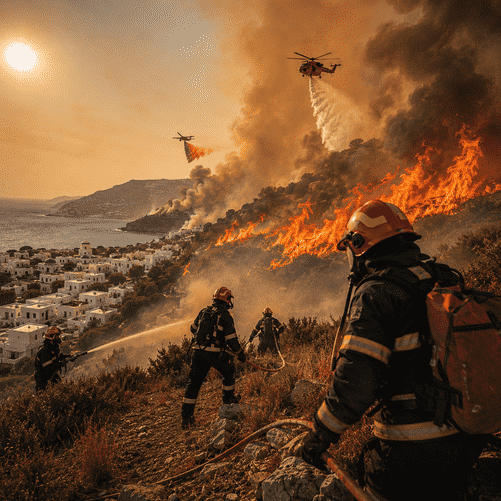
Two of the firefighters died near Krya Vrysi, a village in the Rethymno region of Crete, after becoming trapped while driving between separate fire fronts. A third firefighter was killed in another blaze in the Peloponnese, according to the Greek fire service. Their deaths came as powerful winds drove flames through dry vegetation and complicated efforts to protect residents, holidaymakers and coastal settlements.
More than 150 firefighters were deployed against the Crete blaze, supported by aircraft and ground vehicles. Residents and tourists were ordered to leave Krya Vrysi and neighbouring communities as the fire advanced towards Agia Galini, a popular coastal destination where hotels rise above the harbour. Evacuations were carried out by buses and private vehicles while smoke spread across the surrounding hills.
Witnesses described sudden shifts in the wind and flames large enough to make roads impassable. Such conditions can transform a manageable fire into a rapidly moving emergency within minutes, leaving firefighters with little time to retreat when fronts change direction.
The tragedy in Greece marked the latest stage of a wildfire emergency stretching across much of Europe. After devastating large areas of France and Spain, the greatest immediate danger was beginning to move east towards Greece, Italy and parts of central Europe, according to the European Union’s Emergency Response Coordination Centre.
In southwestern France, thousands of firefighters continued to monitor an enormous blaze in the Gironde region, where rising temperatures and afternoon winds threatened to reignite smouldering areas. The fire had forced as many as 220,000 people to leave their homes or holiday accommodation at the height of the emergency, making it one of France’s largest peacetime evacuations.
Approximately 42,000 hectares of predominantly pine forest were devastated west of Bordeaux, while homes, businesses and tourism facilities were damaged or destroyed. Although parts of the fire were stabilised, emergency officials warned that concealed embers could cross containment lines as the wind strengthened.
Spain was also preparing for another period of extreme heat. Temperatures were forecast to reach 40 degrees Celsius in several regions, while firefighters confronted new outbreaks and flare-ups even after making progress against major fires around Madrid and Ávila. In Castellón, an uncontrolled blaze had burned more than 10,000 hectares and prevented around 10,000 evacuated residents from returning home.
The scale and geographical reach of the fires have alarmed specialists. Major outbreaks have occurred close to towns, transport routes and tourist destinations rather than remaining confined to remote forests. This has forced emergency services to divide their resources between suppressing the flames, evacuating civilians and defending homes and critical infrastructure.
High temperatures alone do not ignite wildfires, but prolonged heat removes moisture from soil, trees and undergrowth, allowing flames to spread faster once a fire begins. Strong winds then carry burning material beyond firebreaks, create new fronts and make aerial operations more dangerous.
Europe’s repeated heatwaves have produced precisely this combination of dry fuel, low humidity and unstable winds. Western Europe experienced its hottest June on record in 2026, while unusually dry conditions intensified drought and wildfire risks across several parts of the continent. Eight of Europe’s nine warmest Junes have occurred since 2019, according to the Copernicus Climate Change Service.
Europe is warming more than twice as quickly as the global average, making it the world’s fastest-warming continent. Scientists say the trend is increasing the frequency and intensity of dangerous heatwaves while creating conditions in which fires can spread more rapidly and burn for longer periods.
The crisis is also exposing pressure on Europe’s firefighting capacity. Longer and increasingly overlapping wildfire seasons are reducing the ability to move aircraft between regions or continents. Operators have reported shortages of experienced pilots and technicians, while many governments remain dependent on a limited fleet of specialised water-bombing aircraft.
European countries have collectively ordered 22 new Canadair aircraft, but the first of the new generation is not expected to reach Greece until 2028. In the meantime, emergency authorities must rely on existing national fleets, privately operated aircraft and resources shared through the EU’s civil-protection system.
The European Union deployed its largest-ever seasonal wildfire force in 2026, pre-positioning 777 firefighters from 14 countries in high-risk areas. Aircraft, helicopters and ground teams have also been transferred between member states as national services struggle with simultaneous emergencies.
Such cooperation has become essential, but officials acknowledge that emergency response alone cannot eliminate the growing risk. Forest management, controlled vegetation clearance, fire-resistant construction, evacuation planning and stronger public-warning systems are increasingly regarded as necessary elements of Europe’s adaptation strategy.
The deaths of the three Greek firefighters underline the human cost borne by those working closest to the flames. Fire crews are confronting hotter conditions, less predictable winds and fires capable of generating their own extreme weather. During the French crisis, one blaze produced a fire-generated thundercloud that created lightning and violent winds capable of starting additional fires beyond the original perimeter.
For Greece, the immediate priority remains containing the fires and protecting communities still threatened by shifting winds. For Europe, however, the crisis carries a broader warning. Wildfire is no longer an emergency restricted to a handful of Mediterranean regions or a brief period in midsummer. It is becoming a continent-wide threat capable of overwhelming national borders, emergency fleets and traditional assumptions about where—and for how long—the fire season will last.