Riyadh’s openly acknowledged participation in American strikes against Iran-aligned forces has intensified disputes over Iraqi sovereignty and raised the danger of retaliation across the Gulf.

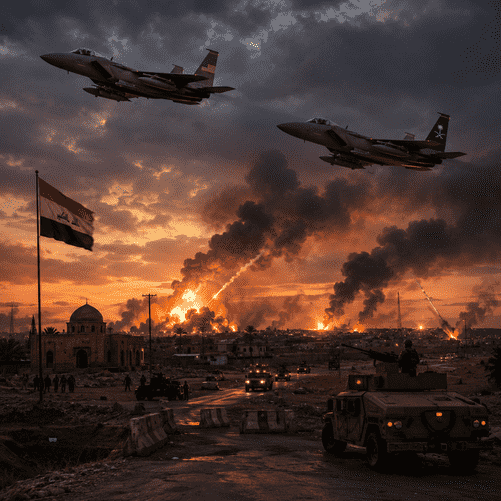
BAGHDAD — Joint American and Saudi airstrikes against Iran-backed armed groups in Iraq have opened a new and potentially more dangerous phase in the Middle East conflict, drawing Riyadh directly into military operations beyond its borders and placing further pressure on an Iraqi government struggling to remain outside the confrontation.
The strikes hit several positions associated with Iraq’s Popular Mobilisation Forces, an umbrella security organisation that includes powerful Shiite factions with longstanding ties to Tehran. The PMF said at least 20 of its members were killed and 32 wounded, while international reporting indicated that Iranian military advisers may also have been among the casualties.
Saudi Arabia confirmed that its armed forces had participated in what it described as precision operations coordinated with the United States. Riyadh said the targets belonged to militias accused of launching drones from Iraqi territory against Saudi oil facilities in the kingdom’s Eastern Province.
The decision represents a significant escalation in Saudi Arabia’s military posture. Although Saudi aircraft were reportedly involved in less publicly acknowledged operations against militia targets earlier in the conflict, Riyadh’s formal confirmation of the latest strikes places the kingdom openly alongside Washington in a widening campaign against Iran and its regional allies.
For Saudi leaders, the calculation appears closely connected to the security of the kingdom’s energy infrastructure. Drone attacks attributed by Riyadh to Iran-aligned forces have targeted facilities central to Saudi production and export capacity, reviving memories of previous assaults that demonstrated how relatively inexpensive weapons could threaten some of the world’s most strategically important oil installations.
Saudi officials presented the operation as a defensive response to attacks on the kingdom. Iraq, however, rejected that justification and condemned the strikes as an unacceptable violation of its sovereignty.
Following an emergency meeting chaired by Prime Minister Ali Faleh al-Zaidi, Iraq’s National Security Council said the attack had occurred while Baghdad was still investigating allegations that drones had been launched from Iraqi territory. It instructed the foreign ministry to document the incident under international law and announced a broader security plan intended both to prevent attacks against neighbouring countries and to defend Iraq from further external action.
An Iraqi government spokesman later said Baghdad had not received evidence establishing that the alleged attacks on Saudi Arabia had originated inside Iraq. He described the American-Saudi action as unilateral and unjustified, while emphasising that decisions involving war, retaliation and national security belonged exclusively to the Iraqi state.
That disagreement exposes the central danger created by the strikes. Iraq is formally allied with Washington, maintains extensive economic and security relations with neighbouring Saudi Arabia and simultaneously accommodates armed organisations closely connected to Iran. Several of those factions are incorporated into the official security system, yet retain independent political leadership, weapons and regional loyalties.
The PMF was established during the campaign against Islamic State and later incorporated into Iraq’s state security structure. Its component factions vary considerably, but some of the most influential groups developed with Iranian financial, military and political support. They now possess significant power within Iraq’s security institutions, parliament and economy.
That ambiguous status complicates any foreign attack against them. Washington and Riyadh can present the militias as Iranian proxies responsible for cross-border violence. Iraqi officials and militia leaders can argue that the same strikes targeted recognised members of the country’s security forces.
The result is a confrontation in which the distinction between state and non-state actors has become increasingly difficult to maintain. An attack launched by an armed faction may provoke retaliation against Iraqi territory, while Baghdad is held responsible for organisations it does not fully control. Each exchange weakens the government’s claim to sovereign authority and increases pressure on Iraqi leaders to respond.
The latest strikes also disrupt Baghdad’s effort to redefine its relationship with Washington. Iraq has reaffirmed a timetable under which the remaining mission of the US-led international coalition is due to end by September 30, 2026. The government had hoped to move relations away from military dependency and towards investment, trade and energy cooperation.
Instead, the country again finds itself serving as a battlefield for competing regional powers. Further militia retaliation could draw additional American or Saudi strikes, while a forceful response from Baghdad could damage relationships with two of Iraq’s most important international partners.
The risk extends well beyond Iraq. Iran launched renewed missile attacks against American positions in the region after the joint operation, while Jordan reported intercepting missiles directed towards a base hosting US personnel. Separate drone incidents affected maritime and energy targets, adding to fears that the conflict was spreading across several interconnected fronts.
Iran condemned the strikes and retains several possible avenues for retaliation. Tehran could respond directly, encourage allied factions in Iraq to attack US forces, support renewed Houthi operations against Saudi targets or intensify pressure on commercial shipping near the Strait of Hormuz.
Each option carries a different degree of escalation, but all could produce consequences beyond the immediate military confrontation. The Strait of Hormuz remains one of the world’s most important energy corridors, while Saudi oil facilities, Iraqi export infrastructure and Red Sea shipping routes are all vulnerable to missiles, drones and maritime disruption.
Energy markets reacted sharply to the renewed hostilities. Brent crude rose by about 7% on July 29, reaching more than $90 a barrel as traders assessed the danger to production and shipping routes. The increase reflected concerns not only about the strikes in Iraq, but also about Iranian activity near Hormuz and attacks affecting Saudi infrastructure.
The economic consequences could become increasingly serious if the confrontation persists. Higher crude prices would raise fuel and transportation costs, place additional pressure on inflation and complicate monetary policy in importing economies already confronting weak growth.
Saudi Arabia’s participation also reshapes the region’s diplomatic landscape. Riyadh had spent years attempting to reduce tensions with Tehran while balancing its longstanding American security partnership against a desire for greater strategic independence. Open participation in strikes against Iran-aligned forces may weaken those de-escalation efforts and reinforce Tehran’s view that Saudi territory and infrastructure form part of the opposing military coalition.
At the same time, Saudi officials face pressure to demonstrate that attacks on the kingdom will carry consequences. Failing to respond could encourage further operations against oil installations, while responding too aggressively risks drawing the country into a conflict capable of directly threatening its cities, energy industry and economic transformation programme.
Washington faces a similar dilemma. Strikes may weaken militia capabilities and reassure regional allies, but they may also provide Iran-backed factions with a justification for attacking American personnel. The dispersal of US forces across Iraq, Jordan and the Gulf creates numerous potential targets, making escalation difficult to contain once retaliatory cycles begin.
The joint operation therefore carries significance beyond the immediate destruction of militia positions. It signals that the conflict is no longer confined to exchanges between the United States and Iran, or between Israel and Iranian forces. Saudi Arabia has now publicly entered the military campaign, Iraq’s sovereignty has been directly challenged and armed factions across the region are considering their response.
Diplomatic channels remain open, but their task has become more difficult. Mediators must address not only the central dispute between Washington and Tehran, but also Saudi security concerns, Iraqi sovereignty, militia autonomy, Houthi activity and threats to international shipping.
The greatest danger is that these conflicts begin to reinforce one another. A drone launched against an oil installation can trigger airstrikes in another country. Those strikes can provoke missile attacks against American bases or commercial vessels. Each response then creates political pressure for further retaliation.
Saudi Arabia may regard its intervention as a controlled and proportionate defence of national infrastructure. Iraq views it as an external attack on its territory. Iran and its allies are likely to interpret it as evidence of an expanding coalition against them.
Those competing perceptions leave the region with few reliable limits. The strikes may have been precise in military terms, but their political consequences are broad, uncertain and increasingly difficult for any single government to control.