The unclaimed attack on two gas vessels has drawn Egypt closer to the widening Iran war and raised fears that one of the region’s last major oil-export routes may no longer be insulated from the conflict.

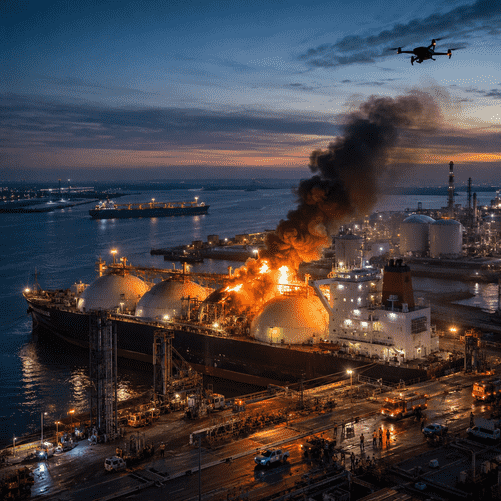
DAMİETTA, Egypt — Egypt has been pulled into the expanding Middle East conflict after authorities confirmed that an unidentified drone caused a fire aboard two gas vessels at the Mediterranean port of Damietta, in what appears to be the country’s first direct drone attack linked to the wider Iran war.
Egypt’s cabinet said an initial investigation found that the blaze, which erupted on Wednesday, was caused by a drone rather than an accident. No group or country has claimed responsibility, and Egyptian officials said investigations were continuing while authorities took measures to protect national security.
The strike hit two gas vessels at Damietta, including the U.S.-linked gas storage tanker Energos Winter and the LNG tanker Gaslog Salem, according to reporting by The Wall Street Journal. Fires were brought under control and no casualties were reported, but the incident disrupted port operations and immediately raised questions about whether Egypt’s energy and maritime infrastructure could become a new target in the regional war.
The location of the attack is what makes it strategically significant. Damietta lies on Egypt’s Mediterranean coast, not far from the Suez Canal, one of the world’s most important shipping arteries and a route that has become increasingly important as conflict disrupts other Middle Eastern chokepoints. Reuters reported that the strike raised fears about navigation through the Suez Canal, now viewed as one of the remaining export routes for Saudi oil as risks grow around the Strait of Hormuz and the Bab el-Mandeb.
The attack comes as the war between the United States and Iran appears to be spreading across several fronts. U.S. forces have carried out fresh strikes on Iranian Revolutionary Guard targets, while Iran and allied groups have intensified attacks across the region. Associated Press reported that the conflict, now in its fifth month, has already damaged energy markets and forced changes in oil shipping routes.
For Egypt, the strike is especially sensitive. Cairo has sought to act as a mediator during regional crises, including conflicts involving Israel, Gaza, Iran and Gulf states. Until now, Egypt had largely avoided becoming a direct battlefield in the confrontation. The Damietta incident threatens to change that calculation, placing Egyptian infrastructure within the broader geography of the war.
The Suez Canal is not only a national asset for Egypt but also a pillar of global trade. Any serious threat to shipping near the canal would have consequences far beyond the Middle East, affecting oil prices, insurance rates, delivery schedules and energy security in Europe and Asia. Even without a direct attack on the canal itself, the perception that nearby ports and vessels are vulnerable may be enough to raise costs for shippers and energy companies.
Analysts say the incident sends a warning that alternative export routes may not be safe from escalation. As Gulf producers look for ways to bypass the Strait of Hormuz, more attention has shifted to routes through the Red Sea, the Suez Canal and related infrastructure. But the Damietta strike suggests that those alternatives could also become exposed if the conflict continues to widen.
The absence of a claim of responsibility adds another layer of uncertainty. Without clear attribution, Egypt must balance the need to secure its ports and reassure global markets with the risk of escalating tensions before investigators determine who carried out the attack. Egyptian authorities have not publicly identified a perpetrator, although the incident is being viewed in the context of the wider U.S.-Iran conflict and attacks by Iran-aligned groups.
The strike also highlights the changing nature of regional warfare. Low-cost drones can threaten high-value maritime and energy targets, creating disproportionate economic and political effects. A single unmanned aircraft can disrupt a port, damage vessels, trigger market anxiety and force governments to reassess the security of routes previously considered reliable.
For Washington and its allies, the attack complicates efforts to contain the war. If Egypt’s ports or the Suez corridor become part of the conflict zone, the strategic consequences would be severe. The United States and Gulf states would face growing pressure to protect not only military installations and oil facilities, but also the maritime arteries that keep global energy markets functioning.
Egypt’s immediate priority will be to secure Damietta and reassure shipping operators that the Suez Canal remains open and protected. But the political message of the attack is already clear: the war is no longer confined to the Gulf, the Red Sea or Iraq. It has reached Egypt’s Mediterranean coast.
The Damietta drone strike may not yet represent a direct assault on the Suez Canal. But it has delivered a powerful warning. In a conflict increasingly defined by drones, proxies and pressure on energy routes, even the region’s most established corridors can no longer be treated as safely outside the war.