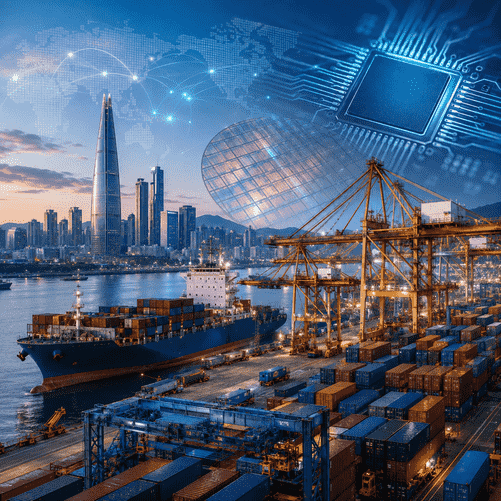
Record semiconductor and computer shipments delivered a major trade surplus in July, reinforcing South Korea’s position at the centre of the global artificial-intelligence supply chain.

SEOUL — South Korea’s exports rose sharply in July as accelerating investment in artificial intelligence drove international demand for semiconductors, computers and other advanced technology products.
Exports increased 62.8 percent from a year earlier to $98.89 billion, exceeding economists’ expectations and recording the country’s second-highest annual growth rate since June 2025. Imports climbed 26.5 percent to $68.56 billion, leaving Asia’s fourth-largest economy with a trade surplus of approximately $30.32 billion.
The figures underline the growing importance of artificial-intelligence infrastructure to South Korea’s economy. Semiconductor exports surged 179 percent, supported by rising memory-chip prices and strong demand from data centres. Computer exports increased more than fourfold as major technology companies continued spending heavily on servers and computing capacity required to train and operate advanced AI systems.
Demand was broad-based across South Korea’s principal overseas markets. Shipments to China rose 96 percent, while exports to the United States increased 69 percent. Sales to the Middle East advanced 25 percent despite continuing geopolitical and energy-market uncertainty.
The July performance followed an exceptional first half of the year. South Korean exports exceeded $100 billion in a single month for the first time in June, placing the country alongside China, Germany and the United States as one of the few economies to have crossed that threshold.
Samsung Electronics and SK Hynix, two of the world’s largest memory-chip producers, have been among the principal beneficiaries of the AI investment cycle. Demand for high-bandwidth memory and other specialised components used in AI accelerators has strengthened profits, expanded production plans and increased expectations that tight global chip supplies could persist.
The export boom is also improving South Korea’s broader economic outlook. Government projections released in July estimated that the economy could grow by 3 percent in 2026, supported by semiconductor exports and additional public spending. Officials also forecast a record current-account surplus of about $290 billion for the year, substantially higher than their earlier estimate.
However, the country’s increasing dependence on the technology sector creates vulnerabilities. A slowdown in global AI investment, falling chip prices or tighter trade restrictions between the United States and China could rapidly weaken demand. Recent volatility in South Korean technology shares has demonstrated how quickly investor confidence can change when expectations for the AI industry are revised.
For the moment, South Korea remains one of the clearest economic winners from the global race to build artificial-intelligence infrastructure. July’s trade figures suggest that AI is no longer merely supporting a handful of technology companies; it is reshaping the country’s export performance, currency flows and national growth prospects.