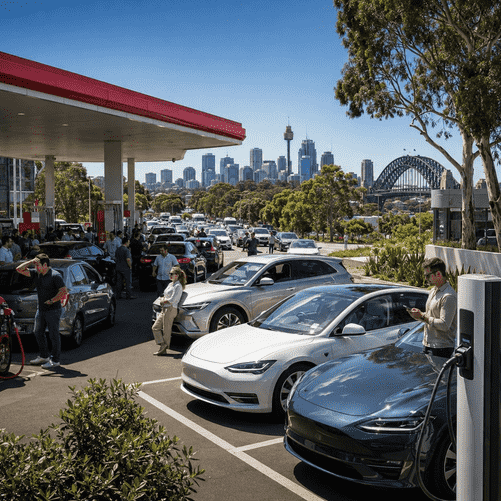
Battery-powered and hybrid vehicles captured nearly half of new sales during the June quarter as volatile petrol prices accelerated a historic shift away from conventional engines

Electric and hybrid vehicles have moved to the centre of Australia’s automotive market, accounting for almost half of all new cars sold between April and June as motorists responded to rising fuel costs and continuing uncertainty over global oil supplies.
Data from the Australian Automobile Association show that vehicles powered entirely or partly by electricity were purchased at almost the same rate as traditional petrol and diesel models during the second quarter of 2026. Internal-combustion vehicles represented 50.84 percent of new light-vehicle sales, their lowest quarterly share on record.
Battery-electric vehicle sales more than doubled from the previous quarter, climbing from 34,435 to a record 69,414 units. Their market share rose to 21.03 percent, while plug-in hybrids accounted for a further 10.58 percent. Conventional hybrids also reached an all-time sales high, bringing the combined share of electrified models close to half of the market.
The figures mark one of the most significant changes in Australian consumer behaviour since electric cars entered the mainstream market. Petrol and diesel vehicles have traditionally dominated sales because of Australia’s long driving distances, limited charging infrastructure and strong demand for large sport utility vehicles and utility vehicles.
That balance is now changing rapidly.
The transition accelerated during a period of sharp fuel-price volatility linked to conflict in the Middle East and uncertainty surrounding international oil supplies. Higher petrol and diesel costs have made the running expenses of conventional vehicles more visible to consumers, strengthening the financial appeal of electric and hybrid alternatives.
Australia’s temporary fuel-excise reduction offered only limited relief. The remaining discount is due to end on August 3, and petrol prices are expected to move above A$2 a litre in many areas. Restoring the full excise could add approximately A$8.80 to the cost of filling a 55-litre tank.
For households already facing elevated housing, food and electricity costs, the prospect of persistently expensive fuel is increasingly influencing major purchasing decisions. Electric vehicles generally carry lower day-to-day energy and maintenance costs, particularly for drivers able to charge at home, while hybrids allow motorists to reduce fuel consumption without relying entirely on public charging networks.
The second-quarter results also suggest that buyers are no longer treating electrification as a choice limited to environmentally conscious consumers. Economic considerations, including protection against unstable petrol prices, are becoming an increasingly important part of the decision.
The growth has been supported by a broader range of available vehicles and increasingly competitive pricing. Chinese manufacturers have expanded rapidly in Australia, offering electric and plug-in hybrid models across several price categories and increasing pressure on established Japanese, South Korean, European and American brands.
More than 103,000 battery-electric vehicles were sold during the first six months of 2026, exceeding the number sold throughout the whole of 2025. In June alone, electric cars represented 23.4 percent of new vehicle sales, compared with 10.3 percent a year earlier.
Government policy has also contributed to the shift. Australia’s New Vehicle Efficiency Standard encourages manufacturers to supply lower-emission models by setting fleet-wide emissions targets. The federal National Electric Vehicle Strategy separately aims to expand the supply of affordable electric cars, improve charging infrastructure and encourage consumer demand.
However, the rapid increase in sales is likely to intensify pressure on governments and energy providers to improve charging access. Apartment residents, renters and motorists in regional communities may struggle to install private chargers, leaving them more dependent on public facilities.
Charging availability remains uneven, and congestion at popular stations could become more common as the electric fleet expands. Electricity networks may also require further investment to manage growing demand, although overnight and intelligently scheduled charging could help reduce pressure during peak periods.
Affordability presents another challenge. While competition has lowered the price of some electric vehicles, many models remain more expensive to purchase than comparable petrol cars. Concerns about battery longevity, repair costs, resale values and access to servicing also continue to affect buyers.
The popularity of hybrids reflects these unresolved obstacles. Conventional hybrids require no external charging, while plug-in hybrids can complete shorter journeys on battery power and retain a combustion engine for longer trips. For many Australians, they offer a transitional option between petrol vehicles and fully electric driving.
Yet the latest figures indicate that the transition is proceeding faster than many industry forecasts anticipated. The question is no longer whether electrified vehicles can establish a meaningful position in Australia, but how quickly they will overtake conventional cars.
Petrol and diesel models still account for most vehicles already travelling on Australian roads, meaning the national fleet will take many years to change. New-car sales, however, provide an early indication of the direction of that transformation.
The June-quarter results represent a symbolic threshold. Electric and hybrid vehicles are approaching market parity with combustion-engine cars, driven not only by environmental policy but by the immediate economic calculations of motorists confronting an unstable global fuel market.
Australia’s dependence on imported oil has long exposed households to events beyond the country’s control. As fuel prices rise again, more drivers appear to be deciding that the most effective protection against the next oil shock may be to use less petrol—or abandon it altogether.