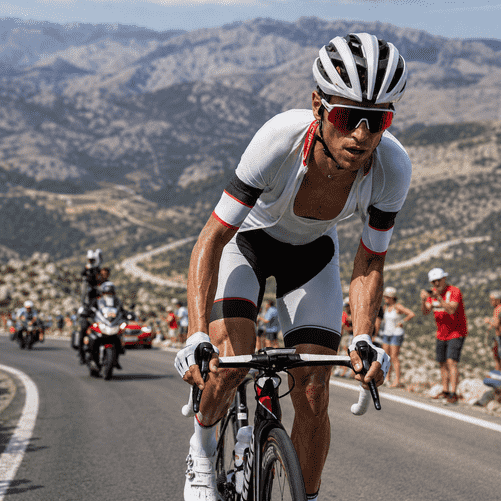
The five-time Tour de France champion will return to the Vuelta a España after a seven-year absence, seeking to join the select group of riders who have won cycling’s three greatest stage races.

Tadej Pogačar will return to the Vuelta a España for the first time since his spectacular Grand Tour debut in 2019, setting up an attempt to claim the only three-week race still missing from his extraordinary career record.
UAE Team Emirates-XRG confirmed on Monday that the Slovenian will start the 2026 Vuelta, which begins in Monaco on August 22. The announcement came little more than a week after Pogačar secured a record-equalling fifth Tour de France title in Paris.
Victory in Spain would allow Pogačar to complete a career sweep of cycling’s three Grand Tours. He has already won the Tour de France five times and captured the Giro d’Italia in 2024, but has raced the Vuelta only once.
That appearance came in 2019, when the then 20-year-old announced himself as one of the sport’s most exceptional young talents. Pogačar won three stages and finished third overall in his first Grand Tour, establishing a reputation that would soon be reinforced by his breakthrough Tour de France victory the following year.
Seven years later, he will return as the dominant figure of his generation and the overwhelming favourite to win the red jersey.
Pogačar’s participation had been the subject of growing speculation throughout the Tour de France. UAE officials initially said that a final decision would be made only after the race, allowing the rider and his support staff to assess his physical condition and recovery.
At a criterium in his native Slovenia, Pogačar teased that an announcement would arrive on Monday. His team then confirmed his return through its official channels, ending uncertainty over whether he would extend an already demanding season into another three-week campaign.
The decision underlines the scale of Pogačar’s ambitions. His fifth Tour triumph placed him alongside Jacques Anquetil, Eddy Merckx, Bernard Hinault and Miguel Induráin as one of only five men to win cycling’s most prestigious race five times. At 27, he remains young enough to pursue the outright Tour record while continuing to target the sport’s other historic prizes.
A Vuelta victory would place him among the small number of riders to have won the Tour, Giro and Vuelta during their careers. It would also close one of the few remaining gaps in a record that already includes world championships, Monument classics and repeated stage-race victories.
The challenge, however, will be considerable. Pogačar will begin the Vuelta less than four weeks after completing the Tour, leaving a narrow recovery period following three demanding weeks of racing in France.
Fatigue may be his most significant opponent. Even riders in exceptional form can struggle to reproduce peak performance in two Grand Tours held so closely together, particularly when the second race contains repeated high-mountain stages and limited opportunities for recovery.
The physical burden will be intensified by the attention surrounding his return. Rivals are likely to organise their tactics around isolating Pogačar from his teammates and forcing UAE Team Emirates-XRG to control the race across all three weeks.
The strength of his team may nevertheless provide a decisive advantage. UAE has assembled one of the deepest rosters in professional cycling, combining experienced mountain domestiques with younger riders capable of challenging for major results themselves.
That depth was evident during the 2026 Tour, where Pogačar not only defended the yellow jersey but also helped teammate Isaac del Toro reach the podium. The performance illustrated UAE’s ability to protect its leader while pursuing several objectives simultaneously.
Pogačar’s return is also a major success for the Vuelta’s organisers. Race director Javier Guillén had openly expressed confidence that the Slovenian would participate, describing 2026 as an ideal opportunity for him to pursue victory in Spain.
His presence will bring increased international attention to a race that often depends on unpredictable mountain battles and late-season rivalries to distinguish itself from the Tour and Giro.
The Vuelta’s route and start in Monaco may suit a rider with Pogačar’s versatility. He is capable of gaining time in the mountains, individual time trials and explosive uphill finishes, giving his rivals few obvious areas in which to expose a weakness.
Yet his dominance may also change the character of the competition. Rather than waiting for isolated mountain stages, opposing teams may need to race aggressively from the opening week, forming alliances of convenience and testing whether the Tour champion has fully recovered.
Pogačar’s decision turns the Vuelta from an important late-season contest into one of the defining races of 2026.
He will arrive in Monaco carrying the expectations created by a decade’s worth of success compressed into only a few seasons. Another victory would not merely add a new trophy. It would complete cycling’s Grand Tour set and strengthen the argument that Pogačar is building one of the greatest careers the sport has seen.
For a rider who has already conquered almost every challenge placed before him, Spain now represents both unfinished business and another opportunity to extend the boundaries of his era.