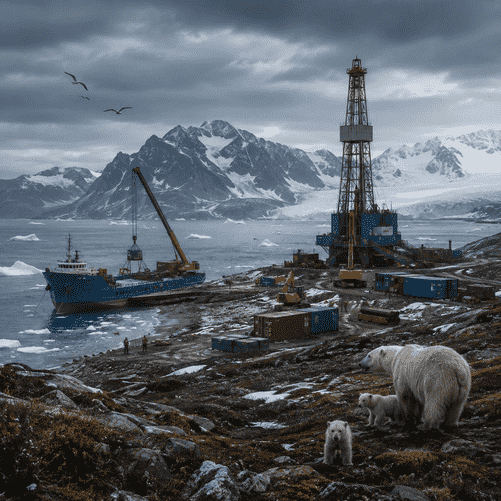
Greenlandic authorities say drilling preparations in the remote Jameson Land region moved ahead without approval, intensifying scrutiny of a project backed by figures with connections to Donald Trump.

Greenland’s government has issued a sharp warning after equipment linked to a planned oil exploration campaign was brought ashore on the island’s remote eastern coast without prior approval, setting up a potentially significant confrontation over energy development, environmental protection and sovereignty in the Arctic.
The dispute centres on Greenland Energy, a Texas-based company planning exploratory drilling in the Jameson Land region of eastern Greenland. According to reporting published on Saturday, materials intended to support the drilling operation were recently unloaded in the area even though Greenlandic authorities say the required permissions had not been granted.
Greenland’s government responded by stressing that future logistical activities must be communicated to and authorised by the island’s mineral resources authority before being carried out. An application connected to the project remains under consideration, while officials have said it would not currently be proportionate to require the equipment already delivered to be removed.
The incident has drawn particular attention because of Greenland Energy’s political connections in the United States and because it comes amid renewed debate over Washington’s strategic ambitions in Greenland.
The company has links to figures associated with U.S. President Donald Trump. Greenland Energy has retained television personality Phil McGraw, widely known as Dr Phil, for a documentary project about the exploration campaign, while one of its directors is a U.S. Navy veteran involved in the Golden Dome missile-defence initiative. Company chairman Larry Swets has maintained that the petroleum project is unrelated to any effort to bring Greenland under American control.
Greenland Energy’s plans are economically ambitious.
The company and its partners believe Jameson Land could contain a major petroleum resource. Greenland Energy has publicised estimates suggesting the basin could hold as much as approximately 13 billion barrels of gross unrisked prospective resources, although such figures represent geological estimates rather than proven recoverable reserves.
Company representatives have previously suggested that crude potentially worth around $1 trillion could lie beneath the region. Determining whether commercially viable deposits actually exist would require exploratory drilling.
Greenland Energy has proposed financing drilling activities in exchange for a majority interest in the project. Its corporate disclosures state that it can earn a working interest of up to 70% after completing specified exploration wells.
The regulatory position, however, remains complicated.
Greenland stopped issuing new oil exploration licences in 2021, citing the potentially significant environmental consequences of petroleum development. Existing licences were not automatically cancelled, leaving several previously issued exploration rights in force.
Historic Greenlandic government documentation confirms that licences covering parts of Jameson Land remained active and that exploration drilling had previously been under consideration in the region.
Greenland Energy is seeking to participate through rights associated with those existing licences, but regulatory approval remains necessary before drilling can begin.
That distinction has become central to the current dispute.
During a community meeting in June, a company representative reportedly told residents that permission existed to place equipment on the land while drilling applications were still pending. Greenlandic authorities subsequently disputed that characterisation, saying there were no active permissions covering exploration preparations at the time.
The arrival of containers and other equipment has therefore increased concern that preparations are moving faster than the regulatory process.
Greenland Energy has taken a more optimistic view. In a recent communication to shareholders, the company said meetings with Greenlandic regulatory and oversight authorities had been constructive and that it remained encouraged by progress toward receiving the remaining approvals required for drilling. The project has reportedly been scaled initially to one exploration well rather than two.
Further equipment is expected to be transported from Canada in September, with drilling targeted for October if approval is secured.
The environmental implications are equally significant.
The proposed drilling area overlaps environmentally sensitive territory associated with a wetland conservation zone protected under the Ramsar Convention. Jameson Land supports Arctic wildlife including migratory bird populations and muskoxen, creating concerns about the potential impact of industrial activity, transport and eventual petroleum extraction.
For Greenland’s leadership, the decision therefore extends far beyond whether a single exploration well should be permitted.
The island possesses enormous quantities of strategically valuable natural resources, including hydrocarbons and critical minerals, while occupying a geographically important position between North America and Europe. Rising geopolitical competition in the Arctic has consequently increased international interest in Greenland’s territory, infrastructure and resources.
Those pressures have intensified alongside repeated statements from Trump regarding greater American control over Greenland.
The petroleum project consequently sits at the intersection of commercial opportunity and geopolitical sensitivity. A major oil discovery could potentially generate investment and revenue for an economy seeking greater financial independence, but it could also expose Greenland to deeper external pressure over the exploitation of its natural resources.
The government in Nuuk must now determine whether the drilling proposal satisfies Greenlandic law, environmental requirements and the conditions attached to the existing licences.
The immediate issue is procedural: Greenland Energy cannot simply move from preparation to drilling without government authorisation.
The wider issue is considerably more consequential.
What might otherwise have been a conventional Arctic exploration project has become entangled with questions of sovereignty, U.S. strategic interests and Greenland’s long-term control over its own resource development.
As drilling equipment accumulates on the eastern coast and the proposed October campaign approaches, Greenland’s response will be closely watched not only by the energy industry but also by governments across the Arctic.
The dispute is rapidly becoming a test of whether Greenland can attract foreign capital to develop its resources while maintaining unequivocal political and regulatory control over how — and by whom — those resources are exploited.