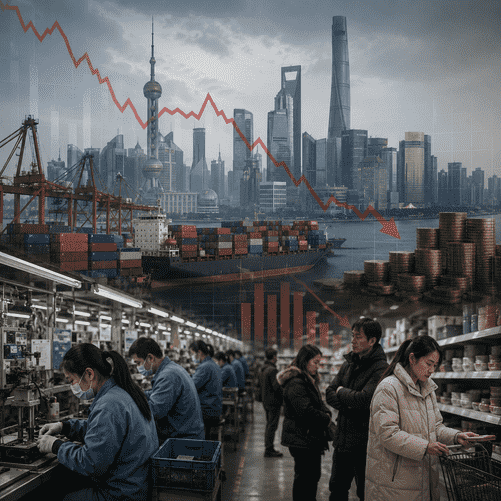
Consumer and factory-gate price growth slowed in July, giving policymakers more room to support spending but highlighting persistent weakness in household demand and the property sector.

China’s inflation cooled in July, offering fresh evidence that the world’s second-largest economy remains caught between easing external price pressures and stubbornly weak domestic demand.
Official data released on Sunday showed that China’s consumer price index rose 0.5% from a year earlier in July, slowing from the previous month. Core inflation, which excludes volatile food and energy prices, increased 0.9% year on year, according to figures from the National Bureau of Statistics.
At the factory gate, price pressures also moderated. The producer price index rose 3.5% year on year, down from 4.1% in June and marking a three-month low. On a monthly basis, producer prices declined 0.7%.
The slowdown partly reflects softer global energy costs after earlier disruptions in Middle Eastern oil markets pushed commodity prices sharply higher. But the figures also expose a deeper challenge for Beijing: Chinese consumers are still spending cautiously, while the long-running property downturn continues to weigh on confidence, investment and household wealth.
Food prices declined 1.5% from a year earlier, while overall consumer prices slipped 0.1% from June. The relatively subdued inflation environment gives Chinese authorities greater flexibility to introduce measures designed to stimulate consumption without immediately creating significant additional price pressures.
For policymakers, however, low inflation is a mixed signal. Moderate prices can support household purchasing power, but persistently weak inflation can also indicate insufficient demand. When consumers and businesses expect prices to remain subdued, they may postpone purchases or investment, potentially reinforcing an economic slowdown.
China has spent much of the past several years attempting to rebalance its economy away from property investment and infrastructure towards household consumption, advanced manufacturing and technology. Progress has been uneven. High-tech industries and exports have remained important sources of resilience, while domestic consumption and real-estate activity have struggled to regain their previous momentum.
Recent indicators reinforce that divergence. Manufacturing activity weakened in July, while services and construction indicators also showed signs of slowing. At the same time, Chinese exports have remained comparatively strong, providing an important buffer against softer activity at home.
The government has signalled that fiscal policy will play a larger role during the second half of the year, with authorities promising more timely measures to support economic activity and encourage domestic consumption. The effectiveness of those measures will depend largely on whether they can convince households to spend rather than save.
That task is particularly important because China’s economic difficulties are increasingly structural rather than purely cyclical. Falling property values, cautious private-sector investment and concerns over employment have all contributed to weaker consumer confidence.
China also faces the delicate challenge of managing competition among manufacturers. Authorities have attempted to discourage aggressive price wars in industries suffering from excess capacity, but efforts to restore stronger corporate pricing power have so far produced limited results.
For international markets, the July inflation figures carry significance far beyond China. The country remains one of the world’s largest consumers of energy, metals and agricultural commodities, meaning weaker Chinese demand can influence commodity prices and the economies of major exporters across Asia, Europe, Africa and Latin America.
Conversely, stronger stimulus from Beijing could quickly increase demand for imported raw materials and industrial products.
The latest figures therefore leave Chinese policymakers with an unusual combination of opportunities and risks. Cooling inflation provides room for additional economic support, but it simultaneously underlines how difficult it has become to generate sustained domestic demand.
The next phase of China’s recovery is likely to depend less on factory production alone and more on whether Beijing can restore confidence among consumers and businesses. Until that happens, subdued inflation may remain less a sign of economic stability than a reminder of the underlying weakness still confronting Asia’s largest economy.