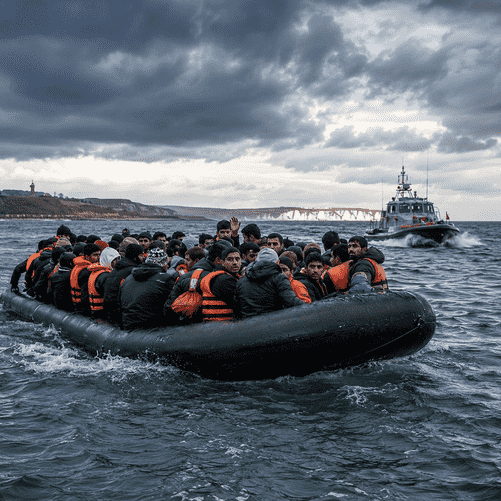
A record 230 people reached Britain aboard a single vessel, highlighting how criminal networks are adapting to tighter enforcement along the northern French coast.

People-smuggling networks operating across the English Channel are increasingly turning to much larger and more heavily loaded inflatable boats, presenting a new challenge to British and French authorities despite a significant decline in the overall number of crossings this year.
A record 230 people arrived in the United Kingdom aboard a single inflatable vessel after crossing the Channel, surpassing the previous record of 165 people carried by one boat. The incident has intensified concern that trafficking networks are responding to stronger enforcement by concentrating larger numbers of passengers into fewer launches.
The development marks a potentially important change in the dynamics of one of Europe’s most closely monitored irregular migration routes. For years, smugglers relied primarily on comparatively smaller inflatable boats launched from beaches around Calais and other parts of northern France. Increasing patrols, surveillance and interceptions are now forcing criminal groups to modify both their launch locations and the size of the vessels they deploy.
The emergence of so-called “mega-dinghies” illustrates that adaptation. Rather than organizing numerous smaller departures, smugglers can attempt to place more than 150 or even 200 people aboard a single vessel, potentially increasing the financial return from each successful launch while reducing the number of separate boats that must evade police intervention.
The strategy carries substantial risks. Inflatable vessels used on Channel crossings are not designed to transport such large numbers of passengers across one of the world’s busiest shipping routes. Severe overcrowding can reduce stability, limit passengers’ ability to move during an emergency and make evacuation significantly more difficult.
Those dangers were demonstrated earlier this month when another oversized dinghy carrying approximately 173 people caught fire during an attempted crossing. Fourteen people were reported injured in the incident, reinforcing concerns about the consequences of increasingly crowded boats.
The latest crossing nevertheless comes against a broader trend of declining arrivals. Small-boat crossings in 2026 are reported to be more than 40% lower than during the equivalent period last year, suggesting that increased enforcement and cooperation between Britain and France have disrupted some smuggling activity even as criminal networks continue to adjust their methods.
British and French authorities have expanded cooperation along the Channel coast, including additional patrols, maritime surveillance and operations targeting the supply of boats and equipment used by smuggling groups. According to figures cited by British authorities, joint efforts since the current government took office have prevented tens of thousands of attempted crossings and resulted in the seizure of more than 1,000 vessels.
The UK government has also strengthened criminal penalties directed at people-smuggling networks, including offences connected to conduct that places lives at risk at sea. Ministers argue that enforcement must target the organizations coordinating crossings rather than focusing exclusively on individual boats once they have entered the Channel.
At the centre of the government’s strategy is closer cooperation with France. Under arrangements introduced between the two countries, Britain can return some people who arrive through unauthorized Channel crossings while accepting other asylum seekers through controlled legal procedures from France. The approach is intended to weaken the economic model used by smugglers by reducing the likelihood that an irregular crossing guarantees permanent entry into Britain.
However, humanitarian organizations and migration campaigners argue that increasingly aggressive deterrence measures may encourage smugglers to adopt more dangerous tactics rather than eliminate demand for crossings. Care4Calais has criticized policies focused predominantly on deterrence and called for broader access to safe and legal asylum routes.
The disagreement highlights the wider political difficulty surrounding Channel migration. Governments want to demonstrate that national borders can be effectively controlled, while humanitarian groups warn that migrants and asylum seekers will continue attempting dangerous journeys when legal alternatives are limited.
For law-enforcement agencies, the appearance of much larger vessels presents a particularly difficult operational problem. Intercepting a boat carrying more than 200 people can require substantial rescue capacity, and any mechanical failure, collision or sudden deterioration in weather could quickly produce a mass-casualty emergency.
The tactics used before boats reach the water are also changing. Smuggling groups have increasingly experimented with different launch points and movements along the French coastline in an effort to avoid concentrated police patrols. Such flexibility allows criminal networks to test enforcement gaps and rapidly redirect operations when particular beaches become more heavily monitored.
This pattern reflects a broader characteristic of organized smuggling networks: enforcement can suppress particular methods without necessarily eliminating the underlying business. As authorities close one route or increase the risk associated with one tactic, criminal organizations may respond by changing departure locations, vessel designs or the number of passengers carried on each journey.
For Britain and France, this means that falling overall crossing numbers do not necessarily represent the end of the problem. The record 230-person vessel demonstrates that smugglers remain capable of adapting rapidly to new security measures.
The next phase of the Channel migration challenge may therefore be defined less by the total number of boats crossing the sea than by the growing scale and danger of individual departures. The use of increasingly large inflatable vessels could allow traffickers to move hundreds of people at once while placing passengers under considerably greater risk.
The record crossing is consequently both a sign of pressure on smuggling networks and evidence of their continuing resilience. Stronger enforcement appears to be changing how the Channel trade operates, but the emergence of oversized boats suggests that criminal groups are searching aggressively for ways to preserve a highly profitable route.
For policymakers, the central question is whether tighter UK-French cooperation can disrupt those adaptations faster than smugglers can develop new ones. The answer will determine not only the future trajectory of Channel crossings, but also the human cost of one of Europe’s most politically sensitive migration routes.