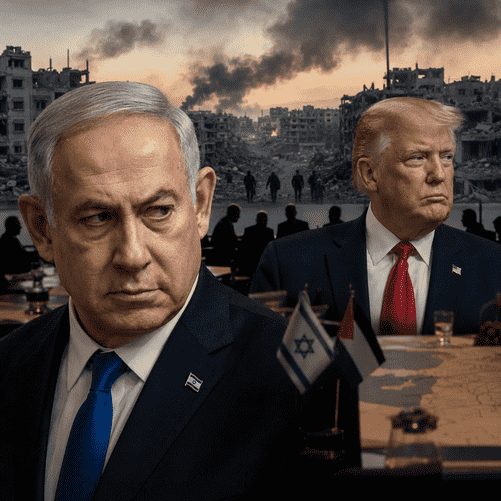
Israel’s prime minister has rejected a U.S.-backed proposal linking Hamas’s disarmament to a phased Israeli military withdrawal, exposing a widening dispute with President Donald Trump over how to advance the next stage of the Gaza peace process.

Israeli Prime Minister Benjamin Netanyahu has publicly rejected the latest U.S.-backed framework for advancing the Gaza peace process, insisting that Israeli forces will not withdraw from the territory until Hamas has been fully and verifiably disarmed. The position places Netanyahu at odds with President Donald Trump, whose administration has been pressing Israel and Hamas to move toward the next phase of a broader settlement intended to stabilize Gaza and eventually end the conflict.
The dispute centres on a 15-point proposal promoted through the U.S.-led diplomatic process. Under the framework, Hamas would surrender its weapons while Israeli forces would begin a phased withdrawal from areas of Gaza they currently control. The plan also envisages a transitional Palestinian technocratic administration and an international security mechanism designed to oversee Gaza during reconstruction and political transition.
Netanyahu, however, has rejected the sequencing at the heart of the proposal. He argues that an Israeli withdrawal occurring alongside Hamas’s disarmament would create unacceptable security risks and potentially allow the militant group to preserve or rebuild parts of its military infrastructure. Israel’s position is that Hamas must first be comprehensively disarmed — including the dismantling of weapons stockpiles and military infrastructure — before significant Israeli troop withdrawals can proceed.
The Israeli prime minister’s intervention represents an unusually public disagreement with Trump over one of the U.S. president’s most prominent Middle East initiatives. Washington has portrayed progress on Gaza as an important element of its wider regional strategy, and Trump has sought to move the process beyond the ceasefire arrangements established in late 2025 toward a more permanent political and security settlement.
Hamas, meanwhile, has indicated that it is prepared to discuss disarmament within the framework of a broader agreement, but has demanded guarantees regarding Israeli withdrawal and the end of military operations. That fundamental disagreement over sequencing remains one of the most difficult obstacles facing mediators: Israel wants disarmament completed before withdrawal, while Hamas has resisted surrendering its remaining military capability without firm assurances that Israeli forces will leave.
The disagreement carries significant political consequences for Netanyahu. With Israeli politics increasingly shaped by security concerns and electoral calculations, any perception that the government is withdrawing from Gaza before Hamas has been neutralized could provoke fierce opposition from nationalist and right-wing constituencies. Netanyahu has repeatedly presented the complete dismantling of Hamas’s military capabilities as a fundamental Israeli security requirement rather than a negotiating concession.
Washington faces a different calculation. The Trump administration wants simultaneous or closely coordinated steps from both sides to prevent the peace process from becoming trapped in an indefinite cycle of competing preconditions. American officials and mediators have therefore sought a formula in which Hamas’s disarmament, Israeli redeployment, transitional governance and international security arrangements progress together rather than sequentially.
The stakes extend beyond Gaza. A prolonged confrontation between Netanyahu and Trump could complicate U.S.-Israeli coordination at a moment when Washington is also managing broader instability across the Middle East. Although the strategic relationship between the two countries remains deep, Netanyahu’s willingness to publicly reject a proposal championed by the White House demonstrates the limits of American leverage when Israeli leaders believe core security interests are involved.
For Gaza, the immediate consequence is renewed uncertainty. Reconstruction, the establishment of a functioning postwar administration and the deployment of international security arrangements all depend heavily on agreement over the military transition. Without a compromise on the relationship between Hamas disarmament and Israeli withdrawal, the broader diplomatic architecture risks remaining largely theoretical.
The confrontation therefore marks a critical test for Trump’s Gaza strategy. The administration has succeeded in bringing the parties into a framework for discussing Gaza’s future, but converting that framework into a durable settlement requires overcoming precisely the issue now dividing Washington and Jerusalem: who takes the first irreversible step.
For Netanyahu, the answer remains clear — Hamas must disarm first. For Trump, progress increasingly depends on persuading Israel that disarmament and withdrawal can occur together. The distance between those positions may determine whether the Gaza peace process moves into its next phase or enters another prolonged period of diplomatic paralysis.