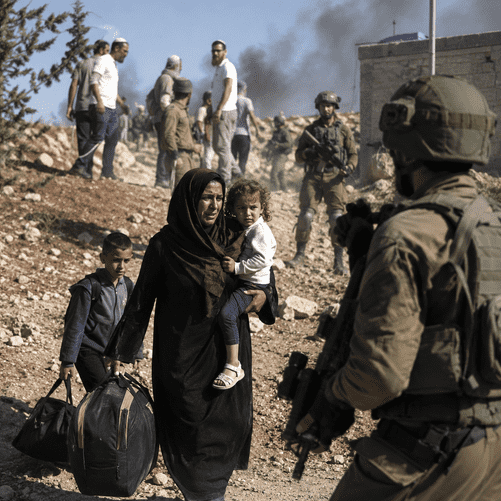
Israeli forces move residents during an operation following days of settler intimidation in Qusra, while former prime minister Ehud Olmert describes the events as a coordinated attempt to remove Palestinians from their land.

A confrontation in the occupied West Bank village of Qusra has intensified international concern over escalating settler violence and the role of Israeli security forces, after Palestinian families were ordered from their homes during a military operation launched following several days in which settlers had surrounded residences, blocked access and cut essential services.
The crisis began over the weekend when groups of Israeli settlers established themselves outside three Palestinian homes on the outskirts of Qusra, south of Nablus. Residents said entrances were blocked, water and electricity were cut and the families were effectively prevented from leaving safely. The United Nations said about 15 Palestinians, including two children, were trapped in the properties without normal access to water or power.
The episode subsequently expanded into an unusual confrontation involving settlers, Palestinian residents and Israeli troops. Israel’s military declared Qusra a closed military zone and attempted to remove illegal settler positions in the area. Soldiers dismantled two outposts and detained at least one Israeli, according to the military, but settlers repeatedly returned. Video from the area also showed clashes between Israeli troops and settlers resisting attempts to clear them.
By Thursday, however, the military operation had itself resulted in Palestinians being moved from homes. Qusra’s mayor said Israeli forces took positions in several Palestinian properties, while residents reported being instructed to leave some houses and gather in another residence. The Israeli military disputed that displacement was its policy, saying soldiers had explicitly been instructed that Palestinian residents should remain in their homes and that troops had been deployed to protect residents and maintain security.
That discrepancy has become central to the controversy. Residents told journalists that military personnel had given them limited time to move, and some said they had not been able to return immediately. Israeli authorities maintained that their objective was to restore order and protect the local population while removing unauthorised settler positions.
The events prompted unusually severe criticism from inside Israel itself. Former Israeli prime minister Ehud Olmert described what was happening in Qusra as a “concerted and meticulous attempt at ethnic cleansing”, accusing the government and security institutions of failing to prevent the intimidation and displacement of Palestinians.
Olmert’s intervention is politically significant because the accusation comes from a former Israeli head of government rather than from Palestinian officials or international campaign groups. His comments add to a widening domestic debate over whether violence by extremist settlers is being adequately confronted by Israel’s military, police and political leadership.
The United States has also issued an unusually forceful response. U.S. Ambassador to Israel Mike Huckabee, historically a strong supporter of Israeli settlements, condemned those responsible for the Qusra siege and referred to their actions as terrorism. He said American officials had been working with Israeli military and police authorities to secure intervention. One of the houses involved belongs to a Palestinian-American family, giving Washington an additional direct interest in the confrontation.
For the Palestinians caught inside the homes, however, the distinction between the settlers surrounding them and the forces subsequently deployed into their neighbourhood offered little reassurance. Families described days of uncertainty, diminishing supplies and fears that the pressure was intended to make continued residence on the edge of the village impossible.
Qusra has become one of the most persistent flashpoints of settler-Palestinian violence in the West Bank. The U.N. humanitarian office said earlier this year that it had recorded more settler attacks in Qusra than in any other West Bank community during 2026. A local Palestinian resident was killed by an off-duty Israeli reservist in March, while others were wounded in attacks.
The latest confrontation also takes place against a much wider surge in violence and settlement activity. Palestinian officials reported 1,476 settler attacks during 2026 by mid-August, while 87 Palestinians had been killed by Israeli settlers and soldiers this year, according to the Palestinian Authority’s Health Ministry. Israel says that some Palestinians included in casualty figures were involved in militant attacks or other violence.
A United Nations commission of inquiry reported in June that settler attacks on Palestinian communities and agricultural land had risen sharply since 2023. The commission alleged that Israeli authorities had enabled some of the violence through financial, military and institutional support, and said security forces had sometimes protected settlers during attacks.
Israel strongly rejected those conclusions. Its diplomatic mission in Geneva accused the U.N. commission of relying on unsubstantiated allegations, while the Israeli military said its role was to maintain security and conduct counterterrorism operations. The army said it condemns violence that undermines security and investigates allegations of misconduct by its personnel.
The broader political environment has nevertheless changed considerably. Prime Minister Benjamin Netanyahu’s government has overseen a major expansion of Israeli settlements in the West Bank and includes influential politicians who support permanent Israeli control of the territory and reject the establishment of an independent Palestinian state.
More than half a million Israeli settlers now live in the West Bank alongside roughly 2.8 million Palestinians. Israel captured the territory from Jordan during the 1967 Middle East war. Palestinians seek the West Bank, together with Gaza and East Jerusalem, as the principal territory of a future state. Most of the international community regards Israeli settlements in occupied territory as illegal, while Israel disputes interpretations of their legal status and maintains historical and security claims to the land.
The Qusra confrontation is especially sensitive because it illustrates how relatively small settler outposts can generate consequences far beyond their physical size. Blocking roads, occupying land around isolated Palestinian homes, disrupting utilities and repeatedly returning after military intervention can create sustained pressure on residents even without a formal government order removing them.
Palestinians and human-rights organisations argue that such pressure has become an increasingly important mechanism of displacement, particularly in rural areas where individual homes and herding communities are vulnerable to intimidation. A June U.N. inquiry said violence had been used to advance displacement and territorial control; Israel rejected the inquiry’s broader conclusions.
At the same time, Qusra demonstrates that tensions also exist between Israeli security forces and radical settlers. Soldiers have attempted to dismantle outposts, used crowd-control measures against settlers and deployed additional personnel to the area. Israeli officials say extremist violence is the work of a minority operating outside the law rather than government policy.
Yet the persistence of the siege despite repeated military intervention has intensified questions about enforcement. Footage earlier in the week appeared to show some men in Israeli military clothing joining settlers in prayer at their encampment; the military said disciplinary action was being taken against personnel involved.
The result is an increasingly volatile situation in which the Israeli government faces criticism from several directions: Palestinians demanding protection from settler violence, international governments warning against forcible displacement, and Israeli critics arguing that authorities have failed to enforce the law consistently.
For Qusra’s residents, those broader political arguments are secondary to the immediate question of whether families can safely remain in their homes.
The events of this week have therefore become more than another local dispute over land. They offer a stark illustration of the rapidly deteriorating security environment in the West Bank, where settlement expansion, Palestinian dispossession claims, militant violence, military operations and increasingly aggressive settler activism are converging.
Whether the Israeli security forces permanently remove those responsible for the siege — and whether the displaced families are able to resume normal life without renewed intimidation — will be closely watched. What happens in Qusra could become an important test of whether Israeli authorities are willing and able to restrain violent settler groups at a moment when even prominent former Israeli leaders are warning that the cumulative effect of such actions threatens to transform the demographic and political landscape of the West Bank.