A sharp exchange between Philippine Defence Secretary Gilberto Teodoro and Beijing underscores the accelerating deterioration in relations between the two Asian neighbours, with disputes increasingly extending beyond the South China Sea into law enforcement, diplomacy and domestic security.

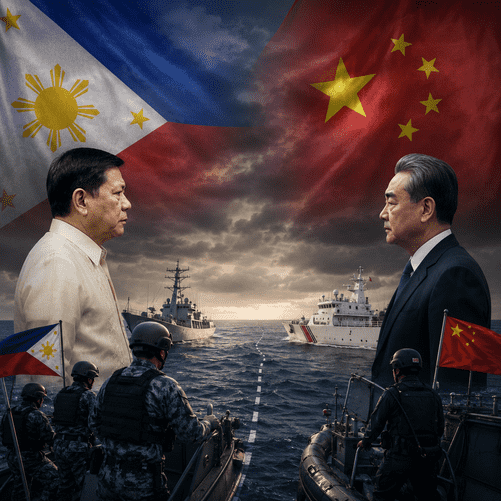
Political tensions between the Philippines and China intensified on Saturday, August 15, after Philippine Defence Secretary Gilberto Teodoro publicly rejected Beijing’s criticism of Manila and accused Chinese officials of attempting to divert attention from what he described as interference in Philippine domestic affairs.
The latest confrontation followed unusually strong comments from China’s Foreign Ministry, which accused Teodoro of repeatedly attacking China and damaging bilateral relations. Chinese Foreign Ministry spokesperson Guo Jiakun criticised the Philippine defence chief over statements connected to law-enforcement operations involving Chinese nationals and accused him of contributing to the deterioration of ties between Manila and Beijing.
Teodoro dismissed the allegations and characterised Beijing’s response as a “squid tactic” — an attempt, in his view, to obscure the underlying controversy by shifting attention toward accusations against the Philippines. His remarks signal that disagreements traditionally centred on competing territorial claims in the South China Sea are increasingly spilling into a much broader political confrontation.
At the centre of the latest dispute is a Philippine law-enforcement operation conducted in May at a steel facility in Misamis Oriental, on the southern island of Mindanao. Chinese citizens were arrested during the operation over alleged environmental violations and irregularities related to their activities in the country. Philippine authorities have maintained that the searches and arrests were conducted under court-issued warrants.
Teodoro went further, accusing personnel associated with the Chinese embassy of attempting to interfere with Philippine law enforcement and of threatening retaliatory measures. Beijing rejects Manila’s portrayal of the episode and has instead accused Philippine officials of politicising cases involving Chinese nationals.
The diplomatic dispute has been aggravated by China’s recent deportation of more than 100 Filipinos accused of illegally working or residing in the country. Teodoro criticised Beijing’s treatment of the issue and described its actions as a form of political pressure, further sharpening an already confrontational relationship.
The personal confrontation between Teodoro and the Chinese government has also become increasingly significant. Beijing imposed sanctions on the Philippine defence secretary in June after he publicly described China as a serious threat to the Philippines. Teodoro subsequently responded with even stronger criticism of Beijing, highlighting how diplomatic exchanges between the two governments have become markedly less restrained.
The deterioration comes against the much larger backdrop of strategic competition in the Indo-Pacific. China has continued to expand its military and security activities across the region, while the Philippines has strengthened defence cooperation with the United States and other partners concerned about Beijing’s growing power. Regional governments including Japan and Australia have similarly intensified security cooperation as they reassess the strategic balance in Asia.
For Manila, the confrontation with China is fundamentally tied to sovereignty and national security. The Philippines has repeatedly challenged Chinese activity in waters inside its exclusive economic zone, particularly around disputed reefs and shoals in the South China Sea. Beijing, meanwhile, maintains extensive territorial claims across the maritime region and has rejected interpretations of international law that contradict its position.
The broader Philippine diplomatic strategy increasingly emphasises what Manila describes as a rules-based international order. The country has simultaneously expanded strategic and defence relationships with other Asian powers, including India, while strengthening cooperation with traditional allies and regional partners. Philippine government material describes defence cooperation and maritime security as increasingly important elements of its external relations.
The latest exchange therefore carries implications well beyond the arrests that triggered it. It illustrates how the China-Philippines dispute is evolving from a predominantly maritime confrontation into a wider political and security rivalry involving diplomacy, migration, domestic law enforcement and competing allegations of foreign interference.
That evolution matters because the Philippines occupies a strategically important position on the western edge of the Pacific, close to Taiwan and major maritime routes connecting Northeast and Southeast Asia. Any sustained deterioration in relations with Beijing inevitably intersects with the broader strategic competition between China and the United States.
Washington’s defence relationship with Manila has expanded considerably as tensions in the South China Sea have risen. At the same time, the United States and several Asian partners are adjusting their defence postures in response to growing Chinese military capabilities and increasingly complex security challenges across the Indo-Pacific.
Neither Beijing nor Manila has indicated that it intends to sever diplomatic relations, and extensive economic ties continue to connect China with the Philippines and Southeast Asia more broadly. Yet the political atmosphere has become increasingly adversarial, making it more difficult for routine disputes to remain isolated from larger strategic disagreements.
The danger is therefore not limited to a single confrontation at sea or diplomatic argument. As mistrust expands into additional areas of government activity, relatively minor incidents may become more politically charged and harder to contain.
Saturday’s exchange between Teodoro and Beijing offers another indication that relations between China and the Philippines have entered a more confrontational phase. The struggle is no longer solely about disputed territory. Increasingly, it is also about political influence, national sovereignty and the future balance of power in Southeast Asia.