As office life becomes more formal again and consumers turn away from disposable trends, Ralph Lauren and Coach are benefiting from a renewed appetite for polished workwear, investment pieces and an accessible form of luxury.

The casualisation of fashion that defined much of the post-pandemic era is beginning to reverse. After years dominated by sneakers, hoodies and athleisure, consumers are rediscovering tailoring, structured jackets, leather accessories and clothing designed to move comfortably between the office and social life.
One of the clearest beneficiaries is Ralph Lauren. The American fashion group reported first-quarter fiscal 2027 revenue of almost $2 billion, an increase of 14% on a reported basis and 13% at constant currency. Growth was especially strong in Asia, where revenue climbed 24%, while North American sales rose 13%.
The resurgence has coincided with a broader return to offices and a change in how younger consumers think about professional clothing. The Financial Times reported on August 16 that Ralph Lauren and Coach have emerged as notable winners from renewed interest in workwear, as corporate return-to-office policies push wardrobes beyond the extreme informality that became commonplace during remote working.
But this is not simply a return to the traditional business suit.
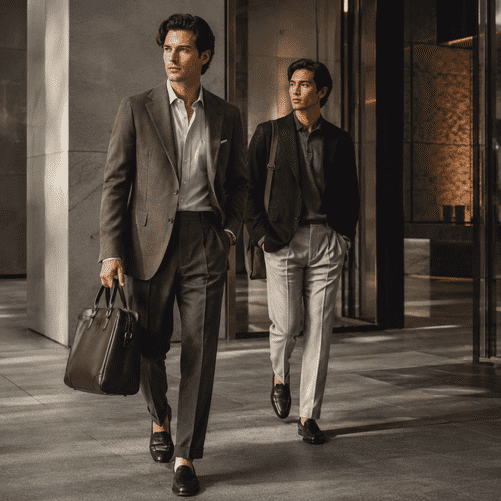
The emerging look is softer, more versatile and considerably less rigid than the office uniform of previous generations. Blazers are increasingly paired with relaxed trousers, denim or knitwear. Loafers and refined sneakers coexist with formal shoes. Shirts are worn open-necked, while lightweight jackets and unstructured tailoring allow consumers to appear dressed without looking conventionally corporate.
In menswear especially, the distinction between office clothing and leisurewear is becoming increasingly blurred. The modern wardrobe is being built around pieces that can work across multiple environments rather than clothing reserved specifically for formal occasions.
That shift plays directly into Ralph Lauren’s long-established aesthetic.
The company has spent decades selling an idealised version of American dressing in which tailoring, Oxford shirts, polo shirts, knitwear, denim and equestrian influences exist within the same wardrobe. In an era when consumers are seeking clothes that feel elevated but not excessively formal, that formula has become unusually relevant again.
The company’s latest results indicate that the strategy is resonating beyond the United States. Asia was Ralph Lauren’s fastest-growing major region during the latest quarter, with comparable sales rising sharply and China recording growth of more than 40%, according to Reuters.
The performance is particularly notable because it comes while much of the global luxury industry continues to struggle with hesitant consumers and slower demand.
LVMH, the world’s largest luxury group, reported only 1% organic growth in its Fashion and Leather Goods division during the second quarter, despite improving sales in the United States. Its Watches and Jewellery division expanded much faster, at 11%, highlighting how uneven the recovery remains across luxury categories.
Ralph Lauren occupies a different position. It offers expensive luxury products, but also maintains a broader price architecture than houses such as Louis Vuitton, Dior or Hermès. That allows customers to enter the brand through relatively attainable products while still associating it with an aspirational lifestyle.
This idea of accessible or inclusive luxury is becoming increasingly relevant as consumers grow more selective about spending.
Rather than buying large volumes of inexpensive fashion, some shoppers are concentrating their budgets on fewer pieces that appear durable, recognisable and capable of being worn repeatedly. A good blazer, leather bag, loafer or coat can therefore compete not only on aesthetics but on perceived longevity.
Coach is benefiting from a similar phenomenon.
The American leather-goods label has undergone one of the fashion sector’s most notable recent revivals, attracting younger consumers through products that combine recognisable design with prices significantly below those of the largest European luxury houses.
Coach sales rose about 14% in Tapestry’s latest quarter, according to Reuters, even as sister brand Kate Spade declined 7%. The company has credited successful products, focused marketing and continued appeal among younger customers for maintaining momentum.
The contrast is revealing.
Gen Z consumers are often portrayed as rejecting traditional luxury, but recent evidence suggests something more complicated. Younger customers may still want premium products, yet they are increasingly questioning whether a famous name alone justifies a very high price.
Brands sitting between mass-market fashion and ultra-luxury may consequently have an opportunity.
A well-made leather bag costing hundreds rather than several thousand dollars can still function as a status object while feeling financially defensible. Likewise, a tailored jacket or premium knit can communicate sophistication without depending heavily on visible logos.
This creates a fashion environment in which value does not necessarily mean cheapness.
Instead, value increasingly means convincing the customer that an item deserves to remain in a wardrobe.
Ralph Lauren has reinforced this positioning by reducing reliance on discounts and elevating its product presentation. Its long-running turnaround has involved closing weaker distribution channels, investing more heavily in brand marketing and moving consumers toward higher-value products.
That strategy is now intersecting with a cultural change.
The return to offices has undoubtedly increased demand for clothing that appears professional, but the revival of dressed-up style extends beyond employment. Restaurants, hotels, travel and social occasions are also seeing consumers embrace a more considered appearance after years in which comfort frequently dominated fashion choices.
The new trend does not necessarily mean ties and three-piece suits are about to become everyday uniform again.
Instead, fashion is moving toward what might be described as intentional dressing: clothes that look chosen rather than merely convenient.
A double-breasted blazer over a T-shirt, pleated trousers with loafers, a suede jacket over knitwear or a structured leather handbag can signal effort without appearing ceremonial.
That distinction is important for younger consumers, many of whom never experienced the traditional corporate dress codes that governed previous generations.
For them, tailoring can feel less like conformity and more like novelty.
Recent runway collections have reinforced the direction. Autumn/Winter 2026 fashion has featured slimmer menswear silhouettes, refreshed tuxedo shapes and renewed emphasis on classic wardrobe components, while designers have experimented with traditional codes rather than simply discarding them.
Prada’s Spring/Summer 2027 menswear collection similarly focused on what designers Miuccia Prada and Raf Simons described as a search for clarity, using pared-back denim, leather jackets, slim trousers and lightweight shirting rather than elaborate statement dressing.
The broader implication is that fashion may be entering a period in which the fundamentals of the wardrobe matter again.
For much of the past decade, luxury depended heavily on novelty: limited releases, collaborations, oversized logos, sneaker drops and rapidly rotating visual codes designed to stimulate frequent purchases.
Economic uncertainty makes that model harder to sustain.
Consumers who feel less financially secure are more likely to ask whether an expensive purchase will still look relevant several years later. Classic tailoring and established leather designs can answer that question more convincingly than highly seasonal products.
The revival also gives heritage brands an advantage.
Companies such as Ralph Lauren possess decades of archival imagery demonstrating that their core styles can survive changing fashion cycles. A blazer, cable-knit sweater, trench coat or leather bag can be presented not as a new invention but as an object whose relevance has already been tested over time.
That credibility is difficult for younger labels to manufacture.
Yet heritage alone is not enough. Brands must still translate traditional codes into silhouettes that feel contemporary rather than nostalgic.
This is why the most successful version of the current trend does not recreate the office wardrobe of the 1980s or 1990s. It borrows its sense of structure while removing much of its rigidity.
The result is wider in cultural reach: tailoring without corporate conformity, luxury without necessarily entering the highest price tier, and formal dressing without abandoning comfort.
The commercial consequences could be significant.
If younger shoppers continue shifting away from disposable wardrobes and toward fewer, better products, brands positioned around timelessness, craftsmanship and recognisable identity may gain ground. The fashion industry’s winners may therefore be those capable of convincing consumers that dressing well is not merely another short-lived trend.
Ralph Lauren’s recent growth offers an early indication that this argument is working. Coach’s continued strength among younger customers suggests it is not limited to apparel.
Together, the two brands point toward an emerging luxury formula: aspirational but attainable, polished but wearable, fashionable without being entirely dependent on fashion.
After years in which casual clothing appeared to have permanently rewritten the rules of everyday dress, the pendulum is moving again.
The suit may not be returning in its old form. But the desire to look dressed — deliberately, distinctively and with a sense of permanence — is becoming fashionable once more.