Two people have died on the Greek island of Salamis while Belgium battles the largest wildfire in its recorded history, forcing hundreds to evacuate as international aircraft and emergency crews join efforts to contain the flames.

Europe’s escalating summer wildfire crisis has claimed two more lives in Greece while forcing an unprecedented emergency response in Belgium, where thousands of hectares of protected landscape have burned close to the German border.
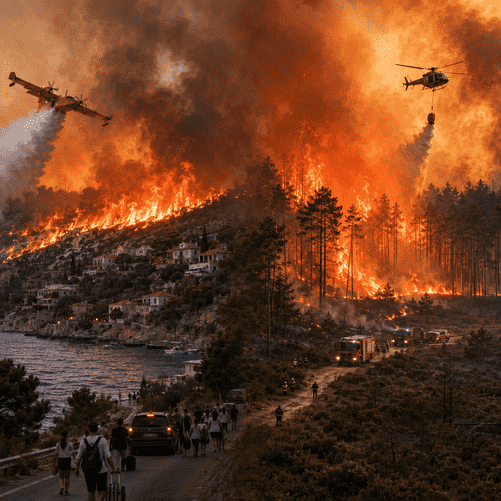
On the Greek island of Salamis, west of Athens, an elderly couple died after a fast-moving wildfire swept through coastal communities on Sunday, August 16. Several other people were injured as flames, driven initially by strong winds, threatened residential areas during one of Greece’s busiest holiday weekends of the summer.
More than 500 people were evacuated as Greek firefighters, coast guard vessels and aircraft mobilised to protect residents and holidaymakers. Around 192 firefighters were involved in the operation, supported by helicopters, firefighting aircraft, volunteers and municipal water tankers. Five people were taken to local health facilities, while authorities prepared for possible additional evacuations by sea if conditions deteriorated.
The two victims were reported to have died near their home in the Peristeria beach area as the blaze advanced through the island. By later in the day, declining wind speeds were helping emergency crews contain parts of the fire, although the cause of the outbreak had not been established. Salamis had already been placed under a high wildfire-risk warning as extreme summer conditions continued across Greece.
Hundreds of kilometres to the north-west, Belgium was simultaneously confronting a wildfire on a scale rarely experienced in the country.
The blaze in the High Fens nature reserve in eastern Belgium had burned approximately 3,000 hectares by Sunday and was moving towards the German frontier. Belgian authorities described it as the largest wildfire on record in the country, exceeding the approximately 1,400 hectares destroyed during the previous record fire in 2011.
About 600 residents and tourists in communities including Waimes and Bütgenbach in Liège province were ordered to evacuate as shifting winds carried heavy smoke through the region. Authorities opened emergency accommodation for displaced residents, while German officials across the border also warned communities about potentially dangerous smoke conditions.
The firefighting operation has rapidly become an international effort. More than 250 emergency personnel have been deployed, with German firefighters assisting Belgian teams and aerial support arriving from neighbouring European countries. Belgium also activated the European Union’s civil protection mechanisms, prompting the deployment of three helicopters and two water-bombing aircraft following Brussels’ request for additional assistance.
Dutch helicopters have been among the aircraft supporting operations, while the Belgian military, local farmers and personnel from neighbouring Luxembourg have also contributed to efforts to control the fire. Crews have faced particularly difficult terrain inside the High Fens, where forests, heathland and peat bogs can allow fires to persist underground and re-emerge even after surface flames appear to have been extinguished.
A defensive line established to protect evacuated Belgian villages was still holding on Sunday, according to local officials. No homes had been reported destroyed in the threatened communities, but residents had not yet been permitted to return because of continuing fire and smoke risks. Authorities were concentrating resources on the eastern edge of the blaze as it advanced in the direction of Germany.
Across the border, officials in the German town of Monschau advised some residents near Belgium to leave because of heavy smoke, although authorities said they did not expect the flames themselves to cross into German territory.
The simultaneous emergencies in Greece and Belgium form part of a wider pattern of severe fires affecting Europe during a summer marked by prolonged heat and exceptionally dry vegetation. Wildfires and evacuations have also been reported in countries including Spain, France, Germany and Croatia, putting national firefighting services under sustained pressure.
The Belgian emergency is particularly notable because large-scale wildfires have historically been less common there than in Mediterranean countries such as Greece, Spain or Portugal. The destruction of several thousand hectares in the High Fens therefore illustrates how wildfire exposure is increasingly extending beyond Europe’s traditionally vulnerable southern regions.
Officials and climate researchers have repeatedly warned that hotter temperatures and prolonged drought can create conditions in which vegetation dries more rapidly, allowing fires to ignite more easily and spread with greater intensity. Belgian authorities have also warned that fires of the magnitude now being experienced could become more frequent as climate conditions change.
For Greece, however, the danger is already deeply familiar. The country has repeatedly faced destructive summer wildfire seasons in recent years, requiring extensive use of aircraft, military resources and international firefighting assistance. The Salamis fire is particularly significant because of the island’s proximity to Athens and its popularity among residents seeking to escape the capital during the August holiday period.
Sunday’s two fatalities underscore how quickly such fires can become lethal. Strong winds can transform relatively contained outbreaks into fast-moving fronts within minutes, while congested coastal communities and seasonal tourism can complicate evacuation operations.
Belgium’s High Fens emergency presents a different but equally significant challenge. A country with comparatively limited experience of fires on this scale is now coordinating hundreds of emergency personnel, military assets and multinational aerial resources to defend communities and one of its most important natural areas.
Together, the two crises offer a stark picture of Europe’s changing wildfire landscape. From Mediterranean islands accustomed to summer fires to the peatlands and forests of northern Europe, increasingly severe heat and drought are expanding both the geographical reach and operational complexity of the threat.
As aircraft continue to circle above Salamis and the High Fens, European emergency services are confronting a reality that is becoming increasingly difficult to regard as exceptional: major wildfires are no longer confined to the continent’s traditional fire zones, and the resources required to fight them are becoming progressively more international.