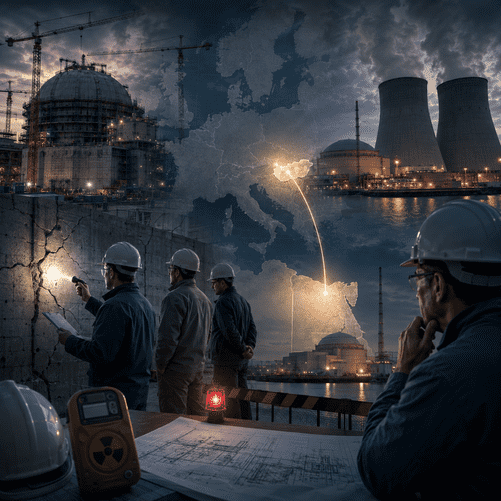
Confidential documents reportedly identify serious construction defects and failures in nuclear safety culture at Egypt’s El Dabaa project, intensifying scrutiny of the Russian state-owned company as it deploys the same VVER-1200 reactor technology in the European Union.

Russia’s state-owned nuclear corporation Rosatom is facing renewed scrutiny over its international operations after confidential documents reportedly revealed construction deficiencies, safety-management failures and allegations of “deliberate negligence” at the El Dabaa nuclear power plant it is building in Egypt — findings that could carry significant implications for a parallel project inside the European Union.
The allegations concern Egypt’s flagship El Dabaa facility, where Rosatom is constructing four VVER-1200 reactors on the Mediterranean coast. The same reactor technology has been selected for Hungary’s controversial Paks II nuclear expansion, making the reported problems in Egypt particularly sensitive for European regulators and policymakers.
According to documents reported by Politico Europe and subsequently detailed by Agenzia Nova, Egypt’s Nuclear Power Plants Authority raised a series of concerns in a letter dated June 4. The authority reportedly identified “serious defects” in concrete structures across several units, breaches of what it described as nuclear safety culture and, in one instance, “deliberate negligence.”
Among the problems cited were voids behind metal cladding at Unit 4, defects affecting foundations at Units 1, 2 and 3 and concerns relating to the wall structure of a reactor building. Egyptian officials were also reported to have accused the contractor of using misleading practices to present construction progress as more advanced than it actually was.
The allegations are especially significant because nuclear construction depends on exceptionally strict quality-control procedures. Concrete structures, containment systems and reactor foundations are designed to remain functional under extreme conditions for decades, meaning that defects discovered during construction can require extensive investigation, remediation and regulatory approval before subsequent stages can proceed.
Additional internal Rosatom documents reviewed by Politico reportedly pointed to delays, construction-quality concerns and shortcomings in project management. A draft audit concerning the 2025 programme was said to have warned that the first El Dabaa unit could face a delay of as much as 18 months, potentially shifting its schedule to March 2030.
Rosatom has rejected the allegations. The company said it operates according to the highest nuclear-safety standards and argued that the claims had not been substantiated through the contractual, technical and supervisory mechanisms governing the Egyptian project. The company has continued to report progress at El Dabaa, announcing as recently as August 12 that another stage of concreting had been completed on the inner containment structure of Unit 1.
The dispute nevertheless has consequences that extend far beyond Egypt.
Rosatom is responsible for Hungary’s Paks II project, under which two VVER-1200 reactors are being constructed alongside the country’s existing Paks nuclear station. Hungary’s nuclear regulator has already issued permits allowing important preparatory work to advance, including soil stabilisation associated with the nuclear island.
That technological link means that any verified deficiencies involving engineering procedures, construction supervision or quality control at El Dabaa could attract attention from European authorities assessing Rosatom’s operations within the EU.
Former Hungarian Green MEP Benedek Jávor said the Egyptian information would likely be considered in evaluations of the Paks project, according to the reporting. The European Commission, meanwhile, said it had not been aware of the documents but stressed that nuclear safety remains a fundamental priority for the EU.
The controversy arrives at an already politically sensitive moment for Paks II.
The project has long generated debate because of Hungary’s continuing nuclear partnership with Moscow despite the deterioration of relations between Russia and most EU governments following the invasion of Ukraine. It has also faced legal challenges over procurement and state support. In September 2025, the European Union’s top court rejected an earlier European Commission decision approving Hungarian state aid for the Russian-built expansion, questioning whether EU procurement rules had been properly respected when the contract was awarded without an open tender.
For Hungary, however, nuclear power remains central to its long-term energy strategy. The existing Paks facility provides a major proportion of the country’s electricity, while the planned reactors are intended eventually to replace ageing capacity and reduce dependence on imported energy.
Recent events have simultaneously demonstrated the vulnerability of European nuclear infrastructure to environmental pressures. Exceptionally low water levels on the Danube this summer forced Hungary’s existing Paks station to sharply reduce and ultimately halt generation because insufficient river water was available for reactor cooling.
The new controversy therefore brings together several of Europe’s most difficult energy questions: nuclear safety, energy security, dependence on Russian technology and the enormous engineering challenge of expanding nuclear generation while existing infrastructure faces increasingly severe environmental stresses.
There is currently no evidence that the reported construction problems at El Dabaa automatically imply similar defects at Paks II. Nuclear plants are subject to country-specific licensing regimes, construction supervision and regulatory inspections, and the Hungarian project remains under the authority of Hungary’s nuclear regulator.
Nevertheless, the similarity of the reactor technology makes developments in Egypt difficult for European authorities to ignore. If the allegations are independently substantiated, regulators are likely to examine whether they reflect isolated construction problems at one site or reveal weaknesses in project management and quality-control practices that could potentially appear elsewhere.
For Rosatom, the stakes are substantial. The company is not merely Russia’s domestic nuclear operator but one of the world’s largest exporters of civilian nuclear technology, with projects spanning Europe, Asia, Africa and the Middle East. Its international reputation depends heavily on its ability to demonstrate that Russian-designed plants meet stringent engineering and safety standards regardless of where they are constructed.
For the European Union, the issue is even broader. Paks II represents one of the most visible remaining areas of strategic cooperation between an EU member state and the Russian state industrial complex.
The allegations emerging from Egypt therefore transform what might otherwise have remained a construction-management dispute into a European energy-security question. Until investigators and regulators establish the seriousness and extent of the reported defects, the accusations remain contested.
But they are likely to ensure that every major stage of Rosatom’s work in Hungary is subjected to even greater scrutiny — because in the nuclear industry, questions about construction quality are ultimately questions about safety measured not in years, but in generations.