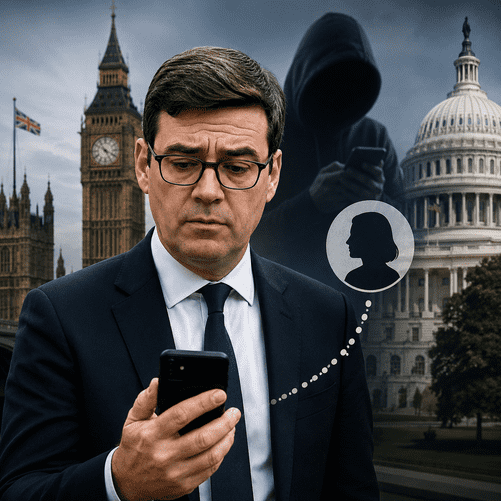
The British prime minister says no meaningful information was disclosed after he exchanged messages with someone posing as Donald Trump’s chief of staff, an episode that has renewed concern over the growing sophistication of political impersonation and digital deception.

British Prime Minister Andy Burnham has rejected suggestions that he should be embarrassed after exchanging messages with an individual impersonating one of Donald Trump’s most senior White House officials, insisting that the contact was brief, insignificant and reported as soon as suspicions emerged.
Speaking to reporters on Tuesday, August 18, Burnham confirmed that he had communicated with someone he initially believed to be White House chief of staff Susie Wiles. Asked directly whether he was embarrassed by having been drawn into the exchange, the prime minister replied that he was not, arguing that he had responded appropriately once doubts emerged about the identity of the person contacting him.
Burnham said there had been only a “minimal exchange” and that nothing consequential had been discussed. He added that he quickly concluded the communication needed to be reported and referred the matter to the appropriate authorities. The episode was first reported publicly on Monday, prompting questions about how an individual posing as one of Washington’s most powerful political figures was able to establish direct communication with the British leader.
The precise contents of the messages have not been disclosed. Downing Street initially declined to discuss the episode in detail on national-security grounds, while reports indicated that the British embassy in Washington alerted the White House after concerns arose over the contact.
According to reports, Burnham became suspicious after several messages and ended the communication. The White House has said the latest incident did not result from Wiles’s devices being compromised, distinguishing it from earlier attempts to impersonate the chief of staff that have already attracted the attention of US federal investigators.
The affair is embarrassing less for what appears to have been disclosed than for what it illustrates: senior political leaders have become attractive targets for increasingly sophisticated forms of digital impersonation, in which attackers attempt to exploit personal relationships, informal communications and the expectation that high-ranking officials may contact one another outside conventional diplomatic channels.
That risk has become particularly significant as artificial-intelligence tools make it easier to reproduce voices, writing styles and other characteristics associated with public figures.
The FBI investigated previous attempts to impersonate Wiles after lawmakers, governors and business executives received calls and messages purporting to come from her. Some recipients reportedly received requests for information or money, while questions were also raised over whether artificial intelligence had been used to imitate her voice. The US State Department separately warned diplomats about attempts to impersonate senior officials, including Secretary of State Marco Rubio.
For governments, such attacks present an unusual security challenge. Traditional cyber-defence concentrates heavily on protecting computer systems, classified networks and official devices. Impersonation schemes instead attack the human layer of government communications, attempting to persuade an official that the person at the other end of a conversation is a trusted political colleague or diplomatic contact.
Burnham’s case also arrives during a sensitive period in relations between London and Washington. He became prime minister in July and has been working to establish his own relationship with Trump after succeeding Keir Starmer. Trump said shortly after Burnham entered Downing Street that the two had held a “very good conversation,” while Burnham has publicly said he would be prepared to disagree with the American president whenever British interests required it.
The impersonation incident therefore carried potential diplomatic implications despite the apparent absence of substantive information in the exchange. Communications apparently originating from the White House chief of staff could, under different circumstances, involve discussions ranging from foreign policy and defence to trade negotiations or presidential visits.
Burnham has sought to portray the episode as evidence that existing safeguards worked rather than failed. His argument rests on the speed with which the communication was questioned and reported, and on his assertion that no significant information changed hands.
Nevertheless, the case has contributed to broader questions about the digital exposure of Britain’s political leadership. The Guardian reported this week that personal telephone numbers belonging to at least three cabinet ministers had been available online, adding another dimension to concerns over how easily malicious actors may be able to identify and approach senior officials.
Such information is not necessarily classified, but access to personal contact details can make so-called social-engineering attacks significantly easier. An attacker does not need to penetrate a government network if a convincing message sent to a politician’s personal device is enough to establish trust.
The danger becomes greater when senior officials routinely communicate through messaging applications and mobile phones, environments where the distinction between personal, political and official conversations can become blurred. A convincing impersonator may only need several exchanges to gather contextual information, establish credibility or encourage a target to move a conversation towards more sensitive subjects.
There is no indication that happened in Burnham’s case. The information currently available points instead to a brief contact that was identified as suspicious before anything significant was disclosed.
Yet the wider lesson extends beyond the prime minister’s individual handling of the messages. The incident demonstrates how the security perimeter surrounding national leaders increasingly includes not only encrypted government systems and intelligence protocols, but also something much harder to defend: the authenticity of ordinary digital communication.
For Burnham, the political argument is straightforward — he believes he recognised the threat, reported it and protected sensitive information. For security officials in London and Washington, however, the more difficult question is how many future impersonation attempts will be convincing enough that their targets do not.