Frasers Group has increased its stake in Hugo Boss to almost 48%, bringing Mike Ashley closer to effective influence over one of Europe’s best-known fashion houses and illustrating how the luxury slowdown is beginning to redraw the industry’s ownership map.

One of the most aggressive investors in European retail has moved dramatically closer to the centre of the luxury-fashion industry.
Frasers Group, the British retail empire controlled by billionaire Mike Ashley, announced on Tuesday, August 18, that it had increased its ownership of Hugo Boss to nearly 48%, transforming what began several years ago as a strategic investment into a position approaching half of the German fashion company.
The development follows Frasers’ €38-per-share cash offer for Hugo Boss in June. Before the offer, the British group controlled just over 26% of the company. Hugo Boss subsequently urged shareholders to reject the nearly €2 billion approach, describing it as financially inadequate, but enough investors accepted the offer to push Frasers’ holding dramatically higher.
The result leaves Ashley tantalisingly close to majority ownership and gives Frasers considerable influence over the future direction of one of Germany’s most recognisable international fashion names.
For the luxury industry, however, the significance extends well beyond Hugo Boss.
Ashley’s advance illustrates how the prolonged slowdown in premium and luxury fashion is creating an environment in which established brands, retailers and department stores that once appeared prohibitively expensive are becoming potential acquisition targets.
Frasers’ expansion has been particularly rapid.
Only five days before announcing its increased Hugo Boss position, the company bought Harvey Nichols out of administration, taking control of the historic British luxury department-store business after years of losses. The acquisition included its principal UK stores, online operations, inventory and more than 1,000 employees. Frasers has already warned that restructuring could involve difficult decisions and a smaller operation before the business can return to sustainable growth.
The timing is striking.
Ashley built his reputation at the opposite end of the fashion spectrum through Sports Direct, where scale, price competition and aggressive retailing were central to the business model. Frasers is now attempting to establish a much larger position in luxury and premium fashion through businesses including Flannels, Mulberry investments, Harvey Nichols and Hugo Boss.
The group also recently accumulated a 4.2% stake in Burberry, another historic European fashion house that has been navigating the consequences of weaker global luxury demand.
Taken together, the investments suggest that Frasers sees weakness in the luxury market not simply as a crisis but as an opportunity.
A Very Different Luxury Market
Luxury fashion has undergone a remarkable change since the post-pandemic spending boom.
For several years, major houses were able to raise prices aggressively while consumers — particularly wealthy Chinese shoppers and aspirational customers in Europe and the United States — continued purchasing handbags, shoes and ready-to-wear collections.
That environment has become considerably more difficult.
The latest second-quarter figures show that the global luxury industry is growing again, but the recovery is highly uneven. Average organic sales growth across the sector reached around 7% in the second quarter of 2026, stronger than analysts had expected, yet much of the improvement was concentrated among particular geographic markets and product categories.
Jewellery is performing especially strongly, while conventional “soft luxury” — fashion, leather goods and accessories — remains more difficult.
Richemont’s jewellery maisons, which include Cartier and Van Cleef & Arpels, recorded a 24% increase in sales, while jewellery businesses at LVMH and Kering also delivered double-digit growth. By comparison, much of ready-to-wear and leather goods remains subdued.
The geographical picture is equally revealing.
American and South Korean consumers have emerged as important drivers of growth, while Chinese demand — once one of the principal engines of the international luxury business — remains comparatively weak. Industry analysts say growth is currently concentrated within a much narrower consumer base than before the pandemic.
That environment is particularly challenging for brands occupying the broad premium segment between mass-market fashion and ultra-exclusive luxury.
The wealthiest consumers continue buying products from houses such as Loro Piana and Brunello Cucinelli, while jewellery has benefited from its combination of exclusivity, emotional value and perceived permanence. Aspirational middle-class customers, by contrast, have become more resistant to sharply higher prices for handbags and clothing.
That distinction matters for Hugo Boss.
The German label occupies an unusually broad position in the market, spanning business tailoring, contemporary menswear, womenswear, casual clothing and accessories. It has modernised significantly in recent years, investing heavily in branding, digital marketing and celebrity partnerships while attempting to appeal to younger consumers.
Yet the wider market environment has become less forgiving. Hugo Boss has faced sluggish Chinese demand and difficulties in parts of its womenswear business, circumstances that have helped strengthen Frasers’ ability to press for greater influence.
Tailoring Is Changing Too
The takeover struggle also arrives at an interesting moment for menswear.
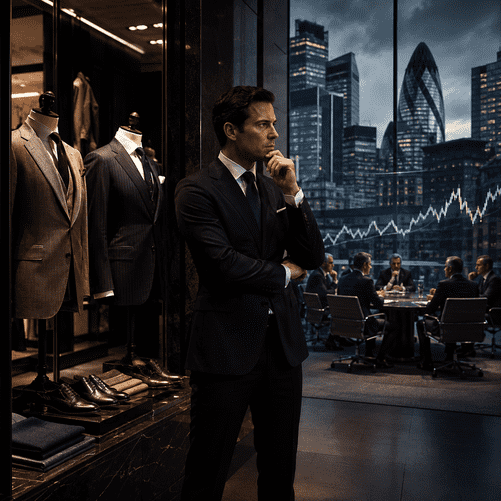
Traditional corporate dressing has never fully returned to its pre-pandemic form. The conventional dark business suit remains important, particularly in finance, law, politics and formal settings, but the wider menswear market has moved toward greater flexibility.
Relaxed tailoring, softer construction, wider trousers, knitted polos, suede footwear and combinations of tailored jackets with casual pieces increasingly occupy the space once dominated by rigid office uniforms.
For brands such as Boss, that shift creates both a challenge and an opportunity.
A company historically associated with sharply cut suits must preserve the authority and recognition of tailoring while convincing younger customers that the brand belongs within a modern wardrobe extending far beyond the office.
The contemporary male luxury consumer is increasingly buying a lifestyle rather than simply a suit.
That means outerwear, sneakers, knitwear, leather goods, fragrances, watches and elevated casualwear have become essential parts of the commercial equation. Fashion houses capable of translating their design identity across those categories can capture a much larger share of consumer spending.
The difficulty is doing so without losing the distinctive identity that made the brand desirable in the first place.
Luxury’s New Age of Consolidation
Frasers’ strategy suggests another potentially important trend: a new period of consolidation within fashion retail.
Luxury groups enjoyed years of extraordinary profitability when Chinese consumption expanded rapidly, international tourism flourished and repeated price increases protected margins.
A weaker market exposes a much wider difference between the strongest brands and everybody else.
Some companies possess enormous pricing power, extensive cash reserves and global distribution networks. Others face expensive store portfolios, declining foot traffic, large marketing costs and consumers who are increasingly selective about where they spend.
Those weaker businesses become attractive to investors prepared to restructure them.
Harvey Nichols is an obvious example. Established in 1831 and still possessing substantial brand recognition, it nevertheless entered administration after years of losses. Frasers acquired the business while making clear that nostalgia alone would not determine which stores or operations survived.
Hugo Boss is in a very different financial position, but the logic behind Frasers’ investment is related: acquire influence in recognisable fashion assets during a period when valuations and expectations are under pressure.
Hugo Boss itself has said it intends to continue implementing the strategy introduced in December 2025 and remains focused on sustainable growth through 2028. Supervisory board chairman Stephan Sturm has also described Frasers as the company’s single largest shareholder and indicated that Hugo Boss intends to maintain a constructive relationship with it.
For now, therefore, Frasers does not own Hugo Boss outright.
But controlling almost half of a listed fashion company is substantially different from being an ordinary institutional shareholder.
It gives Ashley and Frasers enormous strategic weight — and raises inevitable questions about whether the latest increase represents the destination or merely another stage in a longer attempt to obtain control.
A Bargain Hunter Enters Luxury
There is also an intriguing cultural tension surrounding Frasers’ ambitions.
Luxury depends on scarcity, controlled distribution, meticulous presentation and the deliberate avoidance of excessive discounting. Ashley’s business career, by contrast, was built largely around mass retailing, aggressive negotiation and extracting value from businesses under pressure.
Reconciling those cultures may become one of the central tests of Frasers’ luxury strategy.
Luxury brands do not behave like conventional retailers. Selling more units is not always the objective. Excessive availability can damage desirability, while discounting can undermine a brand for years.
The most successful houses carefully regulate distribution, store environments, pricing and customer access precisely because perceived scarcity is part of what consumers are purchasing.
Frasers therefore faces a complicated task: applying financial discipline and retail scale without stripping luxury businesses of the exclusivity that makes them valuable.
Its rapidly expanding portfolio means the fashion industry will be watching closely.
The Bigger Shift
Ashley’s advance on Hugo Boss ultimately captures something broader about luxury in 2026.
The industry is no longer experiencing the uniform boom that allowed almost every major fashion house to benefit from rising prices and seemingly inexhaustible international demand.
Instead, luxury is becoming increasingly polarised.
Jewellery is booming. Ultra-high-end brands remain resilient. American and South Korean wealth is generating new spending. China is no longer delivering the growth once taken for granted. Middle-class consumers are questioning prices. Fashion houses are cutting costs and closing stores while simultaneously spending heavily on new creative directors and marketing campaigns.
In that environment, ownership itself becomes part of fashion’s transformation.
Weakness creates openings for investors with capital, patience and an appetite for restructuring. Brands with enormous cultural recognition but less impressive financial momentum become particularly tempting.
Frasers’ near-48% stake in Hugo Boss is therefore more than another corporate transaction.
It is a sign of a luxury industry entering a new phase — one in which prestige alone may no longer protect a fashion house from shareholder pressure, consolidation or takeover.
The irony is difficult to miss.
Mike Ashley made his fortune selling sportswear to the mass market. He is now assembling the foundations of an increasingly powerful luxury-fashion empire.
And if the present downturn continues to produce distressed retailers and undervalued fashion brands, Hugo Boss may not be the last famous name to find that the bargain hunters have arrived on luxury’s doorstep.