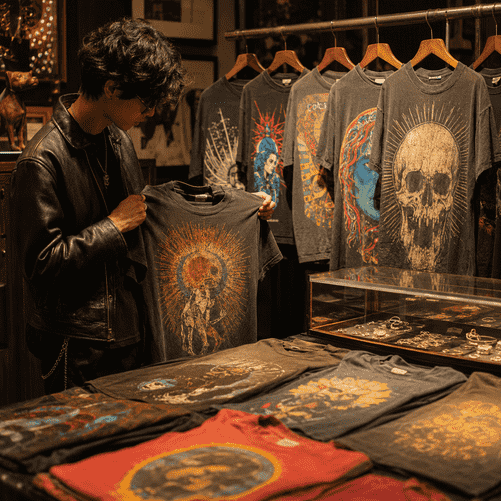
Faded band shirts, cracked graphics and threadbare cotton are commanding extraordinary prices as collectors and fashion buyers seek something modern clothing struggles to manufacture: genuine history.

The old T-shirt buried at the bottom of a wardrobe may no longer belong in the donation pile. Across the rapidly expanding market for vintage fashion, decades-old graphic tees once regarded as disposable clothing are being transformed into increasingly valuable collectibles, with exceptional examples selling for hundreds, thousands and occasionally tens of thousands of dollars.
At New York’s ThriftCon and across specialist vintage stores, auction platforms and online resale marketplaces, buyers are hunting for original shirts connected to music, television, film, sports and other fragments of popular culture. The most desirable pieces are often precisely those that would once have appeared least valuable: faded, stretched, cracked, sun-bleached or visibly repaired.
Condition, traditionally one of the foundations of collectible value, is being reconsidered. In parts of the vintage T-shirt market, wear is not necessarily damage. It can function as evidence.
A shirt softened by decades of washing, with a graphic beginning to fracture and a collar losing its original shape, communicates something a newly manufactured “vintage-inspired” garment cannot easily reproduce: it was actually there. Vogue has identified the same shift more broadly in fashion this summer, with deliberately unpolished, genuinely threadbare T-shirts becoming desirable because their imperfections convey history and individuality.
That appetite for authenticity is producing remarkable prices.
A rare 1967 Grateful Dead T-shirt has sold for more than $17,600, while an original Nirvana tour shirt has reportedly reached $55,000. Even pieces lacking official licensing can attract extraordinary attention. A vintage bootleg Lauryn Hill shirt, for example, sold through luxury resale dealer Justin Reed for about $4,500.
Such sales have pushed the humble graphic tee into a curious space between clothing, memorabilia and cultural artifact.
The transformation reflects a wider change in the way fashion is being valued. For decades, the industry was organised around newness: the latest collection, the latest silhouette, the latest designer collaboration. Vintage culture reverses that logic. Age itself can become desirable, particularly when a garment can be traced to a specific concert, tour, television series, cultural movement or moment in popular history.
For collectors, provenance can therefore matter as much as the logo printed across the chest.
A genuine concert shirt purchased during a particular tour may be worth considerably more than a later reproduction carrying an identical image. Certain printing techniques, fabric blends, copyright markings, neck tags and stitching methods can help specialists determine when and where a garment was produced.
The result is an increasingly sophisticated collecting culture resembling those surrounding watches, sneakers, vinyl records or trading cards.
Yet vintage T-shirts remain unusual because they can still be worn.
That combination of financial value and personal expression is helping fuel their appeal. A rare graphic tee can serve simultaneously as clothing, cultural knowledge and a subtle declaration of identity. Wearing an obscure 1990s band shirt or an original television promotional tee can say more about someone’s interests than a conventional luxury logo.
The fashion industry’s current emphasis on individuality has amplified that appeal.
After years dominated by carefully coordinated minimalism and social-media aesthetics that could make wardrobes across different countries appear remarkably similar, visibly aged clothing offers something harder to replicate. The stains, fading and repairs are rarely identical from one garment to another.
In that sense, imperfection has become a form of exclusivity.
Celebrity dressing has accelerated the shift. Janet Jackson, Miley Cyrus and Zendaya are among prominent figures recently seen wearing vintage graphic tees, helping move the category from specialist collecting circles into mainstream fashion culture.
The phenomenon also fits a much broader resurgence of nostalgic dressing. Ringer T-shirts, another style closely associated with earlier decades, have returned across brands ranging from Levi’s and Marks & Spencer to Ganni, Coach and Versace, reflecting renewed consumer interest in garments connected to memories of earlier music, sport and youth culture.
But nostalgia alone does not explain why certain shirts reach four- or five-figure prices.
Scarcity matters enormously.
Many graphic T-shirts produced for concerts, promotional campaigns or short-lived cultural events were never designed to survive for decades. They were worn heavily, discarded or eventually turned into cleaning cloths. As a result, surviving examples of some designs can be exceptionally scarce.
Paradoxically, the ordinary nature of the original product helped create its future rarity.
Unlike luxury handbags or watches, which buyers may preserve carefully from the beginning, T-shirts were meant to be consumed. Few owners in 1992 imagined that a tour shirt bought outside a concert venue might someday be treated like collectible memorabilia.
This has created a market where seemingly insignificant details can radically affect value.
An original tag can help establish age. Single-stitch construction may indicate a particular production period. A specific variation of a band graphic may have been manufactured only briefly. Even printing errors and unofficial bootlegs can sometimes increase desirability because they make a garment more unusual.
Collectors increasingly approach these distinctions with the same scrutiny traditionally applied to fine watches or rare sneakers.
The rise of archival fashion more broadly is encouraging that mindset. Auction houses and younger collectors are showing greater interest in historically significant clothing, while certain buyers increasingly view rare garments not merely as wardrobe pieces but as alternative collectibles capable of retaining or appreciating in value.
That does not mean every old T-shirt is suddenly an investment.
The market remains highly selective, and speculative enthusiasm can produce inflated prices. Some vintage-market observers have already warned that sections of the graphic-tee trade became overheated following rapid growth in recent years, with resale prices for certain heavily traded designs showing signs of correction.
Authenticity is another growing concern.
As values rise, reproductions and artificially aged garments become increasingly difficult for inexperienced buyers to distinguish from genuine vintage pieces. Modern manufacturers can reproduce faded graphics, distressed collars and washed cotton with remarkable accuracy, making knowledge of labels, stitching and production history more important.
For serious collectors, that expertise is becoming part of the appeal.
The vintage T-shirt market ultimately depends on something more emotional than conventional luxury.
A Rolex communicates craftsmanship. A Hermès bag communicates rarity and prestige. But a battered concert tee can communicate memory: the music someone listened to as a teenager, the television series that defined a decade, the sports team associated with a childhood city or a cultural moment that disappeared long ago.
The garment becomes valuable because its physical deterioration proves that time has passed.
That helps explain one of the more unexpected contradictions in contemporary fashion: while brands spend enormous sums engineering flawless products, some consumers are paying premiums for clothes that visibly carry the marks of previous lives.
The rattier the shirt, in some cases, the more convincing the story.
So before throwing away that faded Nirvana, Grateful Dead, Metallica or obscure 1990s promotional tee, it may be worth examining the tag, the stitching and the date printed beneath the graphic.
Fashion’s next valuable collectible may already be hanging in the back of the closet.