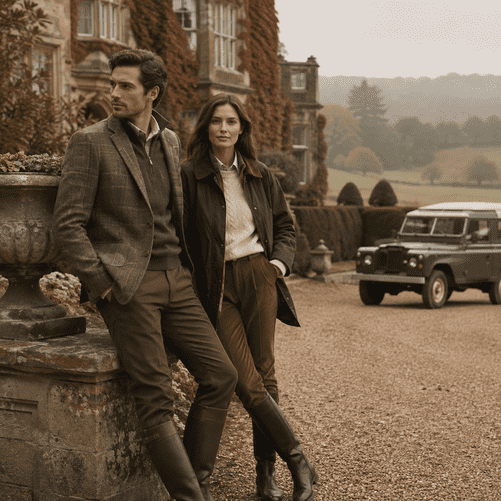
Waxed jackets, tweed tailoring, riding boots and heritage checks are moving back into the fashion mainstream, as luxury brands embrace the English countryside and consumers turn toward clothing built around craftsmanship, longevity and understated wealth.

Fashion’s latest status symbol may not be a new handbag or a conspicuous logo, but a weathered waxed jacket, a pair of polished riding boots and a tweed coat that looks as though it has already survived several winters in the countryside.
Across luxury fashion and mainstream retail, country-house style is making a pronounced return in 2026, reviving an aesthetic built around British estates, rural practicality and inherited-looking clothes rather than overt displays of wealth.
The trend has been visible for months, but it is accelerating as autumn approaches.
Heritage patterns including tweed, plaid, houndstooth and argyle are returning strongly for the coming season, accompanied by belted jackets, structured coats and more defined silhouettes. Vintage-fashion specialists have identified classic prints and tailored outerwear among the key revival trends for autumn 2026.
At the same time, waxed and barn-style jackets — once associated primarily with farmers, equestrians and country estates — are appearing across fashion collections at almost every price level. Even affordable autumn ranges are now featuring wax-effect barn jackets, argyle knits and practical outerwear directly influenced by traditional rural clothing.
The change is being driven from the top of the market as well.
Few brands illustrate the movement more clearly than Burberry, which has made the British countryside central to its current identity. Its recent “Escape to the Countryside” campaign follows a group of young friends leaving the city for rural England before arriving at Deene Park, a historic country estate in Northamptonshire. Burberry says the campaign draws directly on its outdoor heritage and archival imagery.
That choice of setting is significant.
For several years, luxury fashion was dominated by urban imagery, streetwear, sneakers and highly visible branding. Now, designers are increasingly drawing inspiration from a different visual vocabulary: gravel drives, manor houses, muddy fields, shooting jackets, equestrian references and clothes designed to improve rather than deteriorate with age.
It is a form of luxury that looks less newly purchased.
And that may be precisely the point.
The English country-house aesthetic traditionally depends on garments that appear worn-in rather than pristine: waxed cotton softened by years of use, leather boots with visible creases, heavy wool jackets, old cashmere and scarves that look inherited rather than recently acquired.
In fashion terms, this creates an impression of understatement and permanence.
The return of the Barbour jacket is perhaps the clearest example.
British Vogue noted this summer how Barbour has moved far beyond its original association with rural Britain, becoming a fashion staple worn by royals, musicians and younger style-conscious consumers. Its classic waxed jackets now operate simultaneously as practical outdoor clothing and as symbols of a recognisable British aesthetic.
The appeal lies partly in authenticity.
Unlike many luxury products designed to imitate heritage, brands such as Barbour genuinely emerged from functional outdoor clothing. Jackets were built to withstand rain, mud and wind rather than simply to evoke them.
That history has become increasingly valuable at a time when consumers are questioning the durability and meaning of expensive fashion.
The same logic is helping revive tweed.
Once closely associated with conservative country dressing, tweed has returned in lighter and more contemporary forms. Its attraction in 2026 is connected to a broader movement toward natural fibres, craftsmanship and clothing intended to last for years rather than seasons.
The fabric also fits neatly into fashion’s renewed fascination with the countryside.
A tweed blazer can suggest a Scottish estate, an old university, a London club or a country weekend depending on how it is styled. Designers are increasingly using that versatility to remove the fabric from its traditional context.
Instead of pairing tweed with matching skirts or formal country clothing, modern styling combines it with denim, loafers, knitwear or even relaxed trousers.
The result is less costume and more reinterpretation.
The trend has also revived interest in the Sloane Ranger, the archetype associated with affluent young Britons in the 1980s.
The original Sloane wardrobe revolved around Barbour jackets, pearls, silk scarves, tweed, loafers and conservative knitwear. The look was closely associated with the King’s Road, country weekends and Britain’s upper classes.
In 2026, those codes are returning in a more relaxed form. London’s Standard has pointed to renewed interest in tweed, Barbours and traditional blouses, suggesting that what once appeared deeply unfashionable has become unexpectedly desirable again.
This revival is not entirely British.
French fashion is also embracing rural imagery.
For Spring-Summer 2026, Jacquemus presented “Le Paysan,” a collection inspired by designer Simon Porte Jacquemus’s rural upbringing in southern France. Staged at the Orangerie of Versailles, the collection celebrated agricultural life, family heritage and humble garments reinterpreted through luxury fashion.
The message was similar: rural life no longer represents fashion’s opposite.
It has become fashion material.
The countryside is being reframed as a source of authenticity, craftsmanship and emotional connection — qualities increasingly valuable in an industry saturated with digital imagery and rapidly generated trends.
That cultural shift extends beyond clothes.
Country-house interiors are also enjoying renewed popularity, creating a broader lifestyle aesthetic in which fashion, travel and home design reinforce one another.
The modern interpretation is less about heavily decorated aristocratic rooms and more about warm natural materials, antique furniture, handcrafted objects and interiors that appear collected gradually over time. Designers have described “Modern English Country” as one of the defining premium British interior aesthetics of 2026.
Fashion is responding to the same desire.
Consumers appear increasingly interested in objects that suggest history rather than novelty.
That helps explain why waxed jackets, old-looking leather, handwoven wool and heritage checks feel contemporary again.
There is also an economic dimension.
After years of aggressive luxury price increases, conspicuous consumption has lost some of its appeal. Clothing that communicates wealth more discreetly — through material, fit and provenance rather than obvious branding — fits the continuing evolution of so-called quiet luxury.
Country dressing represents a particularly convincing version of that idea.
A beautifully cut tweed coat or well-made field jacket does not necessarily advertise its price.
Instead, its value is communicated through fabric, construction and familiarity with a particular set of cultural codes.
Burberry has already demonstrated the commercial potential of this approach.
The company has leaned heavily into its British heritage under chief executive Joshua Schulman, and its Cotswolds handbag line has reportedly performed particularly well among American consumers. The success coincides with growing U.S. fascination with the English countryside and the Cotswolds in particular, an area increasingly associated with luxury travel, celebrity residents and high-end rural living.
That transatlantic interest matters because British country style has always functioned partly as fantasy.
To international consumers, the aesthetic evokes manor houses, fireplaces, Land Rovers, horses, misty fields and weekends away from the city.
Fashion brands can sell into that fantasy without requiring customers to live anywhere near the countryside.
A Barbour jacket worn in Manhattan or Milan still carries the cultural associations of rural Britain.
That is what makes the trend commercially powerful.
It also works unusually well across age groups.
Younger consumers can wear barn jackets oversized with jeans and sneakers. Older shoppers can pair similar pieces with tailoring, corduroy or traditional knitwear.
Men’s style is benefiting particularly from the revival.
Tweed sports jackets, heavy wool trousers, suede footwear, field jackets and roll-neck sweaters offer an alternative to both formal businesswear and streetwear.
The result is a wardrobe that feels polished without appearing rigid.
Even tartan is finding new life.
Supreme’s Fall-Winter 2026 collection includes a Black Watch wool suit made from cloth produced by historic Scottish mill Lochcarron, an unexpected collision of streetwear and one of Britain’s most traditional fabrics.
That pairing says much about the broader direction of menswear.
Heritage is no longer being treated as something that must remain untouched.
Instead, traditional fabrics are being absorbed into contemporary wardrobes and worn with less formality.
Country-house style therefore should not be understood as a literal return to aristocratic dressing.
Its modern form is looser, younger and more democratic.
The essential ingredients remain familiar: tweed, waxed cotton, suede, corduroy, cable-knit wool, tartan, sturdy footwear and earthy colours.
But the styling has changed.
A traditional shooting jacket might be worn over a T-shirt. Riding-inspired boots may appear with a flowing dress. A silk scarf can be tied casually around the neck rather than presented as formal decoration.
That tension between old and new is precisely what gives the trend energy.
Fashion is rarely satisfied simply reproducing the past.
Instead, it borrows the most recognisable elements and strips them of their original rules.
The country house becomes less a location than a mood.
It represents escape from the city, slower consumption, durable possessions and the idea that the best clothes should look better after years of wear.
In an industry increasingly shaped by artificial intelligence, instant commerce and relentless digital novelty, those values may feel unusually attractive.
For autumn 2026, the message from fashion is therefore surprisingly traditional.
The sharpest wardrobe may be built not around whatever looks newest — but around garments that appear as if they have belonged to you for years.