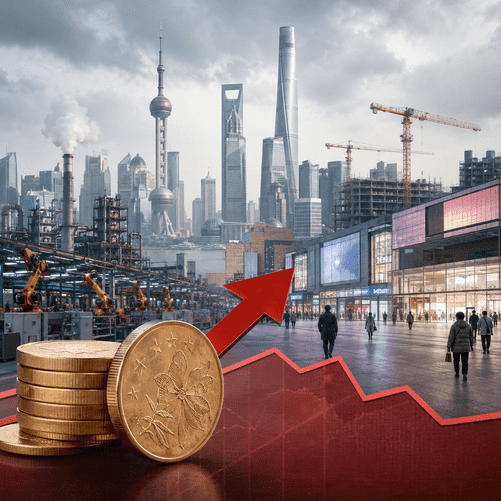
Beijing signals fresh measures to strengthen consumption and investment after weak July data exposed renewed pressure on the world’s second-largest economy.

China is preparing a new round of fiscal measures aimed at strengthening domestic demand, as policymakers confront renewed signs that the country’s economic recovery is losing momentum. Vice Finance Minister Liao Min said on Friday that the government would introduce additional policies in the second half of 2026, with an emphasis on supporting consumption, businesses and economic activity while maintaining stability in the public finances.
The announcement comes at a sensitive moment for the world’s second-largest economy. Official data released earlier this week showed that industrial production expanded by 4.5 percent from a year earlier in July, slowing from 5.3 percent in June and falling short of market expectations. Retail sales, an important gauge of household demand, increased by only 0.6 percent, while fixed-asset investment declined 6.7 percent during the first seven months of the year. The figures reinforced concerns that China’s export and manufacturing strength is not yet being matched by a sufficiently robust recovery in domestic spending.
Rather than unveiling a single large-scale stimulus package, Beijing appears to be pursuing a more targeted strategy. The finance ministry has indicated that fiscal expenditure on already approved projects will be accelerated, while financial support for households and smaller companies will be expanded. Measures include interest subsidies covering eligible consumer loans, credit-card instalment products and financing for small businesses, part of an effort to lower borrowing costs and encourage spending without relying exclusively on broad monetary easing.
The approach reflects a wider shift in China’s economic policy. For years, infrastructure investment, property development and exports were central engines of growth. But the prolonged adjustment in the housing market, cautious household sentiment and mounting external trade pressures have increased the urgency of developing a stronger consumption-driven economy. Officials have repeatedly identified domestic demand as a strategic priority, and on Friday the government said it would formulate further measures according to economic conditions during the remainder of the year.
China entered 2026 with an official growth target of between 4.5 percent and 5 percent, slightly below the pace recorded in 2025. Beijing also set its budget deficit target at roughly 4 percent of gross domestic product, providing the government with additional room to use fiscal policy to support growth. The broader economic blueprint places greater emphasis on technological development, advanced manufacturing and household consumption as China attempts to reduce its dependence on traditional property-led investment.
The latest weakness nevertheless illustrates the difficulty of that transition. China continues to benefit from competitive manufacturing industries and strong demand in sectors linked to technology and artificial-intelligence infrastructure, while its trade surplus has remained substantial. But domestic consumers have been considerably more restrained, reflecting uncertainty over employment, incomes and property values. Weak household confidence has therefore become one of the most persistent constraints on the recovery.
Beijing also appears reluctant to rely too heavily on lower interest rates. Expectations ahead of the August fixing suggested that the People’s Bank of China would leave its benchmark loan prime rates unchanged, despite softer economic data. Policymakers are instead giving fiscal measures a larger role, partly because aggressive monetary easing could put further pressure on bank profitability and create additional financial imbalances.
For international markets, the direction of China’s economy carries consequences far beyond its borders. A stronger Chinese consumer sector could support exporters from Europe and across Asia, particularly companies selling luxury goods, automobiles, machinery and consumer products. Conversely, prolonged weakness in domestic demand could encourage Chinese manufacturers to depend even more heavily on overseas markets, potentially intensifying trade tensions as governments confront rising imports from China’s industrial sector.
The challenge for Beijing is therefore becoming increasingly clear: stimulating enough demand to preserve economic momentum while avoiding a return to the debt-heavy investment model that powered earlier decades of growth. The fiscal measures announced on Friday suggest policymakers are prepared to intervene more actively, but their effectiveness will depend on whether they ultimately persuade households and private companies—not only state institutions—to spend and invest again.
China’s next phase of economic policy may consequently be judged less by the scale of headline stimulus than by whether Beijing can restore confidence. After July’s disappointing figures, the government has signalled that additional support is coming. The more consequential question is whether that support can transform cautious consumers into a durable new engine for Chinese growth.