At least 15 people were killed and around 130 wounded when Russian drones struck a crowded shopping centre in President Volodymyr Zelenskyy’s hometown, with Ukrainian authorities accusing Moscow of using a second strike to endanger rescuers.

A devastating Russian drone attack on a shopping centre in the central Ukrainian city of Kryvyi Rih killed at least 15 people and wounded around 130 on Friday, in one of the deadliest attacks on a civilian commercial site in Ukraine this year and the latest indication that the war’s aerial dimension is intensifying even as the battlefield remains largely deadlocked.
The daytime attack hit a busy shopping complex in Kryvyi Rih, an industrial city in the Dnipropetrovsk region and the hometown of Ukrainian President Volodymyr Zelenskyy. More than 20 children were among those injured, and regional authorities said dozens of victims remained in serious condition.
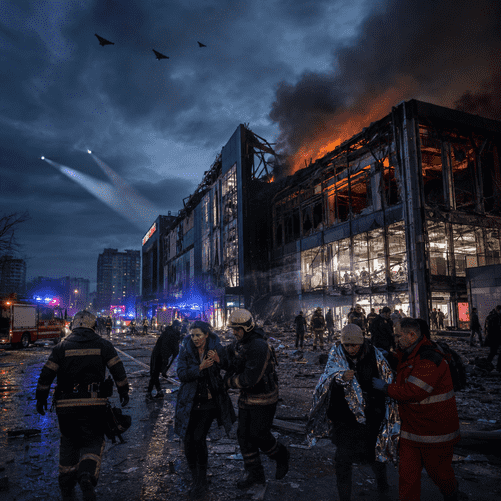
Emergency crews rushed to the complex as fire and thick black smoke engulfed sections of the building. Ukrainian officials said the attack did not end with the initial impact.
Zelenskyy described the incident as a “double-tap” strike, saying a second Russian drone hit the shopping centre approximately half an hour after the first, when rescuers and emergency personnel were already responding. Kyiv accused Russia of deliberately timing the second strike to endanger those attempting to assist the wounded.
Such tactics carry particular significance in modern warfare because a delayed second attack can dramatically increase casualties among firefighters, medics, police officers and civilians who move toward an impact site after the first explosion. The Ukrainian president characterised Friday’s attack as an act of terrorism and said his country would respond.
The allegations concerning the intent behind the second strike could not be independently established from the available reporting. What is clear is the scale of the destruction: photographs from the scene showed firefighters working through smoke and debris inside and around the severely damaged commercial complex.
The attack was only one part of an exceptionally violent day across Ukraine.
In the southern Mykolaiv region, another Russian strike killed four people, including three children, according to Ukrainian emergency services. In the Kharkiv region, two elderly women were killed in a separate drone attack. Together with the deaths in Kryvyi Rih, Friday’s Russian attacks left at least 21 people dead across the country, Ukrainian authorities said.
The escalation follows a major Russian missile and drone barrage against Kyiv just 24 hours earlier that killed at least 16 people. Large-scale attacks against the Ukrainian capital have become increasingly frequent this summer, adding to concerns that Russia is using its expanding missile and drone arsenal to overwhelm Ukraine’s increasingly strained air-defence network.
Ukraine’s air force said it intercepted or electronically suppressed 107 of 135 Russian drones launched overnight before Friday’s attacks. But the numbers illustrate the increasingly difficult arithmetic confronting Ukrainian air defence: even a relatively small proportion of weapons penetrating the defensive screen can cause considerable destruction when directed toward heavily populated areas.
The pressure is particularly acute against ballistic missiles.
Ukraine remains heavily dependent on U.S.-made Patriot systems, one of the few weapons available to Kyiv capable of reliably intercepting advanced ballistic threats. Stocks of interceptors are limited and expensive, and Ukrainian officials have repeatedly pressed Western governments for additional systems and ammunition as Russia intensifies its attacks on cities and infrastructure. AP reported that Moscow has recently increased its use of ballistic missiles against Kyiv while exploiting Ukraine’s shortage of Patriot interceptors.
The violence in Kryvyi Rih also carries considerable symbolic weight.
The sprawling steel-producing city has repeatedly been struck during the war and holds particular political importance because Zelenskyy was born and raised there. In April 2025, another Russian attack on the city killed 20 people, including nine children, making it one of the deadliest strikes on Kryvyi Rih since the full-scale invasion began.
Friday’s attack comes as the conflict approaches four and a half years since Russia launched its full-scale invasion in February 2022.
On the ground, neither side has achieved a decisive breakthrough. The front stretches roughly 1,250 kilometres across eastern and southern Ukraine, and the extraordinary proliferation of surveillance drones, attack drones and remotely operated ground systems has made large troop movements increasingly dangerous. Soldiers and vehicles can often be detected and targeted within minutes of entering exposed territory.
That battlefield stagnation is helping push both countries toward an increasingly intense campaign of long-range strikes.
While Russia has continued attacking Ukrainian cities, energy facilities and other targets with drones and missiles, Ukraine has expanded its own deep-strike campaign against Russian military and economic infrastructure.
On Friday, Zelenskyy said Ukrainian drones had struck an oil refinery in Perm, more than 1,600 kilometres from the Ukrainian border, as well as the Marinovka military airfield in Russia’s Volgograd region. Russian officials acknowledged damage at an industrial facility in Perm, while the Russian Defence Ministry said its forces intercepted hundreds of Ukrainian drones over Russian territory and occupied Crimea during the same period.
Ukraine’s strategy is increasingly focused on attacking the infrastructure that sustains Moscow’s war effort — particularly refineries, fuel depots, air bases and logistics networks.
The objective is partly military. Disrupting fuel production and transportation can complicate Russian operations at the front and force Moscow to divert air-defence systems away from occupied Ukrainian territory.
But the strategy also has a political dimension.
Ukrainian officials have made clear that they want the consequences of the war to be felt more directly inside Russia, calculating that attacks on economically important facilities and military installations could increase the domestic cost of continuing the conflict and potentially strengthen pressure for negotiations.
The result is a war in which geographic distance from the front is offering progressively less protection.
For Ukrainians, that reality has been familiar for years. Cities hundreds of kilometres from active combat zones routinely experience air-raid alerts, drone attacks and missile strikes. But Ukraine’s growing ability to send domestically manufactured long-range drones deep into Russia is increasingly extending the same strategic logic in the opposite direction.
The technological evolution of the conflict is therefore becoming as important as changes to the front line.
Relatively inexpensive one-way attack drones can now travel hundreds or even thousands of kilometres. Their cost makes them easier to manufacture in large quantities than traditional cruise or ballistic missiles, while their numbers can force defenders to expend valuable interceptors or accept that some weapons will penetrate.
For Russia, mass drone attacks provide a means of exhausting Ukraine’s defensive resources while maintaining pressure on cities and infrastructure. For Ukraine, long-range drones provide one of the few tools available for striking industrial and military targets deep inside a much larger adversary.
The attack on Kryvyi Rih demonstrates the civilian consequences of that transformation.
A shopping centre far from the most heavily contested sectors of the front became, within minutes, the scene of mass casualties. Families, shoppers and employees were caught in an attack that rapidly required a major emergency response. Then, according to Ukrainian authorities, another drone arrived.
The incident is likely to intensify Kyiv’s appeals for additional Western air-defence systems and ammunition. It will also add urgency to discussions among Ukraine’s European supporters over how to maintain military assistance as Russia demonstrates that it remains capable of conducting sustained long-range attacks despite years of sanctions, battlefield losses and Ukrainian strikes against its own military-industrial infrastructure.
Moscow, meanwhile, has shown little public indication that it is preparing to end the war on terms acceptable to Kyiv. Russian officials continue to insist that any settlement must reflect what they describe as the territorial and military realities created by the conflict. On Friday, a senior Russian diplomat said Moscow remained prepared to examine new proposals for a settlement but only if they recognised those realities.
That gap between diplomacy and battlefield reality remains enormous.
For Ukraine, Friday’s attack will reinforce the argument that negotiations conducted without credible military deterrence would leave the country vulnerable to continued Russian pressure. For Moscow, its growing ability to maintain aerial attacks while holding territory in eastern and southern Ukraine provides leverage it is unlikely to surrender easily.
The war is consequently entering another dangerous phase: neither side appears capable of forcing a rapid decision on the battlefield, yet both possess increasingly sophisticated tools for striking far beyond it.
In Kryvyi Rih, the consequences were measured not in territorial gains but in civilians pulled from a burning shopping centre.
At least 15 were dead by Friday evening. Around 130 had been wounded. Among them were more than 20 children.
As rescuers continued working through the wreckage, the attack offered a grim illustration of where the conflict may be heading. The front lines may move slowly, but the war itself is reaching ever further beyond them.