China’s increasingly selective consumers are spending more on prestige skincare, fragrance and cosmetics while postponing expensive leather goods, signalling a potentially profound change in the way the world’s most important luxury market defines indulgence.

For much of the past two decades, the designer handbag stood at the centre of China’s extraordinary luxury boom. A Louis Vuitton monogram, Gucci tote or Hermès Birkin offered something simultaneously personal and public: craftsmanship, fashion and an immediately recognisable declaration of wealth.
That hierarchy is beginning to change.
As Chinese consumers become more cautious about expensive discretionary purchases, prestige beauty is emerging as one of the strongest areas of the luxury market. High-end skincare, sophisticated fragrances and premium cosmetics are attracting spending at a time when demand for traditional entry-level luxury products such as handbags and watches remains comparatively subdued.
The shift does not mean Chinese consumers have stopped wanting luxury. Rather, they appear to be redefining what constitutes a justifiable luxury purchase.
Research cited by Reuters found that 37% of affluent Chinese consumers expected to increase their spending on prestige beauty during the coming year, compared with just 4% who planned to spend more on leather goods. The difference is striking in a market where handbags once served as one of the principal gateways into European luxury brands.
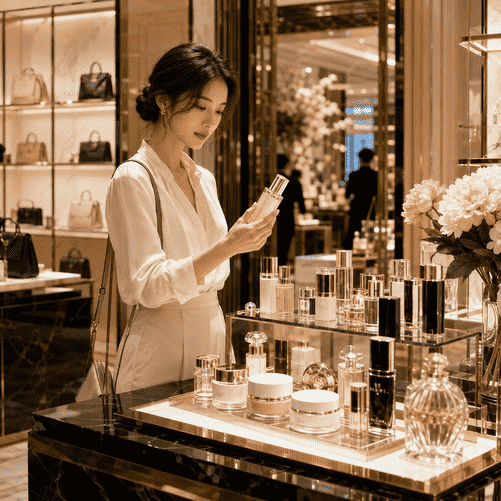
Beauty offers consumers a different proposition. A sophisticated serum from La Mer or Helena Rubinstein, an exclusive fragrance from Le Labo or Tom Ford, or premium cosmetics from Lancôme can still deliver the experience of purchasing a globally recognised luxury brand without requiring the several thousand dollars increasingly demanded for a designer handbag.
That distinction has become particularly important as China continues to grapple with the consequences of a prolonged property downturn, weaker consumer confidence and a more cautious middle class.
“The aspirational consumer has not traded down,” Jacques Roizen, co-founder of Shanghai consultancy Foresight Performance Partners, told Reuters. Instead, shoppers are increasingly choosing the highest-quality product within a category they can comfortably afford rather than purchasing an entry-level item from a dramatically more expensive one.
That behavioural shift is now visible in corporate results.
Estée Lauder, one of the world’s largest prestige beauty groups, reported on August 19 that it had returned to annual sales growth during its 2026 financial year. Net sales increased 5% to just over $15 billion, while organic sales rose 3%. The company ended the year with organic sales growth accelerating to 5% during the fourth quarter.
China played a particularly important role.
Estée Lauder reported market-share gains in mainland China during both its fiscal fourth quarter and full year across fragrance, skincare and makeup. During major Chinese online shopping festivals including 11.11 and 6.18, brands including Estée Lauder, La Mer and Jo Malone London achieved leading positions across prestige beauty and luxury fragrance categories on major platforms.
L’Oréal is seeing a similar pattern.
The French beauty group reported €23.8 billion in first-half sales, with adjusted like-for-like growth of 6.5%. Its luxury division expanded faster than the broader selective beauty market, while China became one of the strongest contributors to its performance in North Asia.
L’Oréal Luxe recorded double-digit growth in China, driven in part by high-end skincare. Helena Rubinstein’s Replasty franchise performed particularly strongly, while fragrances from Prada, Yves Saint Laurent, Valentino and Armani continued to generate substantial growth globally. The company said luxury fragrance remained one of its strongest categories.
The contrast with traditional luxury fashion is increasingly difficult to ignore.
Hermès, despite remaining one of the industry’s strongest companies, reported only modest improvement in China during its latest quarter. Sales in Asia-Pacific excluding Japan increased 2.5%, while chief executive Axel Dumas said he could see stabilisation in the Chinese market but not yet a fundamental rebound.
LVMH has similarly described Chinese consumer spending as broadly flat, while Kering has continued to report weakness in China even as early signs emerge that its Gucci turnaround may be gaining traction.
The divergence suggests that luxury’s problem in China may not simply be insufficient spending power. It may also be a question of what consumers now consider worth buying.
Prestige skincare has several advantages in the present economic climate.
Unlike a handbag, skincare is consumed and replenished. Purchases can therefore be justified as part of a personal routine rather than as an occasional extravagance. High-end creams and serums also sit at the intersection of luxury, wellness and increasingly sophisticated scientific marketing — all categories with considerable appeal among younger Asian consumers.
Luxury beauty brands have responded by elevating the language surrounding their products.
Prestige skincare is increasingly marketed not simply around moisturisation or appearance but around longevity, cellular science and highly concentrated ingredients. L’Oréal, for example, highlighted the launch of Lancôme Absolue Longevity M.D. as part of its attempt to capitalise on growing consumer interest in longevity.
Fragrance represents another important shift.
Once treated by many fashion houses primarily as an accessible extension of their core businesses, perfume is becoming a prestige category in its own right. Consumers are showing greater interest in niche fragrances, unusual ingredients, more concentrated formulations and perfumes associated with exclusivity rather than mass recognition.
Estée Lauder’s portfolio reflects the trend particularly clearly. Jo Malone London and Tom Ford have now joined its group of billion-dollar brands, while Le Labo, Kilian Paris and Editions de Parfums Frédéric Malle give the company exposure to consumers seeking increasingly specialised fragrance identities.
For younger luxury customers, scent also offers something handbags cannot easily provide: individuality without obvious branding.
A fragrance can communicate taste without displaying a logo. That fits neatly with a broader movement toward quieter, more personalised expressions of luxury in which knowledge, quality and exclusivity can matter more than overt recognition.
Fashion itself has been undergoing a comparable evolution. The conspicuous logo culture that defined important parts of the previous luxury cycle has gradually given way to interest in craftsmanship, heritage, understated clothing and carefully selected accessories.
Beauty may represent the most accessible expression of that philosophy.
A consumer who cannot justify paying several thousand euros for an increasingly expensive leather bag may still spend substantially more than the mass-market average on a sophisticated perfume, lipstick or skincare treatment.
The psychology is different as well.
Oliver Wyman found that younger Chinese travellers are becoming increasingly selective in their luxury spending and are showing greater interest in prestige beauty and luxury apparel than in watches and leather goods. The consultancy estimates that Asia-Pacific travel retail is currently missing approximately $5 billion in potential revenue, partly because retailers have not fully adapted to changing traveller preferences.
The implications could be substantial for luxury groups.
For years, leather goods were one of the industry’s most attractive businesses. Handbags carry high margins, are less complicated to manufacture in multiple sizes than clothing and can become globally recognisable brand symbols. Fashion groups therefore invested enormous resources in convincing aspirational consumers to enter luxury through increasingly expensive bags.
That strategy becomes less effective if those consumers decide that the entry price is no longer rational.
Chinese shoppers appear increasingly unwilling to buy something merely because it provides access to a prestigious logo. Consultants describe a transition from the exuberant “YOLO” mentality of the earlier luxury boom — “you only live once” — toward what has been labelled “YONO”: “you only need one.”
The phrase captures an important psychological change.
A consumer may still desire an exceptional handbag but decide that one is sufficient. Subsequent discretionary spending can then move toward products that offer novelty at a lower absolute cost: perfume, skincare, cosmetics, jewellery, clothing or experiences.
That does not necessarily threaten the very top of luxury.
Ultra-wealthy customers remain capable of purchasing rare Hermès bags, high jewellery and couture regardless of economic uncertainty. The greater vulnerability lies with brands that spent years depending on aspirational middle-class customers repeatedly buying increasingly expensive entry-level products.
Those companies may now have to reconsider the relationship between price and perceived value.
The beauty industry is already exploiting that opening.
L’Oréal’s luxury division is growing twice as fast as the global selective beauty market, according to the company, while its dermatological beauty division expanded at double-digit rates during the first half of the year. Estée Lauder expects prestige beauty to continue expanding in fiscal 2027 and forecasts organic group sales growth of between 3% and 5%.
The change also helps explain why fashion groups are placing greater strategic importance on beauty.
Kering struck a long-term agreement with L’Oréal that will eventually give the French cosmetics giant an exclusive worldwide beauty licence for Gucci. The arrangement reflects growing recognition that fragrance and beauty can no longer be treated simply as peripheral licensing businesses.
They are becoming central components of the luxury ecosystem.
China is once again providing the clearest indication of where that ecosystem may be heading.
The country’s consumers have not abandoned luxury. Nor have they simply moved toward cheaper products. Instead, many appear to be becoming more calculating about where premium prices offer the greatest emotional or functional return.
That distinction matters.
The previous era of Chinese luxury growth rewarded visibility. The next may reward intimacy: the perfume someone chooses, the skincare ritual they repeat, the fabric they wear or the craftsmanship they understand.
For the world’s luxury houses, the challenge is therefore becoming more complicated than simply waiting for Chinese consumer confidence to recover.
Even when confidence returns, the customer may not return in the same form.
The designer handbag will remain one of luxury fashion’s most powerful objects. But the newest signals from China suggest that the industry’s next major battle for affluent consumers may increasingly take place somewhere else entirely — at the fragrance cabinet, the skincare counter and inside the rapidly expanding world of prestige beauty.