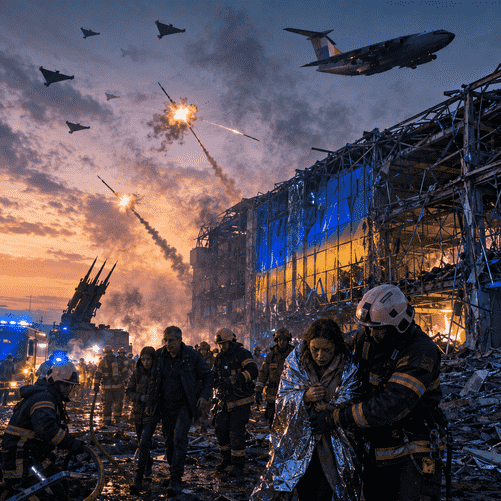
France will accelerate deliveries of interceptor missiles and air-defence equipment to Kyiv after a deadly drone attack on a crowded shopping centre underscored Ukraine’s increasingly urgent struggle to protect its cities from Russia’s expanding aerial campaign.

French President Emmanuel Macron has pledged to accelerate military support for Ukraine, with particular emphasis on air defence, as Kyiv confronts an intensifying Russian bombardment and an increasingly acute shortage of the interceptor missiles needed to protect its cities.
Macron made the commitment during a lengthy telephone conversation with Ukrainian President Volodymyr Zelenskyy on Saturday, August 22, agreeing to speed up deliveries of French equipment and interceptor missiles and to support efforts to obtain additional air-defence capabilities from other allies. The discussion came less than a day after Russian drones struck a crowded shopping centre in Kryvyi Rih, killing at least 16 people and injuring more than 130.
The attack on Kryvyi Rih, an industrial city in central Ukraine and Zelenskyy’s home town, has become the latest symbol of the growing civilian cost of Russia’s aerial campaign. Ukrainian authorities said one drone struck the shopping centre on Friday afternoon before another hit the site approximately half an hour later, after rescuers and emergency crews had arrived.
Zelenskyy described the second strike as a deliberate attempt to hit those responding to the first attack. Regional authorities said 16 people had been confirmed dead, more than 130 were wounded — including more than 20 children — and several people remained missing as rescue teams continued searching through the damaged complex.
Images from the scene showed much of the shopping centre burned and shattered, with firefighters working among twisted metal and debris. The attack came during normal commercial hours, when civilians were inside the building, magnifying both the casualties and the political reaction across Europe.
EU foreign policy chief Kaja Kallas described the strike as evidence of the nature of Russia’s campaign against Ukrainian cities and said she would propose the most extensive package of Russian sanctions listings since the beginning of the war when European ministers meet in Ireland next month.
For Kyiv, however, the immediate concern is not only retaliation or sanctions but the increasingly difficult task of intercepting Russian missiles and drones before they reach populated areas.
Russia has intensified its long-range attacks in recent months, combining large numbers of relatively inexpensive drones with cruise missiles and high-speed ballistic weapons designed to overwhelm Ukrainian air-defence networks. Ukraine has been able to destroy many incoming drones and cruise missiles, but ballistic missiles remain particularly difficult to stop.
The shortage of American-made Patriot interceptors has become one of Kyiv’s most pressing military vulnerabilities. Patriot systems are among the few weapons currently available to Ukraine capable of reliably intercepting the ballistic missiles Russia has increasingly used against major urban centres.
That shortage has already had visible consequences. During a major Russian assault on Kyiv earlier in the week, Ukrainian forces intercepted large numbers of drones and cruise missiles but were unable to stop several ballistic missiles. The attack killed civilians and caused extensive damage across residential areas of the capital.
France is now seeking to address part of that vulnerability through both immediate deliveries and a longer-term effort to strengthen Ukraine’s domestic air-defence capacity.
According to Reuters, Macron agreed during his nearly two-hour conversation with Zelenskyy to accelerate deliveries of new French air-defence equipment and interceptor missiles. France will also assist Kyiv in approaching countries that possess stocks of Patriot missiles, which Zelenskyy has repeatedly identified as essential for defending Ukrainian cities against ballistic attacks.
Paris has pursued a parallel European solution based on the Franco-Italian SAMP/T family of air-defence systems, which uses Aster interceptors and is designed to defend against aircraft, cruise missiles and ballistic threats.
France and Ukraine substantially expanded that cooperation in July. Under a joint defence roadmap, Ukraine intends to acquire four next-generation SAMP/T-NG systems, while France and Italy have agreed to accelerate deliveries of Aster 30 interceptor missiles. Paris has also committed to deploying two existing SAMP/T systems to Ukraine while Kyiv waits for the newer systems to become available.
The agreement goes further than traditional weapons deliveries. France and Italy have authorised the licensed production of Aster 30 missiles inside Ukraine, potentially allowing Kyiv eventually to manufacture some of the interceptors it needs rather than depending entirely on supplies from allied inventories. France has similarly authorised Ukrainian production under licence of AASM precision weapons and SCALP cruise missiles.
The strategy reflects a broader shift in European support for Ukraine. After years of drawing weapons from national stockpiles, governments are increasingly attempting to connect Ukrainian defence directly with European industrial production, creating supply chains capable of sustaining a prolonged conflict while expanding Europe’s own military manufacturing capacity.
At a July summit of the so-called Coalition of the Willing, France and its partners committed themselves to increasing deliveries of air-defence systems, interceptors and long-range weapons while developing additional European anti-ballistic capabilities. They also agreed to increase economic pressure on Moscow as long as Russia continues its invasion.
That coalition will meet again on Monday, with Macron joining other European leaders in coordinating the next stage of assistance to Kyiv. The meeting comes on Ukraine’s Independence Day and is expected to focus heavily on air defence, military supplies and measures aimed at increasing pressure on Moscow.
The diplomatic push is unfolding against an increasingly violent exchange of long-range attacks.
Russian strikes killed additional civilians across Ukraine on Saturday, while Ukrainian drones struck targets deep inside Russia and Russian-occupied territory. Kyiv has increasingly targeted oil refineries, industrial facilities and logistics infrastructure that it says contribute to Moscow’s military effort. Russian authorities, meanwhile, reported civilian casualties from Ukrainian drone attacks in several regions.
The escalation illustrates how the war has evolved far beyond the front line. Both countries are now capable of striking targets hundreds of kilometres from the battlefield, and drones have become central to efforts to disrupt industrial capacity, logistics networks and public life.
For Ukraine, however, the imbalance in missile inventories remains substantial. Russia possesses a much larger stock of ballistic and cruise missiles and has expanded its production of long-range drones, enabling Moscow to launch repeated mass attacks intended to exhaust Ukrainian interceptors.
Western governments therefore face a difficult equation: providing Ukraine with enough sophisticated missiles to defend itself while simultaneously replenishing their own increasingly depleted inventories.
France’s approach is intended partly to break that dependency. By transferring technology, licensing missile production and developing a new generation of European anti-ballistic systems, Paris is seeking to transform assistance from an emergency programme of weapons deliveries into a more sustainable defence-industrial partnership.
The urgency of that effort was made stark again by the destruction in Kryvyi Rih.
For Macron and other European leaders, the attack strengthens the argument that air defence has become one of the most consequential forms of military assistance available to Ukraine. Every interceptor delivered potentially represents not simply another weapon for the battlefield, but a means of shielding apartment buildings, power stations, hospitals and commercial centres from increasingly frequent Russian attacks.
France’s latest commitment therefore carries significance beyond the additional missiles themselves. It reflects a European calculation that protecting Ukraine’s cities — and building the industrial capacity necessary to continue doing so — is becoming central to sustaining Kyiv’s resistance.
As Russia expands its aerial campaign and Ukraine struggles to replace the interceptors it fires each night, the contest is increasingly becoming one of production as much as military operations.
Macron’s promise to accelerate deliveries offers Kyiv some immediate relief. Whether France and its European partners can expand production rapidly enough to match the scale of Russia’s missile and drone campaign may prove a far more consequential test.