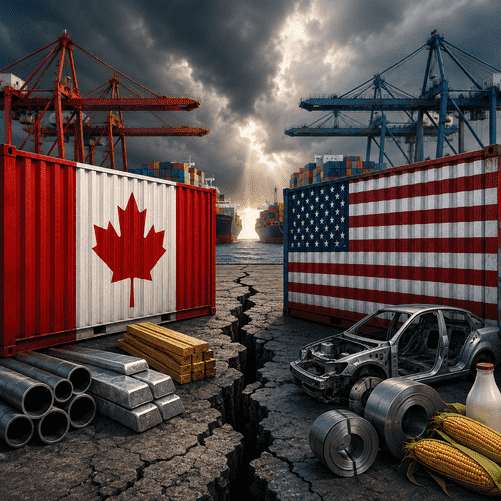
Washington’s 50% duties on nearly $20 billion of Canadian goods have shattered weeks of negotiations, prompting Prime Minister Mark Carney to promise equivalent retaliation and raising new questions over the future of North America’s economic partnership.

Canada has vowed to answer a new wave of United States tariffs “dollar for dollar” after negotiations between the two countries collapsed, transforming what had appeared only days ago to be an approaching trade agreement into one of the most serious confrontations between Washington and Ottawa in decades.
The United States has imposed 50% tariffs on nearly $20 billion worth of Canadian products, extending President Donald Trump’s increasingly aggressive use of trade barriers against one of America’s closest economic and political partners. The duties affect a range of Canadian exports and come after negotiators failed to bridge disagreements over automobiles, steel, aluminium, dairy products and other politically sensitive sectors.
Canadian Prime Minister Mark Carney responded by suspending further trade negotiations and announcing that Ottawa would impose matching tariffs on American products beginning September 8. The retaliatory package is expected to target U.S. steel, electronics, dairy products, household appliances, agricultural machinery, pulp and paper and other goods, with the value of the Canadian measures designed to match the economic weight of Washington’s latest duties.
The escalation is particularly striking because the two governments appeared close to an agreement only days earlier. Negotiators had been discussing a framework under which Washington could reduce tariffs on Canadian-built vehicles and ease duties on key metals, while Canada would address American complaints over market access and restrictions affecting U.S. products.
One proposal under discussion would have reduced U.S. tariffs on Canadian vehicles from 25% to around 15%, although the sides remained divided over how much Canadian and Mexican content should count toward tariff exemptions. Steel, aluminium, dairy market access and restrictions on American alcohol were also among the principal sticking points.
As recently as August 20, Canadian Trade Minister Dominic LeBlanc said the two sides were “very close” to reaching an agreement. President Trump had temporarily delayed implementation of the new tariffs by three days after claiming that progress had been made. But optimism evaporated when the negotiations broke down and Washington proceeded with the duties.
Carney accused the United States of introducing unacceptable terms late in the negotiations and said Canada would not accept an agreement that undermined its economic interests or restricted its ability to conduct trade policy independently. According to Reuters, Canadian officials said the final U.S. proposals were economically damaging and weakened confidence that any agreement could provide a stable basis for future relations.
Washington has presented a very different interpretation of the dispute. The Trump administration argues that Canada has discriminated against American exports through policies affecting dairy products, alcoholic beverages and vehicles. U.S. Trade Representative Jamieson Greer said the tariffs were intended to counter what Washington considers unfair Canadian treatment of American businesses and to protect U.S. industries considered strategically important.
The immediate economic consequences could be concentrated in industries that depend heavily on cross-border trade. Canada sends the vast majority of its merchandise exports to the United States, and production networks in sectors such as automobiles, steel, machinery and agriculture have been integrated across the border for decades.
For businesses operating on both sides, a tariff confrontation therefore carries costs beyond the duties themselves. Components can cross the Canadian-U.S. border several times during manufacturing, meaning that higher import taxes can ripple through supply chains, increase production costs and ultimately feed into consumer prices.
Canadian exporters exposed to the latest measures face the additional risk of losing U.S. customers if American buyers turn to domestic or alternative foreign suppliers. Smaller manufacturers, which often have fewer options to relocate production or absorb tariff costs, may be particularly vulnerable.
Some of those effects are already visible from earlier trade measures. In Quebec, for example, manufacturers heavily dependent on steel-related trade have reported lost orders and layoffs following previous U.S. tariffs. The broader economic damage from the latest round may remain manageable at a national level because the affected products represent only a fraction of total Canadian exports, but the consequences could be severe for individual companies, towns and industrial sectors.
Carney has indicated that his government is preparing support for affected industries and workers, acknowledging that the disruption caused by the deteriorating U.S. relationship could persist for years rather than months. Ottawa has also increasingly emphasized the need to diversify Canadian trade and reduce the country’s dependence on the American market.
Yet the most enduring consequences of the dispute may prove political rather than purely economic.
Canada and the United States share one of the world’s largest bilateral trading relationships and have traditionally presented their economic integration as a foundation of a broader alliance covering defence, intelligence, energy and security. Repeated tariff disputes have increasingly challenged that assumption.
The latest confrontation also arrives at a delicate moment for the United States-Mexico-Canada Agreement, the trade pact that replaced NAFTA and governs much of North American commerce. Washington, Ottawa and Mexico are already confronting difficult questions about the future operation of the agreement, particularly rules governing automobiles and regional manufacturing.
The decision to impose additional tariffs despite the existence of the USMCA is likely to intensify Canadian doubts about how much protection formal trade agreements can provide when Washington is willing to invoke other legal mechanisms to restrict imports.
Domestically, Carney appears to have considerable political space to resist further concessions. Canadian public sentiment has hardened toward the United States during successive rounds of tariff threats, while provincial leaders and opposition politicians have broadly supported measures designed to defend Canadian industries.
The pressure has even altered political dynamics inside Quebec. Reuters reported that support for rapid independence from Canada has weakened as concerns over the economic and political consequences of U.S. policy have encouraged a renewed sense of Canadian unity in parts of the province.
For Trump, tariffs remain a central instrument of his economic strategy. His administration argues that high duties can encourage companies to manufacture inside the United States, strengthen domestic industries and force trading partners to offer better access to their markets. Critics, however, warn that prolonged tariff wars can increase costs for American companies and consumers while disrupting supply chains that cannot quickly be recreated domestically.
The rupture with Canada demonstrates the broader geopolitical risk inherent in that strategy. Trade disputes that begin over dairy quotas, automobiles or steel can gradually reshape political relationships that took generations to build.
There is currently no clear timetable for renewed negotiations. A senior U.S. administration official told Reuters that no additional talks were scheduled after the latest tariffs came into effect, while Canada has signalled that it is prepared for a prolonged dispute rather than accepting an agreement it considers fundamentally unbalanced.
That leaves both governments entering a new and potentially more unpredictable stage of their relationship.
The immediate contest will be measured in tariffs, export losses and jobs. The larger question is whether the confrontation permanently changes how Canada views its economic dependence on the United States — and whether one of the world’s most deeply integrated trading relationships can still rely on the political trust that sustained it for generations.