Birmingham control-centre outage forces the cancellation of almost all CrossCountry services as ministers call on publicly owned rail operators to provide additional capacity

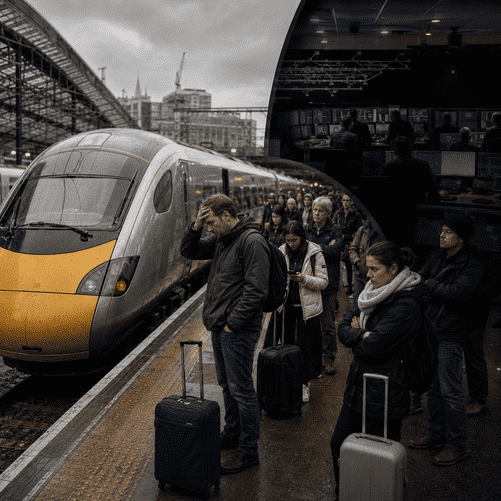
CrossCountry cancelled almost all of its train services across Britain on Sunday after a power failure at its Birmingham control centre disabled critical operational systems, causing widespread disruption for passengers travelling across some of the country’s longest-distance rail routes.
The outage, which began on Saturday, left many of the systems used by CrossCountry to manage its network unavailable and prompted the operator to dramatically reduce its Sunday timetable. Routes affected included important intercity connections linking Manchester and Birmingham, Leeds and York, Cheltenham and Cardiff, and Glasgow and Edinburgh. CrossCountry also operates some of Britain’s longest services, connecting cities across England, Scotland and Wales.
A limited number of trains continued to run, including services between Peterborough, Cambridge and Stansted Airport, while replacement buses were introduced on parts of the network. CrossCountry said it hoped to restore operations progressively, with a small number of trains expected to return from Sunday evening and services approaching normal levels on Monday.
Transport Secretary Heidi Alexander intervened as the scale of the disruption became clear, saying she had asked publicly owned train operators to provide additional services where possible. Network Rail engineers were also deployed to assist efforts to restore power at the Birmingham control centre.
The incident placed renewed attention on the resilience of Britain’s rail infrastructure and the extent to which a failure at a single operational facility can have consequences across a geographically extensive network. CrossCountry’s services connect major regional centres without routinely passing through London, making the operator particularly important for passengers travelling between northern England, the Midlands, south-west England, Scotland and Wales.
Passengers holding CrossCountry tickets were permitted to use a number of alternative operators, including Chiltern Railways and London North Eastern Railway, with tickets purchased for affected Sunday journeys remaining valid until Wednesday, 26 August. Travellers experiencing delays of more than 30 minutes may also be eligible for Delay Repay compensation, while customers choosing not to travel can seek refunds.
The disruption comes at a sensitive moment for Britain’s railway system as the government continues a major restructuring programme centred on bringing passenger services into public ownership and eventually integrating them under Great British Railways. As of May, publicly owned operators were already responsible for roughly eight in 10 journeys that the future organisation is expected ultimately to oversee. CrossCountry, however, remains a privately operated company under a Department for Transport passenger contract.
Sunday’s breakdown may therefore provide another test of the government’s argument that greater coordination between operators and infrastructure managers can make the railway more resilient. Alexander’s request for publicly owned companies to add capacity illustrated how operators elsewhere on the network can be mobilised when a major disruption overwhelms one company’s services.
For CrossCountry, the incident also adds to concerns about operational performance. Passenger watchdog Transport Focus had previously called for improvements in the company’s handling of disruption and overcrowding, issues that have become increasingly important as travellers demand greater reliability from long-distance services.
CrossCountry apologised to passengers and said its teams were working to restore as many services as possible. But for thousands of travellers caught in Sunday’s disruption, the power failure demonstrated how quickly a technical problem far from the tracks themselves can cascade through Britain’s interconnected rail network, turning a single control-centre outage into a nationwide transport problem.