Severe weather forces organizers to abandon stage three with 15 kilometres remaining, leaving Tadej Pogačar in red as riders seek shelter from giant hailstones in the French Pyrenees

The third stage of the 2026 Vuelta a España ended in extraordinary circumstances on Monday after a violent hailstorm swept across the French Pyrenees, forcing organizers to abandon the race with just 15 kilometres remaining.
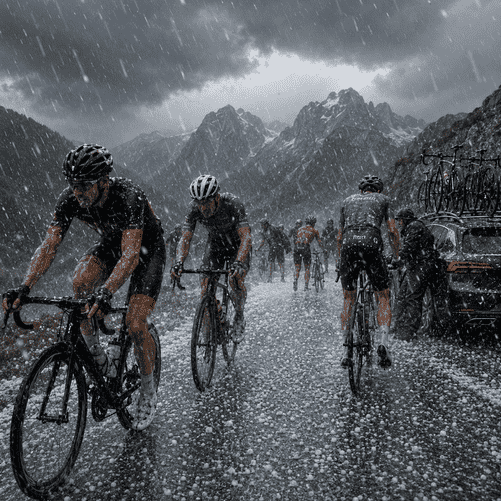
The 174-kilometre stage from Gruissan to Font-Romeu had begun under relatively benign conditions, but the weather deteriorated rapidly as the peloton approached the Col de Mont-Louis. Dark clouds gathered over the mountains before large hailstones began striking the riders and covering sections of the road, creating dangerous conditions on an already demanding mountain route.
Race leader Tadej Pogačar was seen gesturing to riders around him as the storm intensified, apparently indicating that continuing had become unsafe. Within minutes, soaked competitors were leaving the course and taking refuge in a nearby hotel while organizers assessed whether racing could resume. It soon became clear that conditions had deteriorated beyond the point where the stage could safely continue.
The abandonment meant that stage three concluded without a winner.
At the moment racing was stopped, Germany’s Mats Wenzel of Kern Pharma and Italy’s Lorenzo Fortunato of XDS Astana were leading the race by approximately 25 seconds after breaking clear of the main field. Their advantage disappeared with the cancellation, leaving one of the Vuelta’s earliest mountain tests unresolved.
For Pogačar, the decision preserved his position at the top of the general classification. The Slovenian remains nine seconds ahead of Belgium’s Wout van Aert, with Britain’s Matthew Brennan a further second behind in third place.
The incident delivered a dramatic interruption to a race that had already begun at high intensity.
Pogačar opened the Vuelta by winning the opening time trial and entered the race as the overwhelming favourite to claim the one Grand Tour title still missing from his career. A victory in Spain would complete his collection of Giro d’Italia, Tour de France and Vuelta a España triumphs and would make him only the ninth rider to win all three of cycling’s Grand Tours.
The second stage had produced an early surprise when 21-year-old British rider Matthew Brennan sprinted to victory in Manosque, beating Pau Miquel and Pogačar. The result strengthened Brennan’s position among the race’s most promising young riders while Pogačar retained the overall lead.
Stage three was expected to provide the first clearer indication of how the leading contenders would perform in the mountains.
Instead, nature became the decisive factor.
Mountain stages are frequently shaped by heat, rain, fog and rapidly changing temperatures, but hail presents an especially serious danger. Large hailstones can significantly reduce visibility, make braking unpredictable and rapidly transform dry asphalt into a slippery surface covered with ice and water.
For riders descending at high speed on narrow mountain roads, those conditions can become hazardous within minutes.
Monday’s decision therefore reflected the increasing emphasis race organizers place on rider safety when extreme weather makes racing unmanageable. Professional cycling has faced repeated debates in recent years over whether stages should be shortened, neutralized or cancelled when severe weather develops, particularly in high-altitude regions where conditions can change with little warning.
Images from the Pyrenees showed why organizers had little room for manoeuvre. Riders who had spent most of the afternoon exposed on the road suddenly found themselves being struck by heavy hail and searching for shelter rather than preparing for the decisive kilometres of the stage.
The unusual scenes included Van Aert and other competitors entering a hotel along the route, drenched and still wearing their racing equipment, while spectators who had gathered near the finish were left waiting for a conclusion that never came.
For the two breakaway riders at the front, the abandonment was particularly frustrating.
Wenzel and Fortunato had successfully stayed ahead as the race entered its closing phase and appeared to have an opportunity to contest the stage victory. But safety rules meant their position could not translate into an official win once organizers determined that the stage could not continue.
The cancellation also prevented the leading general-classification contenders from testing one another on the final kilometres toward Font-Romeu.
That may ultimately benefit Pogačar, who avoided an unpredictable mountain finale while keeping the red jersey without losing time to his main rivals.
Yet it also means the competitive picture remains unusually compressed after three days.
Van Aert is still within nine seconds of the race lead, while Brennan remains only 10 seconds behind. The close margins preserve the possibility of further changes to the red jersey as the race moves deeper into the mountains.
The Vuelta now turns toward another difficult test.
Stage four is scheduled to take the riders into Andorra la Vella and includes three first-category climbs, offering a far more substantial opportunity for the general-classification contenders to begin separating themselves.
The mountain-heavy route could provide Pogačar with his first genuine opportunity to impose the dominance he has displayed throughout much of the 2026 season. But Monday’s chaotic conclusion also served as a reminder that Grand Tours are rarely controlled entirely by tactics, fitness or team strength.
Weather can transform a carefully planned race in seconds.
For organizers, abandoning a stage is always an exceptional decision. It removes a sporting contest that teams and riders have spent months preparing for and disappoints spectators who have travelled to watch the race.
But in the Pyrenees on Monday, the priority shifted quickly from competition to protection.
There was no sprint to the line, no victory celebration and no podium ceremony for a stage winner.
Instead, one of cycling’s biggest races ended its third day with riders sheltering from giant hailstones inside a mountain hotel — an extraordinary reminder of how quickly the conditions surrounding a Grand Tour can overwhelm even the strongest athletes in the sport.