Tehran threatens consequences for governments that help enforce Washington’s renewed pressure campaign, setting up a test of whether China, India and Russia are willing to challenge the reach of U.S. financial power

Iran has warned that countries cooperating with a sweeping new U.S. sanctions campaign could face retaliation, sharply escalating a confrontation that is increasingly shifting from the battlefield to global trade, banking and energy markets.
The warning came as Washington prepared on Monday to broaden the reach of secondary sanctions against Iran, potentially exposing foreign companies, financial institutions and governments that maintain significant commercial ties with Tehran to penalties or restrictions within the U.S.-dominated financial system. U.S. Treasury Secretary Scott Bessent has described the initiative as potentially the toughest sanctions campaign ever imposed on Iran.
Iranian officials responded by making clear that Tehran may regard participation in the American pressure campaign as a hostile act rather than simply a commercial decision. Foreign Ministry spokesperson Esmaeil Baghaei warned that further economic escalation would have consequences, while senior Iranian official Mohsen Rezaei said countries joining what Tehran describes as an American “economic war” risk being treated as enemies.
The confrontation could have consequences far beyond Iran. The effectiveness of Washington’s strategy will depend heavily on whether major economies — particularly China, India and Russia — believe the threat of secondary sanctions is credible enough to justify reducing trade with Tehran.
That is precisely where the new campaign faces its most important test.
China has for years been the largest buyer of Iranian crude, giving Beijing a central role in Tehran’s ability to generate foreign revenue despite longstanding U.S. restrictions. Chinese purchases have therefore emerged as one of the most obvious potential targets as Washington attempts to tighten Iran’s economic isolation.
Beijing has already signalled resistance. China’s Foreign Ministry said on Monday that it opposed unilateral sanctions and would take measures necessary to protect what it considers its legitimate economic interests. The response suggests that an aggressive American effort to punish Chinese companies dealing with Iran could quickly become another source of tension between the world’s two largest economies.
India presents Washington with a different but equally complicated calculation. New Delhi maintains significant strategic and economic relationships with both the United States and Russia and has repeatedly demonstrated a willingness to pursue its own energy interests when they conflict with Western pressure campaigns. Its response to measures targeting Iranian commerce will therefore be watched closely as an indication of how far Washington can extend secondary sanctions without creating resistance among important international partners.
Russia, already accustomed to extensive Western sanctions, is even less likely to accept American demands without resistance. Moscow and Tehran have developed increasingly important economic, political and security ties, while both governments have sought mechanisms capable of reducing their dependence on Western-controlled financial infrastructure.
The Trump administration is nevertheless betting that access to the dollar, U.S. financial institutions and American markets remains powerful enough to force even reluctant governments and companies to reconsider their exposure to Iran.
Under expanded secondary sanctions, the United States would not necessarily need foreign governments to formally join its campaign. Instead, Washington can pressure individual banks, shipping companies, refiners, insurers and traders by forcing them to choose between doing business with Iran and retaining access to the much larger American financial system.
Reuters reported that the Treasury Department was preparing to expand the categories of transactions and entities vulnerable to such penalties, potentially creating a far broader international compliance risk for companies maintaining links with Tehran.
Iran’s response has deliberately focused on raising the cost of that cooperation.
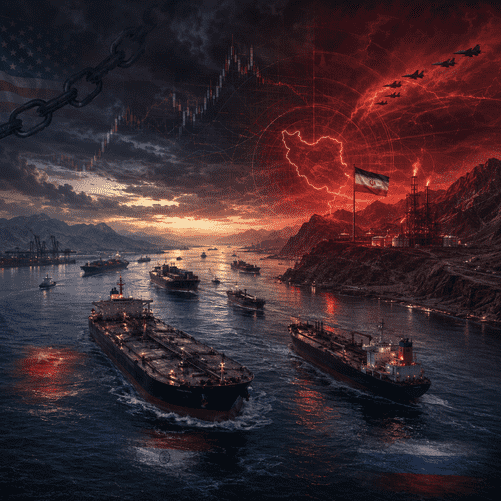
Officials have suggested Tehran could retaliate against the economic interests of countries that participate in the sanctions regime. Iranian warnings have also extended to the Persian Gulf, where Tehran has repeatedly demonstrated its ability to threaten shipping through the Strait of Hormuz — one of the most strategically important energy corridors in the world.
The possibility of disruption there gives Iran one of its strongest forms of leverage. A significant share of globally traded oil and liquefied natural gas normally passes through the narrow waterway separating Iran from the Arabian Peninsula. Any sustained interruption could rapidly push up energy prices and affect economies far removed from the Middle East.
Tensions in the strait are already unusually high. Maritime traffic has fallen sharply amid the continuing regional confrontation, while Iran has threatened vessels it says have violated its transit requirements. The deteriorating security environment has intensified fears that economic pressure could spill over into direct interference with commercial shipping.
Iran itself is entering the confrontation from a position of severe economic weakness. Years of sanctions, conflict and restricted access to international financial markets have placed enormous pressure on the country’s economy and currency. The rial fell to a record low on Monday as markets anticipated Washington’s next sanctions measures.
For the United States, that vulnerability is central to the strategy. The administration appears to believe that intensifying financial pressure can further restrict Iran’s oil revenue and international trade while avoiding some of the costs associated with continued military escalation.
Yet the strategy carries risks of its own. Secondary sanctions are most powerful when businesses believe exclusion from the American financial system would be more damaging than abandoning the targeted country. Their effectiveness becomes more uncertain when Washington attempts to apply them against companies in large economies such as China, especially where political leaders are willing to absorb some economic costs to resist American pressure.
That makes the coming decisions in Beijing, New Delhi and Moscow particularly important. If major Iranian trading partners substantially reduce commercial ties, Washington could deepen Tehran’s isolation without requiring universal diplomatic support for its policy.
If they refuse, the United States will face a more difficult choice: impose penalties powerful enough to demonstrate that its threats are credible, potentially triggering wider economic disputes, or tolerate continued trade that would allow Iran to preserve essential sources of revenue.
China has already provided the first indication that compliance cannot be assumed.
The result could turn the sanctions campaign into something larger than a dispute between Washington and Tehran. It may become a broader test of the international reach of U.S. economic power — and of how willing major non-Western economies have become to challenge it.
For Iran, threatening retaliation is intended to increase the price of choosing Washington’s side. For the United States, the objective is exactly the opposite: to make maintaining economic relations with Tehran increasingly expensive.
The effectiveness of the new strategy will therefore be measured not only in Tehran, but in the decisions taken by governments, banks, oil companies and trading houses thousands of kilometres away.