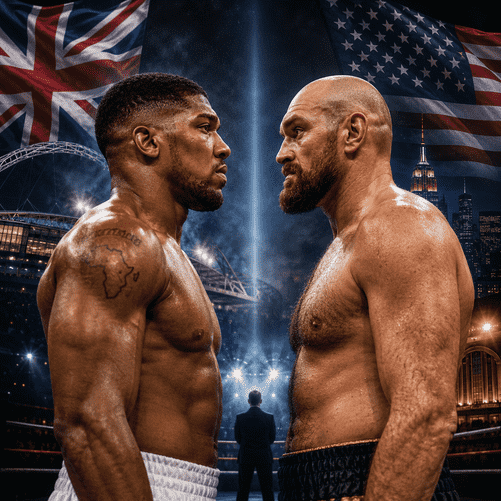
Frank Warren says the long-awaited heavyweight clash must be resolved within days, with Tyson Fury already training in the United States and prepared to move on if Anthony Joshua does not agree to revised terms.

The endlessly anticipated heavyweight collision between Tyson Fury and Anthony Joshua has entered what may finally be its decisive week.
Promoter Frank Warren says negotiations over the all-British super-fight cannot continue indefinitely and expects the uncertainty to be resolved by the end of next week. If an agreement is not completed by then, Fury is prepared to abandon the matchup and face another opponent in November.
After years of false starts, public challenges and collapsed negotiations, the message from Fury’s camp is increasingly simple: the clock is running out.
Warren told The Guardian that Fury has already begun training in Miami and intends to fight in November regardless of whether Joshua is standing in the opposite corner. The promoter says the remaining decision effectively rests with Joshua and his representatives.
The proposed fight has long been regarded as one of the biggest events available to world boxing — two former heavyweight champions, both British, whose careers have unfolded in parallel for more than a decade without ever meeting in the ring.
This time, however, the obstacle is not simply whether the fighters want the contest.
It is where the fight will take place, how much each boxer will be paid and who absorbs the financial consequences of moving an event originally expected to be staged in Britain to the United States.
Wembley gives way to America
The original expectation was that Fury and Joshua would finally settle their rivalry in front of a British crowd, most likely at Wembley Stadium.
That plan has become increasingly uncertain.
Promoters and commercial partners now favor staging the fight in the United States, with Madison Square Garden in New York emerging as the leading candidate and November 20 widely discussed as a potential date.
The shift has created complications because Joshua’s existing agreement was reportedly structured around a fight in the United Kingdom.
His promoter Eddie Hearn has argued that relocating the contest changes the commercial terms substantially. Fighting in America can affect taxation, travel, promotional obligations and other financial considerations, meaning Joshua’s team is seeking revised compensation before accepting the move.
Warren, meanwhile, says Fury would also have preferred Wembley but has accepted the commercial reality.
He told Sky Sports that the huge sums being offered and the interests of broadcasters and international organizers make an American venue increasingly likely.
That has transformed what once seemed like a simple question — can Fury and Joshua finally agree to fight? — into a complicated negotiation involving contracts, broadcasters, promoters, tax considerations and international event organizers.
Fury is already moving forward
What makes the latest deadline different from previous rounds of negotiations is Fury’s preparation.
The former WBC heavyweight champion has travelled to the United States and begun training in Miami.
According to Warren, Fury is not preparing specifically on the assumption that Joshua will eventually sign. He is preparing to fight in November, full stop.
If Joshua does not agree, Fury’s team intends to select somebody else.
Reports suggest that an alternative opponent has already been identified, with heavyweight contender Agit Kabayel mentioned among the possible names. Fury’s brother Shane has indicated that contingency plans are in place so that the November date does not disappear if the Joshua negotiations collapse.
That gives Warren additional leverage.
Joshua is no longer simply negotiating over the terms of a theoretical bout. He is negotiating against a timetable under which Fury can continue his career without him.
For Warren, another prolonged delay is unacceptable.
The promoter has made clear that both fighters are approaching a stage in their careers where postponement carries increasing risk. Fury is 38, while Joshua is 36. Every additional year makes the possibility that injuries, defeats or retirement derail the contest more realistic.
Joshua’s recent performance complicates the picture
There is another element hanging over the negotiations: Joshua’s recent form.
Joshua returned to action against Kristian Prenga last month and ultimately secured a second-round stoppage, but not before being dropped twice in the opening round.
The performance reignited questions about his vulnerability under pressure.
Warren has openly questioned how eager Joshua will be to face Fury after those knockdowns, arguing that Fury would present a dramatically more difficult challenge than Prenga.
Joshua, however, remains one of the division’s most dangerous punchers.
He has rebuilt his career several times following major defeats, and his commercial appeal remains enormous. A fight against Fury would almost certainly generate extraordinary global interest regardless of the venue.
That is precisely why negotiations have survived this long.
Neither camp wants to walk away from the amount of money the event could generate.
The fight British boxing has waited a decade to see
The fascination surrounding Fury versus Joshua comes partly from timing.
For much of the late 2010s and early 2020s, the pair collectively dominated British heavyweight boxing.
Joshua became a two-time unified world champion, filling stadiums and establishing himself as one of the most marketable athletes in the country.
Fury returned from a lengthy absence to produce his celebrated trilogy with Deontay Wilder, eventually becoming WBC champion and establishing himself as one of the defining heavyweights of his generation.
At different moments, Fury and Joshua appeared to hold virtually every major heavyweight title between them.
Yet the fight never happened.
Negotiations repeatedly became entangled in mandatory challengers, rematch clauses, promotional disputes and competing broadcasting agreements.
The bout that once might have crowned an undisputed heavyweight champion is now arriving at a very different stage of both men’s careers.
That does not necessarily make it less compelling.
If anything, the years of rivalry have intensified the emotional importance of the matchup.
Both men now have losses on their records. Both have been world champions. Both have experienced dramatic highs and serious setbacks.
A fight today would therefore be less about determining an undisputed champion and more about settling one of the longest-running unanswered questions in modern British boxing.
Why America wants the fight
The push toward New York also demonstrates how much the economics of boxing have changed.
A fight between two British boxers would traditionally seem destined for Wembley, where a crowd approaching 90,000 could provide an extraordinary atmosphere.
But modern boxing increasingly depends on global streaming platforms and international financial backing.
Netflix is expected to play a major broadcasting role in the Fury–Joshua event, while Saudi-backed organizers have been influential in determining where and how many of boxing’s biggest fights take place.
An American prime-time broadcast could offer greater value to streaming partners than a traditional Saturday-night London event.
Warren has pointed to boxing history to defend the possibility.
Muhammad Ali and George Foreman were American superstars, yet their legendary 1974 encounter took place in Zaire. Ali and Joe Frazier fought their third contest in Manila.
Major fights, Warren argues, ultimately follow the money.
For British supporters, however, that argument may provide little consolation.
Fury versus Joshua has always been imagined as a British sporting event — Wembley under the lights, tens of thousands of supporters and two of the country’s biggest heavyweight stars finally standing across from one another.
Moving it to New York would inevitably change the character of the occasion.
Joshua now faces a decision
The next move belongs largely to Joshua’s team.
Hearn has indicated that revised contractual terms have been submitted and that negotiations remain alive. His position is not necessarily that Joshua refuses to fight in America, but that the financial conditions must reflect the changes imposed by moving the event away from Britain.
Warren believes those issues can still be resolved.
Earlier this week, he publicly predicted the fight would ultimately take place in America, saying he expected contractual disagreements involving Matchroom and Joshua to be ironed out.
His tone now carries greater urgency.
There comes a point, Warren argues, when Fury cannot continue training without knowing who he is fighting.
That point is approaching rapidly.
One last chance
Boxing supporters have learned to treat Fury–Joshua announcements cautiously.
The fight has appeared close before.
Contracts have been discussed before.
Deadlines have passed before.
And each time, one of the biggest contests in British boxing history has disappeared back into negotiation.
The difference this time is that both fighters are active, a November date exists, Fury is already in camp and alternative plans are being prepared.
That leaves very little room for another lengthy delay.
If Joshua agrees to the revised terms, boxing may finally receive the heavyweight event it has been waiting years to see.
If he does not, Fury will move on, and the sport will once again be left wondering whether two of Britain’s most famous heavyweights will somehow finish their careers without ever sharing a ring.
After years of uncertainty, Warren believes the answer is now only days away.