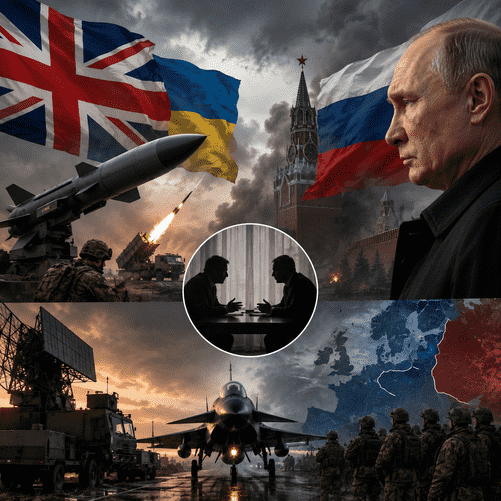
Moscow warns that British military assets could become targets as London deepens missile cooperation with Ukraine, while a reported CIA mission to Moscow underscores Western concern that Russia could attempt to test NATO’s defenses.

Tensions between Britain and Russia have escalated sharply after Moscow accused the United Kingdom of “playing with fire” over its expanding military support for Ukraine and warned that British military targets could face retaliation.
The warning came as separate reports revealed that CIA Director John Ratcliffe travelled to Moscow this week to caution Russian officials against launching any attack on a NATO member state, amid mounting Western concern that the Kremlin could attempt a limited operation designed to test the alliance’s resolve.
The latest confrontation was triggered in part by Britain’s decision to provide Ukraine with sensitive technology associated with the Storm Shadow long-range cruise missile, potentially allowing Kyiv to develop and eventually manufacture its own version of the weapon.
British Prime Minister Andy Burnham, visiting Kyiv earlier this week, said his government would continue supporting Ukraine despite increasingly aggressive Russian warnings. Britain has agreed to make previously classified information on British-produced components available to Kyiv, while also cooperating with France on efforts to establish missile production capacity inside Ukraine.
The move represents a significant evolution in Western military assistance.
Rather than simply supplying Ukraine with a limited number of finished missiles, transferring technical knowledge could help Kyiv build a more sustainable domestic long-range strike capability, reducing its dependence on Western stockpiles over time.
That prospect has provoked an unusually direct response from Moscow.
Russian Foreign Ministry spokesperson Maria Zakharova said Thursday that Britain and France were “playing with fire” and warned that British military installations and equipment could be targeted in retaliation for Ukrainian strikes carried out with Western-supplied weapons.
Zakharova suggested that potential Russian retaliation would not necessarily be confined to Ukraine, raising the possibility that British military assets elsewhere could be considered legitimate targets by Moscow.
Russia has issued numerous threats against Western governments during the war, but the latest language is among its strongest directed specifically at Britain.
Moscow has repeatedly argued that Western countries supplying long-range weapons and intelligence to Ukraine are becoming direct participants in the conflict. NATO governments reject that interpretation, maintaining that Ukraine has the right to defend itself against Russian aggression and that military assistance does not make donor countries belligerents.
The dispute has become increasingly sensitive as Ukrainian forces expand their ability to strike targets far behind Russian lines.
Storm Shadow missiles, jointly developed by Britain and France, are designed to hit heavily defended targets at considerable distance. Ukraine has previously used the weapons against Russian military infrastructure and targets in Russian-occupied Ukrainian territory.
Russia now fears that greater Ukrainian production capacity could make such strikes both more frequent and less dependent on political decisions in London or Paris.
The confrontation comes at an especially delicate moment for NATO.
According to the Wall Street Journal, CIA Director John Ratcliffe made an unusual visit to Moscow on Tuesday after American intelligence assessments raised concern that Russia might attempt some form of limited attack against a NATO member.
The potential scenarios reportedly under consideration did not necessarily involve a full-scale conventional invasion. They ranged from cyberattacks and other hybrid operations to a small military incursion, potentially involving one of the Baltic states.
Such an operation could present NATO with an extraordinarily dangerous dilemma.
Article 5 of the North Atlantic Treaty establishes that an attack against one member can be considered an attack against all. But a deliberately ambiguous or limited Russian action could be designed to test how quickly — and how decisively — allies would respond.
The reported intelligence assessment appears to have been serious enough for Washington to send its intelligence chief directly to the Russian capital.
Ratcliffe reportedly met senior Russian intelligence officials rather than President Vladimir Putin himself, although Putin was subsequently briefed on the discussions. The CIA has not publicly detailed the mission.
The visit carries historical significance.
In November 2021, then-CIA Director William Burns travelled to Moscow to warn senior Russian officials about the consequences of invading Ukraine. Russia launched its full-scale invasion less than four months later.
That precedent has inevitably intensified scrutiny of Ratcliffe’s latest mission.
The Kremlin has attempted to dismiss reports of preparations for an attack on NATO. Spokesperson Dmitry Peskov characterised recent coverage as part of a wave of alarmist reporting and rejected suggestions that Moscow was planning an imminent confrontation with the alliance.
Nevertheless, NATO governments have become increasingly concerned about Russian activity below the threshold of conventional war.
European officials have accused Moscow or Russian-linked actors of involvement in cyberattacks, sabotage operations, GPS interference, infrastructure disruption and other forms of hybrid warfare.
Any attempt to combine such tactics with even a small military incursion could create an exceptionally difficult test for NATO decision-making.
The strategic environment is made more complicated by emerging weaknesses in Western air defence.
A separate Associated Press investigation reported Thursday that American stocks of Patriot missile interceptors in Europe are at critically low levels, partly because large quantities have been diverted to Ukraine and because the United States has consumed substantial numbers of interceptors during conflict in the Middle East.
Patriot systems are among NATO’s most important defences against ballistic missiles.
The shortage has therefore raised uncomfortable questions about how well European allies could withstand a sudden missile campaign if tensions with Russia escalated further.
Britain’s decision to deepen missile cooperation with Ukraine must be understood against that broader backdrop.
London argues that strengthening Ukraine’s ability to strike Russian military infrastructure ultimately strengthens European security by increasing the cost of aggression for Moscow.
Burnham has rejected Russian accusations that Britain is deliberately escalating the war, arguing instead that responsibility for the conflict rests with the Kremlin.
During his visit to Kyiv on August 24, he accused Russia of making “outrageous threats” and insisted that British support would continue.
His government is also encouraging allies to provide additional air-defence capabilities to Ukraine as Russian forces intensify missile and drone attacks against Ukrainian infrastructure.
Recent Russian strikes have targeted energy facilities, ports, industrial sites and logistics infrastructure across several Ukrainian regions, while Ukraine has continued its own campaign of long-range drone and missile attacks against targets inside Russia.
The result is an increasingly dangerous cycle of long-range escalation.
Ukraine is gradually acquiring weapons capable of reaching deeper into Russian territory. Russia is responding with stronger threats against the Western governments enabling those capabilities. NATO, meanwhile, is reinforcing its eastern defenses while attempting to determine whether Moscow’s rhetoric represents intimidation or preparation for something more serious.
The greatest danger may lie in miscalculation.
Russia may hope that threatening Britain and other European countries will discourage further military assistance to Kyiv. Western governments, however, may conclude that yielding to such threats would encourage Moscow to escalate further.
At the same time, a limited Russian operation against NATO territory — particularly one deliberately designed to remain below the threshold of a conventional invasion — could force the alliance to decide rapidly whether deterrence requires an immediate military response.
That makes the reported CIA warning to Moscow particularly significant.
Washington appears determined to ensure that Russian officials understand that even a limited attack on NATO territory could produce consequences far beyond those of the war in Ukraine.
For Britain, the calculation is similarly stark. London believes that helping Ukraine develop a stronger independent missile capability can constrain Russia over the long term. Moscow, meanwhile, is warning that the same policy is bringing Britain closer to direct confrontation.
Neither side currently appears prepared to change course.
What began as a war confined geographically to Ukraine is increasingly shaping the military posture, weapons production and strategic calculations of the entire European continent. The latest exchange between London and Moscow is therefore more than another round of hostile rhetoric: it is a reminder that the boundary between supporting Ukraine and confronting Russia directly is becoming increasingly difficult to manage.