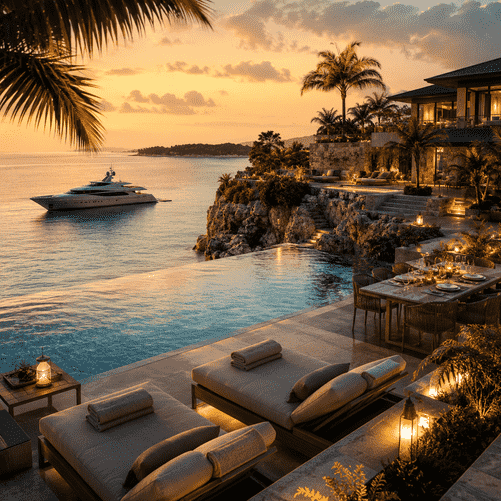
From St. Barth to Sicily and the Bahamas, high-end island holidays are becoming more expensive, yet demand for privacy, exclusivity and experience-led travel shows little sign of weakening.

Luxury travel is entering another expensive phase, and nowhere is the shift more visible than on the world’s most sought-after islands.
From the Caribbean to the Mediterranean, affluent travelers are continuing to spend heavily on secluded resorts, private villas, yacht charters and highly personalized itineraries even as the overall cost of international holidays rises. New analysis published this week highlights how some celebrity-favored island escapes can now push the cost of a relatively short luxury vacation toward $11,000 before private aviation, yacht hire or other premium extras are added.
The trend illustrates an increasingly divided global travel market. Higher aviation fuel costs, tourism taxes and rising hotel and restaurant prices are making overseas holidays more expensive for ordinary travelers. At the upper end, however, those same pressures appear to be doing relatively little to suppress demand.
Instead, scarcity itself is becoming part of the attraction.
Islands such as St. Barth in the French Caribbean, Harbour Island in the Bahamas and Sicily have attracted wealthy and high-profile visitors looking for privacy, warm-weather escapes and accommodations capable of providing a more secluded experience than conventional luxury hotels. Celebrity travel has helped reinforce the appeal, turning certain islands into globally recognizable symbols of discreet wealth.
The phenomenon extends well beyond celebrity tourism. Luxury-travel specialists report intense competition among ultra-high-net-worth clients for the best hotel suites, private lodges and exclusive experiences. At some properties, nightly rates have climbed into the thousands of dollars while reservations for peak periods are being made months—or even years—in advance.
This willingness to pay extraordinary prices is changing what luxury hospitality actually sells.
A decade ago, five-star travel was commonly defined by large suites, premium restaurants and polished service. Today, the most affluent customers increasingly expect something harder to replicate: privacy, privileged access and experiences designed specifically around them.
A villa overlooking an empty beach may therefore command more attention than a conventional presidential suite. A private chef, yacht transfer, remotely located wellness program or dinner arranged somewhere normally inaccessible can become more valuable than traditional displays of hotel opulence.
The shift reflects a broader transformation in luxury consumption. Research and industry commentary suggest wealthy consumers are placing greater emphasis on individuality and personal experiences rather than immediately recognizable status symbols. Travel is particularly well positioned to benefit because an exceptional holiday can deliver something a conventional luxury product cannot: time, access and memories that are difficult for others to reproduce.
Islands Become the Ultimate Luxury Commodity
The geography of luxury travel reinforces this idea of scarcity.
Unlike major cities, island destinations have finite amounts of land and accommodation. High-end resorts often deliberately limit the number of villas available, while private-island properties can accommodate only a handful of guests.
During Christmas, New Year and other peak periods, the best properties can therefore become extraordinarily difficult to secure regardless of price.
Recent research based on Expedia travel interest identified luxury islands as one of the strongest segments of aspirational tourism in 2026, with travelers showing interest in destinations ranging from traditional Caribbean retreats to considerably more remote island environments.
The Maldives remains perhaps the clearest expression of this model. Its overwater villas, private pools and isolated resort islands effectively transformed geographical remoteness into a luxury product. But the concept has spread worldwide.
In the Mediterranean, Sicily and smaller Greek and Italian islands increasingly combine luxury hotels with private villas, superyachts, gastronomy and cultural tourism. The Caribbean offers mature private-island and villa markets, while destinations farther from established tourism corridors are positioning isolation itself as the premium experience.
At the same time, hotel companies are searching beyond Europe’s most crowded coastal destinations as overtourism, congestion and resistance from local communities complicate further expansion. Major hospitality groups are increasingly looking toward smaller cities, rural regions and less saturated destinations in Spain, Portugal, Italy and elsewhere.
That could gradually broaden the map of European luxury holidays.
A $2.5 Billion Bet on the Future of Luxury Travel
The scale of investment entering the sector offers another indication that hospitality companies believe demand will continue.
Puerto Rico recently authorized the development of a roughly $2.5 billion resort community near Boquerón Bay on the island’s southwest coast. The proposed Esencia development is expected to span more than 2,000 acres and bring together internationally known luxury hospitality brands including Aman, Mandarin Oriental and Rosewood. Plans also include residences, a golf course, beach club and supporting infrastructure.
Significantly, the project is designed to incorporate its own solar-powered energy and water infrastructure.
That reflects another change taking place in high-end tourism. Environmental resilience and sustainability are increasingly becoming part of the luxury proposition rather than simply a corporate responsibility program.
Remote resorts require enormous quantities of electricity, freshwater, food and transportation. Properties that can generate cleaner power, reduce dependence on strained public infrastructure and operate more efficiently may increasingly appeal to both governments and wealthy travelers concerned about the environmental footprint of premium tourism.
Price Resistance Is Weak at the Very Top
For hotel operators, perhaps the most remarkable feature of the current market is the persistence of demand despite rapidly rising prices.
Industry reporting indicates that some ultra-luxury properties are commanding several thousand dollars per night, with rates at certain new resorts around $6,000 and premium accommodation prices substantially above their pre-pandemic levels. Yet travel advisers continue to report wealthy customers competing for limited inventory rather than trading down.
Part of the explanation is simple economics.
The global population of very wealthy individuals has expanded, producing a larger pool of customers competing for a relatively small number of truly exceptional hotel suites, villas, safari lodges and yachts.
But generational changes may be equally important. Wealthy younger travelers appear particularly willing to spend on distinctive experiences. For them, travel frequently functions not merely as leisure but as an expression of identity and lifestyle.
That makes a remote island holiday especially attractive.
Privacy can be controlled. Experiences can be customized. Large groups of family and friends can occupy an entire villa or estate. And unlike highly recognizable luxury products, the experience can remain almost completely private if the traveler chooses.
The New Definition of a Luxury Holiday
The implications for the travel industry are substantial.
Hotels can no longer assume that marble bathrooms, infinity pools and Michelin-level restaurants are enough to justify continuously rising rates. At the highest end of the market, those features are increasingly considered standard.
The new competitive advantage is access.
That could mean swimming in waters reached only by private boat, dining with a chef outside normal restaurant hours, visiting a cultural site after it has closed to the public, chartering an aircraft directly to a remote destination or simply spending several days somewhere almost entirely removed from crowds.
Travel companies are responding by designing increasingly elaborate itineraries that combine accommodation with aviation, yachts, wellness, gastronomy and private cultural experiences.
The result is a market in which the conventional distinction between a hotel and an experience is rapidly disappearing.
There are limits to the boom. Geopolitical instability can quickly alter travel patterns, extreme weather threatens many coastal destinations, and growing hostility toward overtourism could restrict future development in some of the world’s most desirable locations.
Yet luxury travelers have historically proved highly adaptable. When one destination becomes crowded, unstable or difficult to reach, spending tends to migrate elsewhere rather than disappear altogether.
That adaptability helps explain why investment continues flowing into remote resorts and private-island experiences even as the price of premium travel climbs.
For the wealthiest travelers, the defining luxury of 2026 is increasingly neither a recognizable brand nor a lavish hotel room.
It is the ability to go somewhere extraordinary, experience it on their own terms—and, preferably, have very few other people there when they arrive.