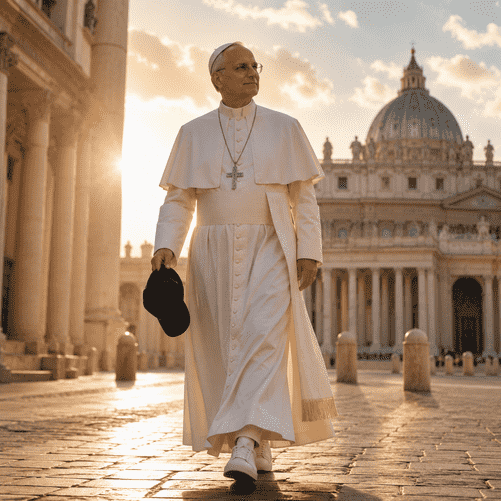
Vanity Fair has named Leo XIV among 2026’s best-dressed figures, celebrating a wardrobe that blends centuries-old Vatican tradition with trainers, baseball caps and an unmistakably American sense of informality.

Pope Leo XIV has joined the ranks of the world’s most fashionable personalities after earning a place on Vanity Fair’s revived Best Dressed List, an unexpected accolade for a pontiff whose wardrobe combines the ceremonial traditions of the Vatican with distinctly contemporary touches.
The magazine placed the 70-year-old head of the Catholic Church in its “Originals” category, reserved for personalities whose clothing reflects an especially distinctive personal identity. The selection puts Leo alongside cultural figures celebrated not simply for wearing expensive clothes, but for developing a recognizable visual language of their own.
For Pope Leo, that language is built on contrast.
His public appearances remain dominated by the familiar white cassock and formal papal vestments associated with one of the world’s oldest institutions. Yet beneath that highly codified exterior, Leo has repeatedly displayed flashes of a much more relaxed personality: vintage-style Nike trainers, conventional black shoes rather than the traditional red papal footwear, and even a Chicago White Sox baseball cap.
It is precisely that collision between sacred tradition and everyday American casualwear that has attracted the attention of the fashion world.
Vanity Fair highlighted Leo’s habit, dating from before his election as pope, of pairing his modest cream clerical clothing with Nike sneakers, praising the way he elevated the combination while retaining an air of informality. The magazine also singled out his occasional use of baseball caps as part of what it described as his continuing sense of casualness.
The sneakers have become perhaps the most surprising element of the papal wardrobe.
Images that circulated earlier this year showed Leo wearing Nike Franchise Low Plus trainers, a retro model associated with the late 1970s and 1980s. Their appearance beneath traditional clerical robes immediately caught the attention of sneaker enthusiasts, particularly because modern audiences had become accustomed to questioning extraordinary images of popes after the explosion of AI-generated fashion pictures online.
This time, however, the footwear was real. Vanity Fair reported in May that the trainers appeared in a Vatican-produced documentary chronicling Leo’s years in Rome before becoming pope, suggesting that the casual footwear was an established part of his personal wardrobe rather than a carefully manufactured post-election fashion statement.
The combination has helped create something unusual in contemporary religious imagery: a pope whose style is simultaneously conservative and unexpectedly modern.
Leo has not attempted to reinvent the papal uniform. Instead, his appeal appears to come from allowing small elements of personality to emerge through an institution where clothing is heavily shaped by history, hierarchy and symbolism.
His Chicago roots have played an important role in that image.
Born Robert Francis Prevost in the United States, Leo became the first American pope when he was elected to lead the Catholic Church. His appearance in a Chicago White Sox baseball cap therefore carried more than simple fashion significance. It offered an immediately recognizable connection to his hometown and to a familiar part of American popular culture.
The image of the pontiff wearing a baseball cap alongside papal garments rapidly circulated online, reinforcing the impression of a religious leader comfortable moving between ceremonial grandeur and ordinary personal references.
That accessibility may explain why Leo’s clothing has generated particular interest among younger audiences.
Fashion increasingly rewards unexpected combinations, personal authenticity and the mixing of formal and casual clothing. The pope’s wardrobe, whether intentionally fashionable or not, happens to sit squarely within that contemporary aesthetic.
A pair of old-school trainers under flowing clerical robes effectively performs the same stylistic trick seen throughout modern menswear: combining garments traditionally belonging to completely different worlds.
In Leo’s case, however, the contrast is far more dramatic.
Few outfits carry more historical meaning than papal vestments. The white cassock itself represents an office shaped by centuries of ritual and Catholic tradition. Adding sneakers does not erase that symbolism; instead, it makes the person inside the institution more visible.
The fashion recognition is also part of a much broader cultural fascination with Vatican clothing.
Catholic imagery has influenced designers for decades, from ornate embroidery and ecclesiastical silhouettes to the use of crosses, vestments and Renaissance references on fashion runways. That relationship reached one of its most spectacular moments with the Metropolitan Museum of Art’s 2018 exhibition Heavenly Bodies: Fashion and the Catholic Imagination, which explored the enormous influence Catholic visual culture has had on designers.
Papal style itself has also varied significantly between pontificates.
Some popes embraced elaborate vestments and traditional accessories, while others deliberately cultivated greater simplicity. Pope Francis became particularly associated with modest clothing and understated presentation, reinforcing his broader emphasis on humility.
Leo appears to be establishing a different visual identity — respectful of traditional papal dress but more willing to allow personal details to remain visible.
His choice of black oxfords rather than conspicuous red slippers has contributed to that image, as has his preference for accessories that appear functional rather than ostentatious. Reports have also drawn attention to his vintage Swiss watch, another understated element that has attracted interest among style observers.
The result is a wardrobe that rarely looks designed to attract attention yet repeatedly succeeds in doing so.
That quality fits neatly with the philosophy behind Vanity Fair’s latest Best Dressed List.
Returning for the first time this decade, the 2026 edition emphasizes personal character at a moment when the magazine argues that fashion has become increasingly homogenized by trends such as “quiet luxury” and the dominance of similar-looking designer collections.
The list therefore rewards individuality rather than conventional elegance alone.
Leo’s inclusion makes sense within that framework. Few people on the planet operate under stricter clothing traditions, yet he has managed to establish a recognizable personal aesthetic without dramatically departing from them.
There is also an inevitable element of humour surrounding the idea of papal fashion.
A pontiff appearing on the same type of best-dressed rankings normally dominated by actors, musicians, designers and models seems inherently improbable. Yet it also demonstrates the extraordinary reach of modern fashion culture.
Clothing is increasingly interpreted not merely as decoration but as communication — a way of signaling identity, background, values and attitude.
Seen through that lens, Leo’s wardrobe communicates several things at once.
The cassock conveys continuity with the Catholic Church. The traditional vestments affirm the ceremonial authority of his office. The sneakers suggest practicality and an absence of excessive formality. The White Sox cap unmistakably points back to Chicago.
Together, those elements have created an image that feels both institutional and personal.
Whether Pope Leo thinks of himself as a fashion figure is another question entirely.
His clothing choices appear far more likely to be guided by comfort, familiarity and the demands of his position than by any deliberate attempt to court the fashion press.
But personal style often becomes most compelling precisely when it appears unforced.
That may explain why a 70-year-old pontiff wearing a centuries-old religious uniform has unexpectedly become one of 2026’s most discussed dressers.
In an era dominated by carefully constructed celebrity wardrobes, luxury sponsorships and viral fashion campaigns, Pope Leo has achieved something considerably harder to manufacture: recognizability.
A white cassock, a pair of vintage Nikes and a baseball cap may not sound like an obvious formula for high fashion.
Yet in the Vatican’s latest contribution to global style, the unlikely combination has proved more than enough to take papal dressing to decidedly heavenly heights.