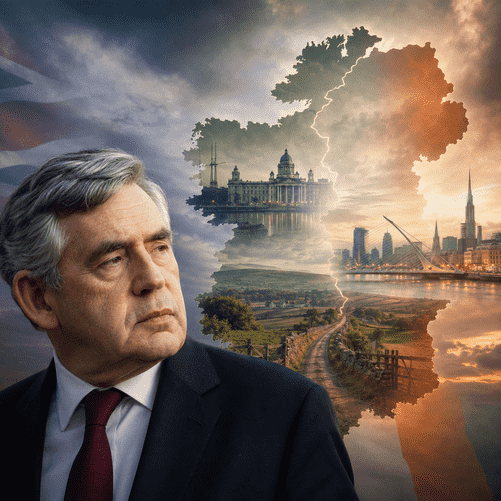
The former prime minister says Irish reunification is likely in the long term, while drawing a sharp distinction with Scotland and reaffirming his opposition to Scottish independence.

Former British prime minister Gordon Brown has said he believes Ireland will eventually be united, arguing that Northern Ireland’s constitutional future is fundamentally different from Scotland’s relationship with the rest of the United Kingdom.
Brown, a lifelong defender of the union and one of the most prominent Labour figures to campaign against Scottish independence, said in an interview published on Saturday that Irish reunification was likely to happen over the long term. His intervention is particularly striking given his own role in the political process that helped consolidate peace and power-sharing in Northern Ireland.
Brown served as chancellor under Tony Blair when the Good Friday Agreement was signed in 1998, and he was prime minister in 2010 when policing and justice powers were devolved to Northern Ireland’s power-sharing institutions. Those experiences place him among the senior British politicians most closely associated with the post-conflict constitutional settlement.
His comments came while discussing the future of Scotland and renewed pressure for independence. Brown argued that Scotland should remain within the UK because of its extensive economic, geographic, social and cultural connections with England, Wales and Northern Ireland.
But when challenged on whether the same geographic logic might support closer constitutional integration between Northern Ireland and the Republic of Ireland, Brown acknowledged that he believed Irish unity would ultimately prevail.
He cautioned, however, that reunification would not be immediate or inevitable through political momentum alone. Instead, Brown stressed that any constitutional transformation would require a prolonged process based on consent and agreement between communities that have historically held profoundly different views about national identity and sovereignty.
The comments touch directly on one of the central principles of the Good Friday Agreement: Northern Ireland remains part of the United Kingdom unless a majority of its population votes otherwise.
Under the settlement, the UK government is responsible for calling a referendum — commonly known as a border poll — if the Northern Ireland secretary concludes that a majority appears likely to support reunification. Precisely what evidence would trigger such a referendum remains politically contested, and debate over the criteria has intensified as demographic, electoral and political conditions have changed.
Brown’s remarks therefore carry significance beyond their immediate political symbolism.
For decades, the constitutional question in Northern Ireland was inseparable from violence between republican and loyalist communities. The Good Friday Agreement transformed that conflict by establishing institutions based on power-sharing, cross-border cooperation and the principle of democratic consent.
Today, discussion of reunification increasingly occurs through electoral politics, economic analysis and constitutional planning rather than armed confrontation.
Sinn Féin has long advocated for a united Ireland, while unionist parties continue to support Northern Ireland remaining within the United Kingdom. Any future referendum would consequently require not only a numerical majority but also careful consideration of citizenship, public services, taxation, healthcare, policing and the rights of the unionist population.
The economic dimension would be particularly complex.
Northern Ireland currently operates within the UK fiscal system and receives substantial public spending from Westminster. Reunification would raise questions over how that funding would be replaced, how taxation and welfare systems would be harmonised and how two healthcare systems — the Republic’s mixed public-private structure and Northern Ireland’s NHS model — could eventually be integrated.
At the same time, advocates of unity argue that removing the constitutional division of the island could generate economic opportunities through closer integration with the European Union, streamlined infrastructure and an expanded all-Ireland market.
Brexit has already altered the debate significantly.
Northern Ireland occupies a unique economic position because arrangements designed to prevent a hard border on the island allow it unusually close access to both the UK internal market and parts of the EU single market. That arrangement has created political friction with unionists but has also strengthened the economic connection between Northern Ireland and the Republic.
Brown’s comments arrive at a moment when broader questions about the survival of the United Kingdom are again receiving attention.
Political leaders in Scotland, Wales, Northern Ireland and the Republic of Ireland have increasingly discussed the possibility of major constitutional change, particularly as shifts in British politics raise uncertainty over the long-term direction of the union. Recent reporting has suggested that political figures across the Celtic nations are already considering how the UK might evolve or fragment under future governments.
Yet Brown remains adamant that Scotland should not follow the same path.
His distinction rests on the argument that Scotland is deeply embedded within the economic and institutional architecture of Great Britain. Despite acknowledging significant support for Scottish independence, Brown has consistently argued that greater cooperation and constitutional reform offer a better solution than separation.
That position reflects his prominent role in the 2014 Scottish independence referendum, when he emerged as one of the most forceful advocates of remaining within the UK.
His latest comments therefore reveal an unusual constitutional position: a former British prime minister defending the continued union of Scotland and England while simultaneously accepting that Northern Ireland may ultimately choose to leave.
Such a view illustrates how dramatically the politics of British and Irish identity have evolved since the Troubles.
For Brown, however, the critical issue is not whether constitutional change can happen but how it happens. His emphasis remains on consent, negotiation and political agreement rather than unilateral action.
A united Ireland, in that interpretation, would not simply be the absorption of Northern Ireland into the Republic. It would require a broader political settlement capable of accommodating British as well as Irish identities and providing credible guarantees to communities that might find themselves part of a new constitutional arrangement.
That challenge could make the process extraordinarily long.
Nevertheless, Brown’s prediction is notable precisely because of who is making it. When a former Labour prime minister and committed supporter of the United Kingdom publicly accepts that Northern Ireland may ultimately leave it, the statement reflects how far Irish reunification has moved from the political margins toward mainstream constitutional debate.
Whether Ireland actually becomes united will ultimately depend not on predictions from Westminster but on voters north and south of the border.
Brown’s intervention nevertheless reinforces a growing reality: the constitutional map of the British Isles, long treated as relatively fixed, is once again becoming an open political question.