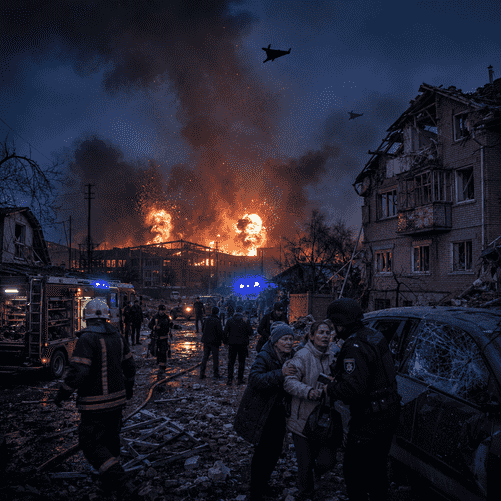
At least 27 people were killed after a drone attack struck a warehouse in the Bucha district, setting off secondary explosions close to residential areas and prompting a criminal investigation into possible official negligence.

At least 27 people have been killed and dozens injured after a Russian drone strike hit a warehouse near Kyiv and triggered a devastating series of explosions, intensifying scrutiny over why ammunition appears to have been stored so close to civilian homes.
The attack struck the village of Myla in Ukraine’s Bucha district late on Friday, August 28. Ukrainian authorities said the initial Russian strike caused a fire at the warehouse, followed by powerful secondary detonations that spread destruction across the surrounding residential area. At least 42 people were reported injured, while hundreds were evacuated as emergency crews worked through the night.
More than 50 residential buildings were damaged, according to regional officials. A care facility for elderly people and people with disabilities was also affected, alongside homes, vehicles and other civilian property. Fires spread from the warehouse complex into nearby buildings, dramatically increasing the scale of the disaster.
Ukrainian President Volodymyr Zelenskyy confirmed that the strike had hit a warehouse and was followed by a major detonation. He also announced that criminal proceedings had been opened to determine whether officials had violated regulations governing the storage of ammunition near populated areas.
“There are regulations in place – ammunition cannot be stored near homes or other residential areas,” Zelenskyy said, placing unusual public emphasis on the possibility that Ukrainian negligence had contributed to the casualties.
The investigation adds a second dimension to the tragedy. While the Russian attack was the direct trigger for the destruction, Ukrainian prosecutors are examining whether improper storage practices turned a targeted strike into a far more lethal event for civilians.
That distinction is becoming politically sensitive in Ukraine, where military logistics increasingly operate under pressure from Russia’s persistent long-range drone and missile campaign.
Modern ammunition depots are ordinarily subject to strict requirements governing distance from residential areas, fire protection, blast containment and the separation of explosive materials. When large quantities of ammunition are concentrated in unsuitable buildings, a relatively localized strike can initiate a chain reaction of secondary explosions capable of causing destruction well beyond the original target.
The Myla disaster appears to have produced precisely that kind of cascading effect.
Ukraine’s Prosecutor General’s Office has opened a pre-trial investigation into possible negligence surrounding the warehouse’s storage conditions. Authorities are expected to examine who authorized the site, what was stored there, whether the necessary permits existed and whether safety requirements were followed.
The investigation carries additional significance because Ukraine experienced a strikingly similar incident only weeks earlier.
On July 6, a Russian attack on Vyshneve, southwest of Kyiv, struck a defense-sector warehouse and triggered the detonation of ammunition stored inside. Ukrainian investigators later concluded that ammunition had been kept in facilities that were unsuitable for explosive materials and situated immediately beside residential areas.
The Security Service of Ukraine subsequently detained the chief executive and deputy production director of the defense enterprise responsible for the site. Investigators alleged that the warehouses were not authorized for ammunition storage and that safety regulations had been ignored.
That earlier incident has made the latest disaster particularly damaging for Ukrainian authorities.
Prime Minister Serhii Koretskyi has questioned why comparable safety failures may have been repeated despite the lessons of Vyshneve. The possibility that two deadly Russian strikes could have been amplified by ammunition storage practices near civilian neighborhoods is likely to increase pressure for stricter oversight of military and defense-industrial logistics.
For Russia, warehouses connected with Ukrainian military production and logistics remain important targets.
Moscow said its latest attacks were directed against military-related infrastructure, including facilities associated with drone components. Russian forces have increasingly used large numbers of attack drones alongside missiles to overwhelm Ukrainian air defenses and strike logistics hubs, energy installations, factories and storage facilities across the country.
The Bucha district carries particular symbolic weight. The area became internationally known in 2022 after evidence emerged of mass killings and other atrocities committed during the Russian occupation in the opening phase of the full-scale invasion.
More than four years later, communities around Kyiv remain exposed to long-range Russian attacks despite being hundreds of kilometers from much of the active front.
The latest strike came during another sustained wave of aerial assaults against Ukraine. Kyiv and surrounding regions have endured repeated air-raid alerts, while attacks have also affected Kharkiv, Zaporizhzhia, Sumy and Kherson. Warehouses, homes, shopping facilities and critical infrastructure have all been damaged during the recent bombardments.
The growing use of relatively inexpensive attack drones has transformed the geography of the war.
Military production, logistics and storage facilities far behind the front can now be attacked repeatedly, forcing Ukraine to disperse sensitive equipment and ammunition. Yet dispersal also creates difficult security decisions: placing smaller depots across populated regions can reduce the strategic consequences of losing one major facility, while potentially exposing civilians if proper separation and protective measures are not maintained.
That tension lies at the center of the investigation now under way.
Ukraine must continue moving weapons, ammunition and drone components through areas that also contain cities, businesses and residential communities. But the deaths in Myla underline the potentially catastrophic consequences when military logistics and civilian spaces overlap too closely.
Responsibility for the initial attack remains with the Russian forces that launched it. Ukrainian authorities, however, are signaling that wartime conditions will not automatically shield domestic officials from scrutiny where safety regulations may have been ignored.
That willingness to investigate could become increasingly important as Ukraine’s defense industry expands and production facilities become more dispersed across the country.
For the families affected in Myla, the immediate concerns are much more basic. Rescue teams continue to clear debris and assess damaged buildings, while hundreds of displaced residents face uncertainty over whether their homes remain habitable.
Officials have cautioned that the death toll could still rise.
The disaster is therefore emerging as both another grim episode in Russia’s aerial campaign against Ukraine and a serious test of Kyiv’s own wartime accountability.
A Russian drone initiated the catastrophe. The investigation now underway will seek to determine whether preventable decisions on the ground helped turn that strike into one of the deadliest attacks on the Kyiv region in recent months.