The agreement gives a US-backed venture majority operational control over fields containing more than 65 billion barrels of proven reserves, potentially reshaping American energy security while reopening questions over Venezuela’s sovereignty and investment risks.

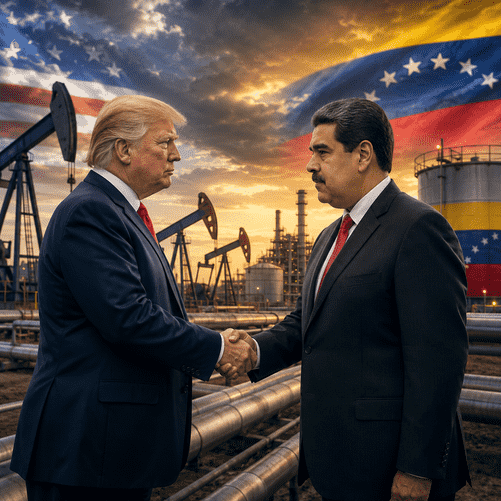
President Donald Trump has announced a far-reaching oil agreement with Venezuela that he says will give the United States majority control over more than 65 billion barrels of proven crude reserves, marking one of the most significant shifts in the relationship between Washington and Caracas in decades.
Trump unveiled the agreement on Friday, August 28, describing it as a major victory for both countries and saying the arrangement would dramatically expand American access to Venezuelan crude. According to the president, the negotiations involved Secretary of State Marco Rubio, Defense Secretary Pete Hegseth and Venezuela’s interim president, Delcy Rodríguez, alongside private-sector participants.
Under the reported structure, a new venture would oversee the development of 17 Venezuelan oil fields containing more than 65 billion barrels of proven reserves. The United States would hold a 55% operational interest in the venture, according to details reported by the Associated Press, while American companies would be positioned to provide capital and technical expertise needed to rehabilitate Venezuela’s badly deteriorated petroleum infrastructure.
The scale of the resources involved is considerable. Venezuela possesses roughly 303 billion barrels of proven crude reserves, the largest officially recorded oil endowment in the world. Much of it is concentrated in the Orinoco Belt, where extremely heavy crude requires significant investment and specialized processing before it can be efficiently brought to international markets.
Trump argued that securing control over the Venezuelan assets would more than double the oil reserves available to the United States and ultimately help lower fuel prices for American consumers. The administration has been under increasing political pressure over gasoline costs ahead of the November midterm elections, while Washington has also been looking for ways to rebuild the Strategic Petroleum Reserve.
The agreement could therefore serve several strategic purposes at once. Greater access to Venezuelan crude could give US refiners a comparatively nearby source of heavy oil, reduce exposure to some overseas suppliers and provide Washington with additional flexibility during periods of disruption in global energy markets.
Venezuelan production, however, remains far below the country’s historical potential. The country currently produces roughly 1.25 million barrels of crude per day, despite its enormous reserves. Years of underinvestment, sanctions, political instability, deteriorating infrastructure and the exodus of technical expertise have severely weakened the industry.
Restoring output will consequently require enormous sums of money and years of work.
The proposed agreement is expected to attract close to $100 billion in private American investment, according to reports, with capital directed toward oilfields, pipelines, upgrading facilities and other infrastructure. Venezuelan officials have presented the arrangement as a cornerstone of the country’s economic reconstruction and have estimated that it could eventually generate as much as $209 billion in government revenue.
For Caracas, that potential influx of capital represents an opportunity to revive an industry that remains fundamental to the country’s economy.
Yet the agreement also marks a profound departure from the resource-nationalist policies that dominated Venezuela for much of the past quarter-century. Under Hugo Chávez and later Nicolás Maduro, the government expanded state control over the oil sector and imposed strict limits on foreign ownership. The new arrangement would place considerable operational authority in the hands of a US-backed structure, representing an extraordinary reversal of that model.
That shift is already generating controversy.
Questions remain over whether the deal complies with Venezuela’s constitution and hydrocarbons legislation, both of which historically assign the state a dominant role in petroleum resources. Analysts have warned that the legal architecture surrounding foreign control of Venezuelan oil could complicate implementation or produce future disputes over ownership, taxation and operating authority.
Venezuelan opposition figures have also reacted angrily, arguing that the agreement risks transferring control over strategic national assets without adequate democratic scrutiny. The political dispute is likely to become increasingly important as details of the arrangement emerge.
For American energy companies, Venezuela presents both extraordinary potential and substantial risk.
The country’s enormous reserves are attractive, particularly to refiners along the US Gulf Coast that were historically configured to process heavy Venezuelan crude. But decades of political interference, asset nationalizations and contractual disputes have left international oil companies wary of committing large amounts of capital without strong legal protections.
Infrastructure presents another obstacle. Production facilities, pipelines, electrical systems and refineries require extensive rehabilitation. Even if companies commit billions of dollars immediately, analysts caution that bringing significant additional volumes onto the market could take years rather than months.
That means the agreement is unlikely to deliver an immediate surge in global oil supply.
Its geopolitical importance may be more immediate.
For years, Venezuela cultivated close relations with Russia, China and Iran as its confrontation with Washington intensified. A large-scale return of American capital into Venezuela’s oil industry could gradually alter those relationships and expand Washington’s influence over one of the world’s most strategically important energy producers.
China has been a particularly significant creditor and customer for Venezuelan crude, while Russia has repeatedly provided Caracas with diplomatic and economic support. A US-backed restructuring of the petroleum sector therefore has implications that extend well beyond energy markets.
It could also strengthen Washington’s influence throughout the Western Hemisphere at a time when control over energy resources, critical minerals and supply chains has become increasingly intertwined with national security policy.
For Trump, the agreement fits into a broader strategy centered on expanding American control over strategic energy supplies while attempting to suppress domestic fuel prices.
Whether the arrangement ultimately achieves those objectives will depend on something considerably more difficult than announcing access to reserves: actually producing the oil.
Venezuela’s 65 billion barrels represent an immense geological resource, but turning those reserves into commercially viable production will require political stability, legal certainty, enormous investment and years of infrastructure reconstruction.
The agreement therefore represents both an extraordinary opportunity and an equally significant gamble. If successful, it could restore Venezuela as a major petroleum producer while giving the United States unprecedented influence over a vast pool of crude close to its own shores.
If political instability, legal disputes or investment hesitation derail the plan, however, much of the promised oil could remain where it has been for decades — beneath the ground.