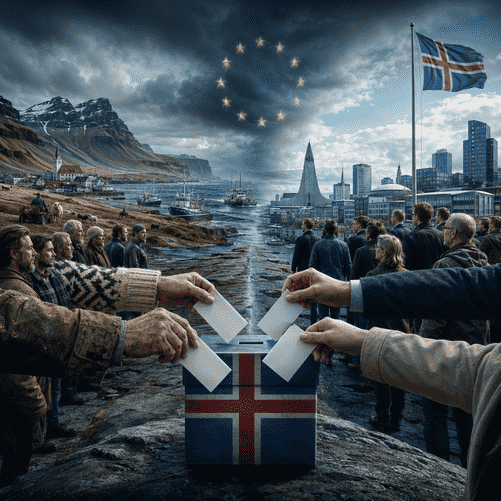
A narrow referendum defeat for renewed accession negotiations exposes a sharp divide between pro-European Reykjavík and communities determined to protect control over fishing, farming and economic policy

Icelanders have narrowly rejected a proposal to reopen negotiations on joining the European Union, dealing a setback to supporters of deeper European integration and reaffirming the country’s longstanding caution toward surrendering national control over some of its most important industries.
In the referendum held on Saturday, August 29, 52.8% of voters opposed restarting accession talks, while 47.2% supported the proposal. Reykjavík emerged as the only region where the “yes” campaign prevailed, while stronger opposition across rural and provincial constituencies ultimately tipped the national result toward rejection.
The vote did not ask Icelanders to approve immediate EU membership. A victory for the “yes” campaign would instead have authorised the government to resume negotiations with Brussels, after which any eventual membership agreement would have been put to voters in a second referendum. The distinction became an important feature of the campaign, with supporters arguing that negotiations would merely allow Iceland to discover what terms it could secure before making a final decision.
For opponents, however, reopening talks risked beginning a process that could eventually weaken Icelandic sovereignty, particularly over fisheries and agriculture.
Fishing remains one of the defining economic and political issues in Iceland’s relationship with the European Union. The sector is deeply embedded in the country’s export economy and national identity, while Iceland has historically insisted on maintaining direct control over fishing quotas and access to its territorial waters.
The prospect of becoming subject to the EU’s Common Fisheries Policy has therefore remained one of the most persistent obstacles to membership. Rural communities and fishing regions were especially resistant to the idea that decisions affecting a strategic national resource might ultimately become subject to negotiation within a wider European regulatory framework.
Agriculture also played a significant role. Icelandic farmers operate under unusual geographic and climatic conditions, and opponents of EU membership argued that greater exposure to European competition could place pressure on domestic food production and agricultural communities. Concerns about food security, subsidies and the ability to maintain policies tailored specifically to Iceland featured prominently in the campaign.
The geographical split in the result reflected those competing priorities.
In Reykjavík, where voters are generally younger, more internationally oriented and less directly dependent on traditional primary industries, support for renewed negotiations was stronger. Many urban supporters viewed EU membership as a potential route toward greater economic stability, particularly after years of concern over inflation, high borrowing costs and volatility in the Icelandic krona.
Outside the capital, however, the argument for economic stability was outweighed by concerns over sovereignty and control of natural resources. The result demonstrated the continuing political power of Iceland’s fishing and agricultural communities even as the country’s economy becomes increasingly service-oriented and internationally connected.
The debate had returned to national prominence against an unusually uncertain geopolitical backdrop.
Iceland is already closely integrated with Europe. It participates in the European Economic Area, giving it extensive access to the EU single market, and it is also a member of the Schengen passport-free travel area. Yet because Iceland is not an EU member, it implements many European economic regulations without holding the same voting rights as member states when those rules are formulated.
Supporters of membership argued that this arrangement leaves Iceland accepting significant portions of EU regulation without exercising proportional influence over the bloc’s decisions. Full membership, they said, could give Reykjavík a stronger voice in European policymaking and potentially open a longer-term path toward adopting the euro.
Economic pressures also helped revive the issue. Rising living costs and relatively high interest rates have intensified debate over whether the small Icelandic krona remains the most effective currency for an economy deeply connected to European trade.
Advocates of closer integration argued that eventual euro adoption could reduce currency volatility and borrowing costs. Opponents countered that abandoning the krona would remove an important tool that allows Iceland to set monetary policy according to its own economic conditions.
Security considerations added another dimension.
Iceland occupies a strategically important position in the North Atlantic and Arctic but maintains no standing army of its own. It has been a NATO member since 1949 and relies heavily on alliances with the United States and other NATO partners for defence.
Russia’s war against Ukraine, growing competition in the Arctic and uncertainty surrounding Washington’s long-term approach to European security had encouraged some Icelanders to reconsider whether EU membership could offer another layer of political and strategic protection.
Yet those arguments were not enough to overcome the deeply rooted scepticism surrounding membership.
The result represents another chapter in Iceland’s complicated relationship with the European Union. Reykjavík first applied for EU membership in 2009 following the devastating global financial crisis, when the collapse of Iceland’s banking system generated intense debate over the country’s economic model and currency.
Formal accession negotiations followed, but domestic political support weakened. The talks were suspended in 2013 and effectively abandoned by a Eurosceptic government two years later.
The 2026 referendum therefore offered Icelanders their first major opportunity in more than a decade to reopen the question.
Prime Minister Kristrún Frostadóttir, whose Social Democratic Party supports closer European ties, had promised to respect the result regardless of the outcome. Before the vote, she argued that reopening negotiations would allow Iceland to determine exactly what kind of agreement Brussels might be prepared to offer rather than debating membership on hypothetical terms.
The electorate has instead chosen to keep that door closed.
For Brussels, Iceland’s decision is unlikely to fundamentally alter relations. The country will remain deeply embedded in European economic structures through the European Economic Area and Schengen agreements, while cooperation on trade, energy, climate and security is expected to continue.
Politically, however, the referendum has demonstrated that European integration remains one of Iceland’s most divisive national questions.
The narrow margin also suggests that the debate is unlikely to disappear permanently. Nearly half of Icelandic voters supported reopening negotiations, and support was particularly visible in the capital and among constituencies more receptive to deeper European integration.
For the moment, though, Iceland has chosen continuity over a new European experiment.
The result leaves the country in the distinctive position it has occupied for decades: economically intertwined with the European Union, strategically aligned with the West and closely connected to the continent — but determined to preserve its independence when it comes to the resources and institutions many Icelanders consider fundamental to national sovereignty.