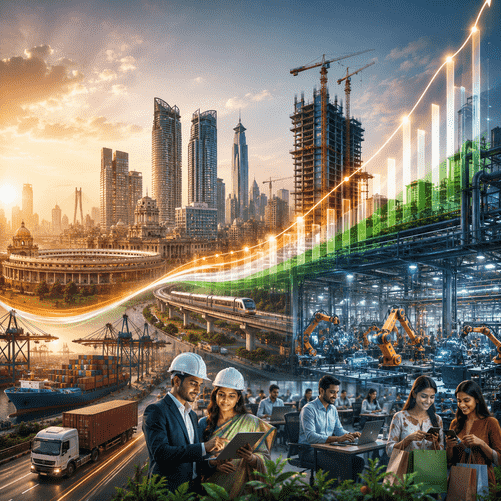
Strong manufacturing, private investment and consumer demand propel Asia’s third-largest economy beyond forecasts, even as expensive oil and geopolitical instability threaten the outlook

India’s economy has delivered a stronger-than-expected start to the new financial year, expanding by 7.8% in the April-to-June quarter and reinforcing its position as one of the fastest-growing major economies in the world.
Official figures released by India’s Ministry of Statistics and Programme Implementation on Monday showed real gross domestic product rising 7.8% year-on-year during the first quarter of the 2026-27 financial year. The result comfortably exceeded the roughly 7.1% expansion anticipated by economists and the Reserve Bank of India’s earlier projection of around 7%.
While growth moderated from the particularly strong performance recorded in the preceding quarter, the latest figures suggest that the Indian economy is entering a new phase in which private investment is beginning to play a more prominent role alongside household consumption and public infrastructure spending.
Investment emerges as a powerful new engine
Among the most significant elements of the latest data was the strength of capital formation. Gross fixed capital formation — a broad measure of investment in machinery, factories, infrastructure and other productive assets — increased by 10.8% year-on-year.
Private-sector investment has also accelerated sharply, with companies directing increasing amounts of capital toward data centres, power generation, metals, manufacturing facilities and other infrastructure-intensive industries.
The shift is economically important. For much of the past decade, Indian growth has relied heavily on household consumption and large government infrastructure programmes. A sustained expansion in private capital expenditure would potentially create a more balanced and durable growth cycle.
Manufacturing was another major contributor. Industrial output expanded strongly during the quarter, while financial and professional services continued to record double-digit or near-double-digit rates of expansion. Official data showed overall gross value added rising close to 8%, indicating that the strength of the economy extended across several major sectors rather than being concentrated in a small number of industries.
Consumers continue spending
Domestic demand remains another important pillar of the expansion.
Private consumption increased by more than 7% during the quarter, supported by rising incomes, previous tax reductions and improving credit availability. Government consumption also remained positive, although its contribution was considerably smaller than investment or household expenditure.
Bank lending has simultaneously accelerated, providing businesses and consumers with additional financing. Credit growth has reached its strongest levels in more than a decade, with loans expanding across agriculture, manufacturing and services.
For policymakers in New Delhi, the combination of consumption and investment growth is particularly encouraging because it suggests domestic demand may be capable of insulating the economy from weaker conditions elsewhere in the world.
Foreign investors begin returning
The stronger economic picture is also beginning to influence international capital flows.
Foreign portfolio investors placed approximately $3.1 billion into Indian equities during August, the largest monthly inflow in almost two years. Improving corporate earnings expectations and efforts by the Reserve Bank of India to limit volatility in the rupee have helped restore some investor confidence.
Major Indian corporations have reported stronger profits, while expectations of continued infrastructure investment and domestic consumption have encouraged analysts to revise earnings forecasts upwards.
The renewed inflows follow a difficult earlier period during which international investors shifted large amounts of capital toward technology-heavy Asian markets including Taiwan and South Korea.
Oil remains India’s biggest vulnerability
The impressive growth figures nevertheless arrive at a difficult moment for the global economy.
India imports roughly 85% of the crude oil it consumes, making the country particularly sensitive to increases in global energy prices. Renewed instability in the Middle East has pushed Brent crude back above $90 per barrel in recent trading, increasing the potential cost of India’s enormous energy import bill.
A prolonged period of expensive oil could weaken the rupee, widen India’s trade deficit and eventually feed into consumer inflation.
Economists are consequently watching energy markets almost as closely as domestic growth indicators.
Higher inflation would also complicate the Reserve Bank of India’s monetary policy. Persistent price pressures could force policymakers to maintain tighter financial conditions — or eventually raise interest rates — despite the benefits of allowing the current investment cycle to continue.
India increasingly stands apart
The performance is particularly striking when compared with several other large Asian economies.
China continues to struggle with weak domestic demand. Official indicators released on Monday showed an improvement in Chinese manufacturing activity during August, but factories remained in contraction while the services sector continued to show weakness. Beijing is simultaneously attempting to prevent the yuan from appreciating too rapidly in order to protect exporters and support an economy still suffering from subdued consumption and lending.
Japan, meanwhile, recorded annualised growth of just 1.1% during the April-June quarter as household spending and business investment weakened.
Against that backdrop, India’s combination of population growth, expanding domestic consumption, rapid infrastructure construction and accelerating private investment increasingly distinguishes it from many other large economies.
A test of whether 7% growth can become structural
The central question is now whether India can sustain growth above 7% as external conditions become more challenging.
Higher oil prices, geopolitical instability and tighter global financial markets remain significant risks. Agricultural output could also become vulnerable if rainfall patterns deteriorate, particularly because a substantial proportion of Indian farmland remains dependent on seasonal monsoons rather than irrigation.
Yet the underlying composition of the latest GDP figures provides reasons for optimism.
Investment is accelerating. Manufacturing remains strong. Consumption continues to expand, and service industries are demonstrating considerable momentum.
If those trends continue, India could record its fourth consecutive year of economic growth exceeding 7%, further increasing its weight in the global economy.
Prime Minister Narendra Modi described the latest performance as evidence of India’s economic resilience despite oil shocks, supply-chain disruption and wider international uncertainty.
The more important signal, however, may lie beneath the headline number. India is no longer expanding solely because of public infrastructure spending and consumer demand. Private companies are increasingly investing again.
If that investment cycle proves sustainable, the 7.8% expansion recorded this quarter may represent more than another strong GDP figure. It could mark the beginning of a broader transformation in the structure of India’s economic growth.