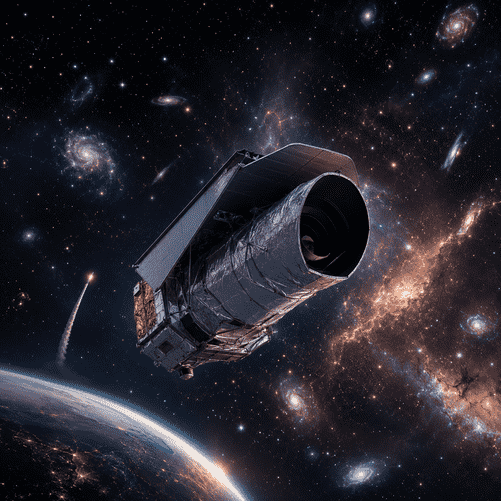
The Nancy Grace Roman Space Telescope promises panoramic infrared observations on an unprecedented scale, giving astronomers a powerful new tool to study dark energy, dark matter and distant worlds

NASA has launched one of the most ambitious astronomical observatories of the coming decade, sending the Nancy Grace Roman Space Telescope into space on a mission designed to transform scientists’ understanding of the universe on both the largest and smallest cosmic scales.
Roman lifted off from NASA’s Kennedy Space Center in Florida on Sunday morning aboard a SpaceX Falcon Heavy rocket. The launch occurred at 7:26 a.m. Eastern time, and the spacecraft later separated successfully from the rocket’s upper stage before establishing communications with ground controllers.
The successful departure begins a journey of approximately one million miles toward the second Sun-Earth Lagrange point, known as L2, where Roman will operate in a gravitationally stable region of space already used by other major observatories.
But Roman is not simply another powerful telescope.
Its defining capability is scale.
The observatory combines sharp infrared imaging with a field of view at least 100 times larger than that of the Hubble Space Telescope, allowing astronomers to survey enormous areas of the sky while retaining the image quality needed to study distant galaxies, exploding stars and planetary systems.
That combination could fundamentally change how astronomical surveys are conducted.
From individual snapshots to panoramic astronomy
Hubble revolutionized astronomy by producing extraordinarily detailed observations of relatively small regions of space.
Roman is designed to complement that approach by observing much larger areas at once.
Rather than concentrating primarily on individual cosmic objects, the telescope will repeatedly scan broad sections of the universe, producing enormous datasets containing potentially billions of galaxies and stars.
NASA expects the observatory to map billions of galaxies during its mission and generate a volume of astronomical information large enough to support research well beyond its original scientific objectives.
This panoramic capability is particularly important because some of the largest unanswered questions in cosmology cannot be solved simply by examining one galaxy, star or supernova.
Scientists need enormous statistical samples.
Roman was built to provide them.
The mystery of dark energy
Among the mission’s most important objectives is investigating dark energy — the still poorly understood phenomenon believed to be driving the accelerating expansion of the universe.
Astronomers discovered in the late 1990s that cosmic expansion is accelerating rather than slowing under the influence of gravity.
The finding fundamentally changed modern cosmology.
Yet the underlying cause remains uncertain.
Scientists use the term dark energy to describe whatever is producing that acceleration, but its physical nature remains one of the deepest mysteries in science.
Roman will attempt to narrow the possibilities by measuring the structure and expansion history of the universe with extraordinary precision.
One method will involve observing large numbers of Type Ia supernovae, stellar explosions whose predictable brightness allows scientists to estimate their distances from Earth.
By comparing those distances across different periods of cosmic history, astronomers can reconstruct how quickly the universe was expanding at different times.
Roman will also study how galaxies are distributed across enormous regions of space and how gravity bends light as it travels through the cosmos.
Together, those observations could reveal whether dark energy behaves like a constant property of empty space or whether a more complex physical mechanism is involved.
Mapping the invisible universe
The telescope will also help astronomers investigate dark matter.
Unlike ordinary matter, dark matter does not emit, absorb or reflect light.
Its presence is instead inferred from its gravitational influence on stars, galaxies and light itself.
Scientists believe dark matter accounts for far more of the universe’s matter than the atoms forming planets, stars and people.
Roman will map its distribution partly through gravitational lensing, a phenomenon in which the gravity of massive objects distorts the appearance of more distant galaxies.
By measuring those distortions across huge sections of the sky, researchers can reconstruct otherwise invisible concentrations of matter.
The resulting maps could provide some of the most detailed pictures yet of the universe’s hidden gravitational architecture.
A census of distant planets
Roman will simultaneously conduct a major search for worlds beyond our solar system.
Thousands of exoplanets have already been discovered, but astronomers believe the Milky Way contains hundreds of billions of planets.
Roman will help determine how common different categories of planetary systems actually are.
One of its principal techniques will be gravitational microlensing.
When a foreground star passes almost perfectly in front of a more distant star, its gravity temporarily magnifies the background star’s light.
If planets orbit the foreground star, they can produce additional changes in that magnification.
Because the phenomenon is sensitive to planets located relatively far from their host stars, Roman could discover categories of worlds that are difficult to detect using many existing techniques.
NASA says the observatory will conduct a statistical census of planetary systems across the galaxy, potentially revealing thousands of previously unknown exoplanets.
Technology for directly imaging other worlds
Roman also carries an experimental Coronagraph Instrument.
The device is designed to suppress the overwhelming brightness of a star so that much fainter objects orbiting nearby can potentially be observed directly.
Imaging an exoplanet is extraordinarily difficult.
Seen from many light-years away, a planet is billions of times fainter than the star beside it.
The situation has often been compared to attempting to photograph a firefly beside a lighthouse from thousands of kilometers away.
Roman’s coronagraph will test technologies intended to overcome that problem.
The instrument is primarily a technology demonstration rather than one of Roman’s core survey instruments, but its success could influence the design of future space telescopes capable of directly examining Earth-like planets around nearby stars.
That makes the experiment particularly important for one of astronomy’s ultimate goals: determining whether potentially habitable worlds exist elsewhere.
An unusual origin
Roman also has an unusual technological history.
Its primary mirror originated from hardware transferred to NASA by the U.S. National Reconnaissance Office, which operates American intelligence satellites.
The donated optical technology was adapted and transformed into a scientific observatory.
Roman’s mirror is approximately the same diameter as Hubble’s, but advances in detectors, instrumentation and optical design allow the new telescope to observe vastly larger sections of the sky.
The result is effectively a combination of Hubble-like sharpness and wide-area survey capability.
NASA named the telescope after Nancy Grace Roman, the agency’s first chief astronomer and one of the central figures behind the creation of Hubble.
She is frequently described as the “mother of Hubble” for her role in establishing the scientific and institutional foundations that eventually produced the famous observatory.
An enormous stream of scientific data
Roman’s scientific impact may extend far beyond the questions its designers originally intended to investigate.
Wide-field surveys inevitably record objects and phenomena unrelated to the primary mission.
Asteroids, variable stars, black holes, stellar explosions, distant galaxies and previously unknown transient events may all appear in Roman’s observations.
The telescope could therefore become something resembling a cosmic discovery machine.
Unexpected findings may prove just as important as the discoveries scientists are already planning.
NASA has also committed to making the observatory’s processed science data publicly available, allowing research teams around the world to investigate the enormous datasets it produces.
Artificial intelligence and advanced computing are likely to become increasingly important in that process.
Astronomers will be faced with datasets containing billions of astronomical objects, making automated classification and anomaly detection essential.
That combination of advanced optics, enormous datasets and machine-assisted analysis illustrates how modern astronomy is increasingly becoming both an observational science and a data-science discipline.
The next stage of the mission
Roman is now beginning its roughly three-month journey toward L2.
Once it reaches its operational region, engineers will undertake a detailed commissioning phase during which the observatory’s telescope, detectors and instruments will be calibrated and tested.
Only after those checks are completed will full scientific observations begin.
The mission is designed for a primary lifetime of five years, although NASA hopes the observatory could operate for approximately a decade if its systems remain healthy.
The expectations surrounding Roman are unusually high.
Hubble gave humanity some of its deepest and most iconic views of individual regions of the universe.
The James Webb Space Telescope pushed observations deeper into cosmic history and expanded astronomers’ ability to study early galaxies, stars and planetary atmospheres.
Roman brings a different capability.
It is designed to look wide.
By observing enormous sections of the cosmos repeatedly and with exceptional precision, the telescope could allow scientists to move from examining individual examples to understanding entire populations of galaxies, stars and planets.
And that statistical revolution may ultimately prove just as transformative as the extraordinary images produced by its predecessors.
Roman has only just left Earth.
But if the observatory performs as intended, its greatest achievement may be revealing just how much of the universe remains hidden in plain sight.