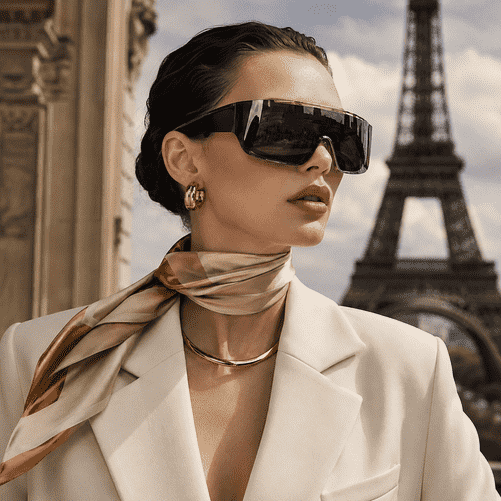
Oversized shields, sculptural frames and sharply branded eyewear are emerging as some of the most important women’s accessories of pre-fall 2026, as luxury labels turn sunglasses into high-impact style statements

Luxury fashion’s latest obsession is sitting squarely on the face.
After several seasons dominated by handbags and footwear, sunglasses are emerging as one of the most visible women’s accessories of pre-fall 2026, with oversized shield designs, sharply sculpted frames and futuristic silhouettes moving from runway accents into a broader luxury trend.
Vogue’s latest pre-fall accessories report identifies shield sunglasses as one of the styles retaining particularly strong momentum as the fashion calendar moves from summer into autumn. The trend reflects a wider shift toward accessories capable of transforming an outfit immediately, without requiring an entirely new wardrobe.
The effect is dramatic.
Where previous seasons favored narrow 1990s frames or quietly minimalist designs, the new generation of sunglasses is deliberately more conspicuous. Lenses are becoming larger, temples thicker and shapes more architectural, often extending across much of the face.
The result combines glamour with a slightly futuristic aesthetic that can move easily between resort dressing, tailoring and urban streetwear.
From functional object to fashion centerpiece
Sunglasses have always occupied an unusual place in the luxury market.
Unlike fine jewelry or watches, they are relatively accessible. Unlike handbags, they do not need to carry anything. And unlike shoes, they rarely determine the practicality of an outfit.
Their value lies largely in transformation.
A pair of distinctive sunglasses can alter the personality of otherwise simple clothing almost instantly.
That characteristic appears particularly relevant in the current fashion environment, where consumers are becoming more selective about large luxury purchases.
Instead of replacing an entire wardrobe, shoppers can introduce a new silhouette through a comparatively smaller accessory.
Pre-fall collections increasingly reflect that logic.
Bold eyewear can give classic tailoring, knitwear, trench coats or evening pieces a more contemporary identity, making sunglasses especially useful during transitional seasons.
Vogue’s assessment of pre-fall 2026 emphasizes precisely this approach: accessories capable of refreshing existing wardrobes through relatively small but visually powerful interventions.
The shield returns
The most important silhouette is the shield.
Typically characterized by a broad continuous lens or strongly connected lenses spanning much of the upper face, shield sunglasses have historical associations with sport, skiing, cycling and early-2000s futurism.
Luxury fashion has gradually stripped away their purely technical identity.
Designers are now interpreting the shape through polished metals, transparent acetate, gradient lenses and exaggerated temples.
On women, the effect can be simultaneously athletic and glamorous.
That contradiction is part of the appeal.
The current luxury market has become increasingly comfortable combining sportswear references with highly polished fashion, allowing technical shapes to migrate naturally into more sophisticated wardrobes.
The shield frame is therefore appearing not merely as an athletic accessory but alongside dresses, structured jackets, tailoring and evening looks.
Celebrity culture accelerates the trend
Eyewear also benefits from extraordinary visibility.
Unlike many accessories, sunglasses occupy the same visual space as the wearer’s face, making them especially prominent in celebrity photography and social-media imagery.
Recent celebrity styling has continued to give sunglasses a major role in complete looks.
Hailey Bieber, for example, has incorporated dark oval frames into the nostalgic, early-2000s-inspired outfits that have become an important part of contemporary fashion imagery.
Amal Clooney has taken almost the opposite approach, using oversized dark sunglasses as part of polished European summer dressing, pairing them with evening pieces and sophisticated resort wardrobes.
The difference illustrates the breadth of the category.
Sunglasses can function as a nostalgic Y2K reference, a piece of futuristic styling or a traditional symbol of jet-set glamour.
Few accessories move between those identities so easily.
Luxury brands see an opportunity
That versatility is attracting brands beyond the traditional luxury eyewear establishment.
Alo, which has built its reputation primarily around premium activewear and wellness-oriented lifestyle branding, launched its own sunglasses collection as part of an aggressive international expansion strategy.
The company promoted the collection through high-visibility summer activations in locations including Saint-Tropez, reinforcing the connection between eyewear, travel, celebrity culture and aspirational luxury.
Alo’s entry is particularly revealing.
It demonstrates that sunglasses are no longer regarded simply as licensed accessories sitting alongside a fashion collection.
They can instead function as brand-building products in their own right.
For companies seeking to enter luxury-adjacent markets, eyewear offers several advantages.
The product is immediately recognizable, highly photographic and typically less expensive than a designer handbag or fine-jewelry purchase.
It can therefore introduce new consumers to a brand while still providing enough design space to communicate a distinctive identity.
The economics of the accessory matter
The trend arrives at an important moment for the wider luxury industry.
Luxury groups have recently returned to stronger growth after a difficult period, but consumers remain selective and stock-market reactions to company results show considerable nervousness around the sector.
Vogue Business reported that the average organic growth of major luxury companies reached approximately 7% in the second quarter of 2026, outperforming some expectations, although performance varied significantly between brands.
Within that environment, accessories occupy an important strategic position.
They allow luxury houses to offer recognizable pieces at prices below their most expensive ready-to-wear, handbags or jewelry.
Sunglasses are particularly effective because they remain highly visible even when worn with clothing from entirely different brands.
A distinctive pair of eyewear can effectively become a small advertisement for a fashion house.
That helps explain why branding on temples, hinges and lenses has become increasingly sophisticated rather than disappearing entirely.
The logo may be smaller than in earlier periods of conspicuous consumption, but the silhouette itself is increasingly designed to be recognizable.
Quiet luxury gives way to stronger silhouettes
The rise of dramatic eyewear also suggests a subtle shift away from the extreme restraint associated with the “quiet luxury” movement.
Minimalism has not disappeared.
But fashion is becoming more comfortable with decorative and expressive accessories again.
The current interest in colorful scarves, tassel details, stronger jewelry and statement eyewear indicates that consumers may be looking for more personality after several seasons dominated by restrained neutrals and discreet branding.
Sunglasses are an easy place for that experimentation to happen.
A woman may continue wearing a minimalist coat, classic knitwear or understated tailoring while introducing a much more aggressive frame around the face.
The contrast can make the entire look feel new.
Jewelry follows a similar direction
The same desire for distinctive accessories is visible in jewelry.
Vogue’s latest survey of contemporary jewelry highlights designers moving beyond basic chains and discreet hoops toward arm cuffs, sculptural earrings and more recognizable forms.
The publication describes a growing appetite for modern labels producing pieces that feel less ubiquitous than traditional luxury-jewelry staples.
That trend and the rise of shield sunglasses appear connected.
Both reflect a consumer desire for accessories that establish identity rather than merely demonstrate price.
The accessory does not necessarily need to be covered in branding.
It needs to be memorable.
A small object with enormous visual power
That may ultimately explain why sunglasses are becoming such an important category.
Fashion increasingly exists not only in physical environments but in photographs, videos and social feeds.
Accessories positioned close to the face perform particularly well in those environments.
They are immediately visible in portraits.
They remain noticeable even when images are cropped.
And they can communicate an entire aesthetic with relatively little information.
For luxury brands, that makes eyewear an unusually efficient product.
For consumers, it makes sunglasses one of the easiest ways to participate in a new fashion direction without completely rebuilding a wardrobe.
The shield silhouette may eventually give way to another shape.
But the broader change appears more durable.
Eyewear is moving beyond its traditional role as a seasonal finishing touch.
In pre-fall 2026, the sunglasses are increasingly becoming the look.