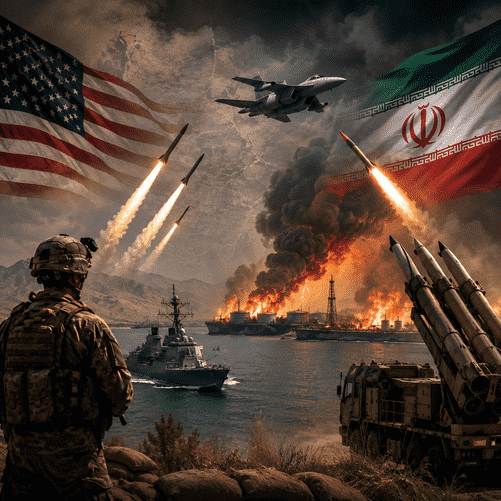
Iranian missiles target American forces after a U.S. strike on Larak Island, reviving fears that the fragile pause in direct hostilities could give way to another cycle of escalation across the Gulf

The United States and Iran have exchanged direct military blows for the first time in roughly a month, reopening one of the Middle East’s most dangerous fronts and prompting President Donald Trump to promise a powerful response to Tehran’s overnight missile attacks on American forces.
Trump told Fox News on Monday that the United States would respond forcefully after Iran fired missiles toward U.S. military installations in Jordan.
“We’re going to hit them hard,” Trump was quoted as saying, adding that there would be a response.
The renewed confrontation follows a U.S. military strike on Iran’s strategically positioned Larak Island in the Strait of Hormuz, where Washington says Revolutionary Guard forces were preparing to deploy weapons capable of threatening maritime traffic through one of the world’s most important energy corridors.
Iran responded hours later by launching missiles toward two American bases in Jordan.
Trump said U.S. air defenses intercepted the Iranian missiles capable of causing damage. No major American casualties or destruction had been reported in the immediate aftermath.
The sequence of attack and retaliation marks the first sustained direct exchange between Washington and Tehran since late July, breaking a period during which the conflict had shifted increasingly toward economic pressure, maritime confrontation and diplomatic maneuvering rather than large-scale direct strikes.
U.S. strike targets Iran’s position in the Strait of Hormuz
The latest confrontation began when U.S. forces attacked two Iranian launchers on Larak Island, a small but strategically important island near Bandar Abbas at the entrance to the Strait of Hormuz.
U.S. Central Command described the action as limited and precise, saying Revolutionary Guard forces had been preparing to use rockets and sea mines that posed an imminent threat to shipping.
The Strait of Hormuz carries a substantial share of the world’s seaborne crude oil supplies under normal conditions, making any confrontation in the waterway economically significant far beyond the Middle East.
Iranian media reported that three people were killed in the American attack. Two were subsequently identified by an Iranian state-affiliated outlet as members of the Revolutionary Guards Navy.
Washington’s explanation reflects a long-running concern that Tehran could use mines, missiles, drones and small naval vessels to restrict access to the strait.
U.S. forces have spent considerable resources attempting to keep maritime routes open and reduce Iran’s ability to threaten international shipping.
The latest strike therefore appears to have been intended not simply as retaliation, but as a preventive operation against what American commanders regarded as an emerging threat to the waterway.
Tehran sees the situation differently.
Iran has repeatedly argued that American military operations near its coastline represent aggression and has insisted that it retains the right to defend its territory and strategic waters.
Iran strikes back
Iran’s military responded to the Larak attack by targeting American forces in Jordan.
A senior Iranian source familiar with Tehran’s decision-making described the confrontation to Reuters as “limited and contained,” suggesting that Iranian leaders were attempting to signal both retaliation and restraint.
At the same time, the source warned that Iran would respond severely to further American attacks and maintained that no potential target was beyond Tehran’s reach.
That combination of limited military action and aggressive rhetoric has become a recurring feature of the conflict.
Both Washington and Tehran have repeatedly attempted to demonstrate that they can impose military costs on the other while avoiding actions that automatically trigger an uncontrolled regional war.
The danger is that the margin for miscalculation remains extremely narrow.
A missile that penetrates air defenses, an attack that causes significant American casualties or a strike against strategically important Iranian infrastructure could rapidly transform a calibrated exchange into a much larger confrontation.
UAE drawn into the crisis
The renewed hostilities also spilled toward the United Arab Emirates.
Iran claimed that it had attacked the Al Minhad Air Base in the UAE, an allegation rejected by the Emirati government.
The UAE Defense Ministry later said its forces had intercepted an Iranian drone over Emirati territorial waters and described the incident as a serious violation of national sovereignty.
The episode underlines the vulnerability of Gulf states hosting Western military infrastructure.
Countries such as the UAE, Qatar, Bahrain and others have traditionally attempted to balance close security relationships with Washington against the need to maintain working relations with Tehran.
Direct Iranian attacks — or even attempted attacks — against territory belonging to those states could make that balancing strategy increasingly difficult.
The Gulf monarchies have repeatedly called for restraint, fearing that a broader U.S.–Iran war would expose energy installations, ports, airports and urban centers to missile and drone attacks.
Trump shifts back toward military pressure
Trump’s promise of retaliation represents a notable change in tone after a period in which his administration had increasingly emphasized economic pressure rather than continuous military strikes.
Washington has recently imposed increasingly severe secondary sanctions designed to punish financial institutions, companies and governments that continue doing business with Tehran.
Treasury Secretary Scott Bessent argued Monday that Iran’s decision to resume military action showed that those economic measures were beginning to inflict serious damage.
“They’re lashing out kinetically because they are losing economically,” Bessent said, according to Reuters.
He indicated that additional secondary sanctions could be announced on a near-weekly basis, with banks and financial networks initially among the principal targets.
The administration’s strategy increasingly appears to combine two forms of pressure.
Economically, Washington is attempting to reduce Iran’s revenues and access to international finance.
Militarily, U.S. forces appear prepared to strike Iranian capabilities whenever Washington believes Tehran is directly threatening American personnel or international shipping.
The difficulty is that those two strategies can reinforce Tehran’s incentives to retaliate.
If Iran concludes that sanctions are steadily reducing its economic room for maneuver, its leadership may increasingly use military pressure in the Strait of Hormuz as one of the few remaining tools capable of imposing immediate costs on Washington and its allies.
Hormuz remains the central pressure point
The strategic importance of the Strait of Hormuz makes the current confrontation particularly dangerous.
Located between Iran and Oman, the narrow waterway normally handles around one-fifth of global crude oil shipments.
Any sustained interruption can therefore affect energy prices almost immediately.
Traffic through the strait has already been severely disrupted during the wider conflict, while concerns about Iranian mines, missiles and naval operations have contributed to higher shipping costs and energy-market volatility.
Oil markets reacted nervously to the latest confrontation, with Brent crude trading above $90 a barrel amid fears that renewed military escalation could further restrict exports from the Gulf.
For Europe and Asia, the stakes are especially high.
Several major Asian economies remain heavily dependent on Gulf crude, while European energy markets remain vulnerable to sudden increases in global prices.
A prolonged closure or severe disruption of Hormuz could therefore produce inflationary consequences far beyond the battlefield.
Tehran combines defiance with calls for negotiations
Despite Iran’s military response, President Masoud Pezeshkian continued to signal interest in a negotiated settlement.
Speaking during a meeting with Indian Prime Minister Narendra Modi on the sidelines of a regional summit in Kyrgyzstan, Pezeshkian said Iran still wanted an agreement and argued that continued war was in nobody’s interest.
The comments contrasted sharply with the warnings issued by Iranian military officials.
That contrast may be deliberate.
Iran has frequently pursued parallel diplomatic and military tracks, presenting negotiations as possible while simultaneously demonstrating that continued pressure could carry security and economic costs.
For Tehran, a negotiated settlement could potentially offer sanctions relief and guarantees concerning its sovereignty.
For Washington, negotiations remain tied to far more ambitious demands concerning Iran’s nuclear capabilities and regional military power.
Those differences have repeatedly prevented diplomacy from producing a durable settlement.
The Kharg Island controversy
Tensions intensified further after Trump posted an AI-generated video on Truth Social depicting massive explosions at Iran’s Kharg Island oil hub and suggested that the facility had been destroyed.
There was no evidence that such an attack had occurred.
A U.S. official subsequently told Reuters that American forces had not attacked Kharg Island, while Reuters analysis concluded that the footage was most likely synthetically generated.
Iranian officials dismissed the video.
The episode nevertheless carried strategic significance because Kharg Island is one of the most important facilities in Iran’s energy infrastructure and historically handled the overwhelming majority of the country’s crude exports.
An actual American attack against the site would represent a substantial escalation and could dramatically disrupt Iranian oil exports.
It could also push Tehran toward more aggressive retaliation against Gulf energy infrastructure or commercial shipping.
Six months into a war without a clear conclusion
The renewed confrontation comes approximately six months after the wider conflict began with major U.S. and Israeli attacks on Iran in February.
Those strikes killed Iran’s supreme leader Ayatollah Ali Khamenei and marked the beginning of an unprecedented phase of direct warfare involving Iran, Israel and the United States.
Yet several of Washington’s major strategic objectives remain unresolved.
Iran’s nuclear capabilities remain a central concern.
Its ability to threaten regional targets through missiles, drones and naval systems has not been completely eliminated.
And expectations that sustained military and economic pressure might produce fundamental political change inside Iran have so far not materialized.
Instead, the confrontation has increasingly evolved into an unstable combination of limited strikes, sanctions, threats, maritime pressure and intermittent diplomatic contacts.
Risk of escalation returns
For roughly a month, the absence of major direct exchanges between American and Iranian forces had created at least a limited degree of stability.
That pause has now ended.
Trump’s promise of further retaliation means the next decision belongs largely to Washington.
A narrowly targeted response could allow both sides to maintain the pattern of calibrated escalation that has characterized much of the conflict.
A broader attack on Iranian military or economic infrastructure could provoke another round of missile and drone strikes.
And any attack producing significant casualties could change the political calculations on both sides.
For Gulf governments and global energy markets, the principal danger is therefore not necessarily the confrontation that has already occurred.
It is the confrontation that may follow.
Washington and Tehran continue to insist that they can defend their interests while controlling escalation.
The renewed exchange around the Strait of Hormuz demonstrates just how difficult that balance has become.