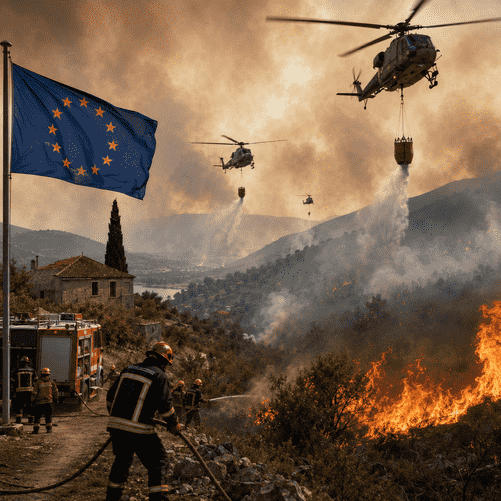
Helicopters and firefighting teams from across the European Union have been deployed as severe fires continue to burn, highlighting the growing strain climate-related disasters are placing on Europe’s response capacity.

The European Union has extended emergency firefighting assistance to Serbia as severe wildfires continue to threaten communities and landscapes, underscoring how extreme heat and prolonged dry conditions are stretching disaster-response systems across the continent.
European civil-protection authorities said EU support to Serbia was being extended into early September, with four helicopters drawn from the rescEU strategic reserve in Czechia, Romania and Slovakia remaining available alongside a Romanian ground firefighting team.
Serbia activated the EU Civil Protection Mechanism in August as fires intensified. The wider European response has included aircraft, specialist crews and coordination support designed to reinforce national emergency services during periods when local resources risk being overwhelmed.
The Serbian emergency forms part of a much wider pattern.
According to the European Commission’s Joint Research Centre, worsening drought and exceptional heat have placed water resources, agriculture, energy systems, river transport and ecosystems under mounting pressure. By early August, the amount of land burned by wildfires across the European Union was already ahead of the equivalent point in 2025 — itself the worst year on record for EU burned area.
Nine countries had activated the EU Civil Protection Mechanism for wildfire assistance by 24 August, illustrating the increasingly international character of disaster response.
The system allows countries facing major emergencies to request assistance from other participating states, while rescEU provides a strategic reserve of aircraft, helicopters and other critical capabilities that can be deployed when national resources are insufficient.
The expanding scale of these operations reflects a significant shift in Europe’s security landscape. Climate-related emergencies are no longer treated only as environmental problems. They increasingly intersect with public safety, infrastructure protection, energy security and economic resilience.
Wildfires can force large evacuations, close highways and airports, interrupt power supplies and destroy agricultural production within hours. The cost continues long after flames are extinguished, particularly in rural regions where tourism, farming and forestry provide much of the local economy.
Serbia’s latest fires therefore carry significance beyond the immediate emergency.
They demonstrate how Europe’s disaster-response architecture is gradually evolving into a permanent cross-border capability. Aircraft based in one member state may now be deployed hundreds of kilometres away within hours, while multinational ground teams increasingly operate side by side.
As temperatures rise and drought periods become more severe, such cooperation is likely to become less exceptional and more routine.
Europe’s wildfire season is becoming a test not simply of firefighting capacity, but of whether the continent can adapt fast enough to a new era of increasingly frequent and destructive climate emergencies.