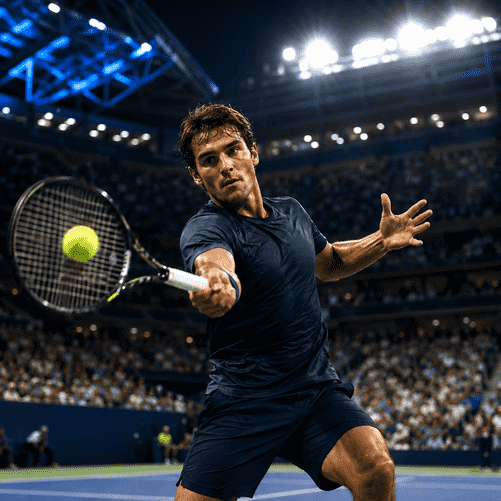
Carlos Alcaraz advances, Novak Djokovic suffers a stunning first-round exit and a new generation presses its case under the lights at Flushing Meadows.

The US Open has barely begun, but the final Grand Slam tournament of the 2026 tennis season has already delivered the kind of upheaval that can redefine an entire championship.
Carlos Alcaraz moved safely through his opening assignment on Monday, joining Aryna Sabalenka, Amanda Anisimova and Stefanos Tsitsipas among the prominent winners as the tournament gathered momentum in New York.
Alcaraz arrived at Flushing Meadows attempting something unusual: becoming the first man to win the US Open without having competed in at least one North American hard-court event beforehand. His progress will be closely watched as the tournament moves into its decisive stages.
But the early rounds have already been defined by a far more unexpected result.
Novak Djokovic, one of the most successful players in tennis history, was eliminated in the first round by Argentina’s Mariano Navone — an extraordinary upset that immediately altered the competitive landscape of the men’s draw.
Djokovic’s departure removes one of the sport’s most formidable Grand Slam competitors and intensifies attention on the younger generation that has been gradually reshaping men’s tennis.
Elsewhere, Ben Shelton survived a difficult opening against Tallon Griekspoor, recovering from a poor first set to win 1-6, 6-1, 7-6(3), 6-2 inside Arthur Ashe Stadium.
Former champion Sloane Stephens also made an impressive return to New York, defeating Clara Tauson 6-4, 6-1 in a commanding opening-round performance.
The tournament is producing significant stories beyond singles competition as well. Karolína Muchová and Jakub Menšík captured the mixed doubles title after defeating Belinda Bencic and Flavio Cobolli 6-3, 1-6, [10-6].
For the men’s championship, however, Djokovic’s exit changes the strategic equation.
Players who might previously have expected to encounter the Serbian deep in the tournament now see a draw with significantly more space. The pressure consequently increases on contenders such as Alcaraz, who must convert opportunity into results while navigating the intense physical and psychological demands of two weeks in New York.
The US Open has always rewarded players capable of adapting to volatility.
Night sessions can stretch deep into the early hours, crowd energy can swing momentum rapidly and the hard courts punish even brief lapses in concentration.
In 2026, that unpredictability has arrived almost immediately.
One champion has already disappeared from contention. Others are beginning to establish momentum. And under the lights of Arthur Ashe Stadium, the battle to define the closing chapter of the tennis season is only beginning.