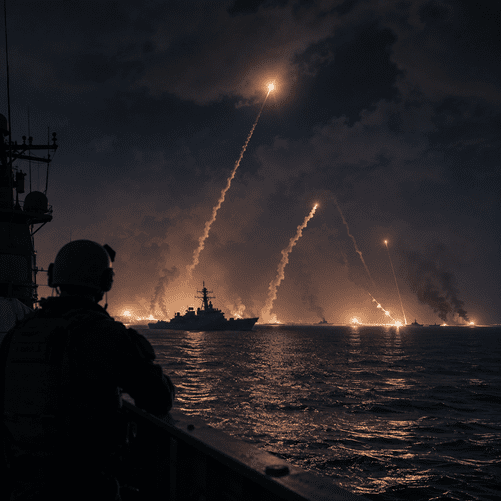
A brief lull has collapsed into the most serious exchange of fire in weeks, placing Gulf infrastructure, regional allies and the Strait of Hormuz once again at the centre of a rapidly widening conflict.

The fragile pause in fighting between the United States and Iran has broken down.
American forces launched renewed attacks against Iranian military targets, and Tehran responded with missile and drone strikes aimed at U.S.-aligned states across the Gulf, marking the most significant escalation in the conflict in recent weeks.
The renewed exchange immediately demonstrated why the war has implications far beyond Iran itself.
Iranian missiles and drones were reported over Kuwait, Bahrain, the United Arab Emirates and other parts of the region. Air-defence systems intercepted several attacks, while a drone reportedly triggered a fire in a Kuwaiti residential complex. The Kurdistan region of Iraq also reported intercepting explosive drones.
The United States said its strikes targeted Iranian military infrastructure, including radar and air-defence facilities.
Washington has warned that additional Iranian retaliation could prompt further attacks.
Tehran, meanwhile, portrays its operations as retaliation for American military action and argues that U.S. regional bases and allies participating in or facilitating attacks against Iran are legitimate targets.
This creates one of the most dangerous dynamics of the war.
The Middle East contains a dense network of American military facilities, energy infrastructure, ports and allied governments. Any Iranian attempt to impose costs on Washington risks drawing those states more directly into the conflict.
Bahrain hosts the U.S. Navy’s Fifth Fleet.
Qatar has major American military facilities.
Kuwait and the United Arab Emirates maintain extensive defence relationships with Washington.
These installations provide logistical depth for U.S. operations but simultaneously create potential targets.
The escalation also threatens civilian infrastructure.
Modern long-range strike campaigns involve missiles and drones travelling hundreds or even thousands of kilometres. Even highly sophisticated air-defence systems cannot guarantee complete interception.
Debris from intercepted weapons can itself cause damage.
The broader economic consequences are potentially enormous because the conflict intersects with the world’s most strategically important oil transportation route.
The Strait of Hormuz connects the Persian Gulf with the Arabian Sea.
A substantial share of globally traded oil and liquefied natural gas normally passes through this narrow maritime corridor. Continued disruption has already pushed energy markets higher, with Brent crude trading above $95 per barrel amid concern about prolonged restrictions on shipping.
A sustained closure would affect almost every major economy.
Asia is particularly exposed because China, India, Japan and South Korea import large quantities of Gulf energy.
Europe would also experience higher prices, particularly for refined fuels and liquefied natural gas.
Transport costs would increase globally, adding inflationary pressure at precisely the moment when many central banks have been trying to stabilise prices.
Military control of the strait is therefore becoming a strategic objective in its own right.
Washington says it possesses overwhelming military capability in the region, but keeping a maritime passage permanently open is far more complex than destroying individual targets.
Iran can threaten shipping using missiles, drones, mines, fast attack craft and coastal systems.
Even the perception of danger can be enough to deter commercial vessels because insurers can dramatically raise war-risk premiums.
That means Tehran does not necessarily need to physically close the strait to disrupt trade.
It merely needs to make passage sufficiently dangerous.
The conflict is also becoming increasingly international.
Russia publicly pledged support to Iran this week, with President Vladimir Putin telling Iranian President Masoud Pezeshkian that Moscow intended to assist Tehran during the crisis. The exact scale and character of that assistance remain unclear.
Russia and Iran have developed increasingly close military ties during the past several years.
Iran supplied drones and other military technology to Russia during the Ukraine war, while Moscow has expanded defence cooperation with Tehran.
A deeper Russian role could complicate Western strategy considerably.
China is another important actor.
Beijing has substantial economic interests in Iran and depends heavily on Gulf energy supplies. China therefore has powerful incentives to prevent a prolonged closure of Hormuz, even while opposing American military pressure on Tehran.
Regional governments face equally difficult choices.
Several Gulf states have spent years attempting to reduce tensions with Iran while simultaneously strengthening ties with Washington.
They now risk becoming battlefields regardless of their preferences.
Diplomatic efforts have not disappeared.
Pakistan and other countries have continued advocating negotiations, arguing that previously discussed arrangements could still provide a route toward de-escalation.
But diplomacy becomes harder with each new round of strikes.
Wars develop their own momentum.
Military planners respond to perceived threats. Political leaders face pressure not to appear weak. Civilian casualties create demands for retaliation.
As escalation continues, the number of ways a conflict can expand unintentionally grows.
The greatest immediate risk is therefore not necessarily a deliberate decision by either Washington or Tehran to begin a much larger war.
It is miscalculation.
A missile striking a crowded residential area, the sinking of a major warship, heavy casualties at an American base or a large-scale disruption of Gulf energy infrastructure could rapidly alter political calculations.
For now, both sides appear determined to demonstrate military resolve.
The brief lull suggested that diplomacy might gain space.
The latest strikes show how narrow that space has become.